
Delcy Rodríguez with Donald Trump: A photo for the universal history of infamy
In the entire history of Chavismo there had never been an image that so clearly expresses the rapprochement between Venezuela and the United States
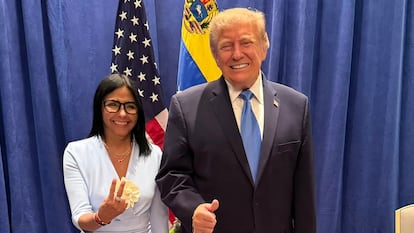
There are photographs that are painful to look at. The one showing Delcy Rodríguez with Donald Trump is one of them. Both leaders are gesturing to their supporters. Trump is seen with his thumb raised — one of his most popular gestures; Rodríguez, making a V sign that, according to interpreters, could mean anything from the V for victory to the V of Chávez’s signature to a V meaning vete al carajo (“go to hell”). Who it was aimed at is another matter. But beyond the gestures, the photo is above all valuable as a document.
In the entire history of Chavismo there had never been an image that so clearly expressed a rapprochement between Venezuela and the United States. Not even the casual handshake between Chávez and Obama at the Fifth Summit of the Americas in Trinidad and Tobago in 2009 went that far. There was a reason for it: despite the many ties between the two countries, over the past three decades their governments have been political and ideological adversaries, not friends. That is why the photo taken at the Lotte New York Palace Hotel will go down in history as testimony of an unprecedented rapprochement.
But that will be only the first reading. What truly matters is what the image does not show, what it conceals or implies. Politically, it signifies Rodríguez’s welcome as a recognized interlocutor by the White House and, therefore, the certification of the statu quo that has been taking shape since the capture of Nicolás Maduro on January 3. Economically, it represents the definitive and perpetual handover of much of Venezuela’s oil to the United States through a corrupt partnership hatched in the shadows between the governments of both countries and the controversial businessman Alejandro Betancourt and his company, North American Blue Energy Partners (Nabep).
In his speech to the United Nations General Assembly, Trump had reiterated that he will not tolerate challenges to his imperial will in the hemisphere. While he was handing out threats left and right, he also did not refrain from uttering his new favorite line, one he repeats with an almost lascivious relish: “To the victor belong the spoils”; in other words, the winner takes everything. And in Venezuela’s case, those spoils are the largest oil reserves on the planet.
The encounter that the photo captures took place behind closed doors. Supposedly, it was meant to “advance an agenda of cooperation in strategic areas such as energy, mining and security.” In reality, what the U.S. president most wants is stability for the big deals that he and his circle of billionaire cronies and donors are launching in Venezuela.
Delcy guarantees that stability through her absolute obedience. In return, she gets what she most desires: more time in power. That is the rawest expression of the so-called win-win that the Rodríguez brothers so like to offer. Given those coordinates, it is easy to speculate about what was discussed. Trump likely ordered: “Drill, baby, drill!” To which Delcy, very skillfully, replied: “Yes, sir!” Behind the cameras, Alejandro Betancourt and other oilmen waited to celebrate the crowning of what Trump calls “the best deal in history.”
While all this was happening, opposition leader María Corina Machado was trying to end — by sea, air and land — the arduous journey of her return to Venezuela. If the photo of Delcy and Trump reveals the parties’ enormous satisfaction, the absence of a photo of Machado’s triumphant arrival in the Tierra de Gracia reveals her fragility in the face of forces that clearly overpower her. That is the part the image does not show. There is something curious and instructive about this. Machado made a serious miscalculation by scheduling her long‑announced return to coincide with the meeting between Trump and Delcy, her nemesis.
It was not only terrible timing, it was also a poor reading of the context. September 22 was the day Trump self‑crowned himself emperor of the whole world and threw the international order to the dogs before everyone’s eyes. It was not a day for split screens. Delcy was a bit player in that story. Machado thought she would spoil the party for her, but the one whose party was being spoiled was Donald’s. And she had been warned not to return to Venezuela without consulting the White House first, something she herself has acknowledged. That is why attempting the trip accompanied by a press entourage ended up looking more like a performance — staged so the press would portray her as a victim — than a substantive political gamble.
Recently, the Venezuelan novelist and cultural critic Alberto Barrera Tyszka described the opposition leader’s situation with an acid but forceful image. When asked whether Machado should break with the Trump administration, he replied: “She built a leadership in the country based on ethical and emotional radicalism, but she runs the risk of ceasing to be perceived as a warrior and becoming seen as a woman who endures mistreatment by a loutish male, a criminal like Trump […] María Corina has to recover something she seems to have lost: indignation.”
Barrera’s observation brings us back to the photograph. While Delcy Rodríguez racks up new successes day after day in her legitimization before the powers that matter, Machado looks increasingly isolated and erratic, to the bewilderment of Venezuelans and many defenders of democracy around the world. Her main mistake since January 3 has been failing to accurately size up Trump, despite the repeated slights she has received from him, and overestimating her own ability to become relevant again on a playing board from which she was excluded.
Machado remains the leader preferred by most Venezuelans. But that preference is not an inexhaustible asset. To give her odyssey meaning she needs to recover her indignation and turn it into a strategy capable of returning to Venezuelans the dignity that today is being negotiated behind their backs. That demands a kind of leadership that leaves behind the performative and weighs every move by the impact it will have on the outcome, not by the image it may generate. The universal history of infamy already has its photo. The one of Venezuelan democracy has yet to be taken.
Sign up for our weekly newsletter to get more English-language news coverage from EL PAÍS USA Edition









































