
Inside the US-Venezuela oil agreements: Big promises, little clarity
The United States gains access to 17 oil fields containing billions of barrels of crude as Chevron, Eni and others announce new investments
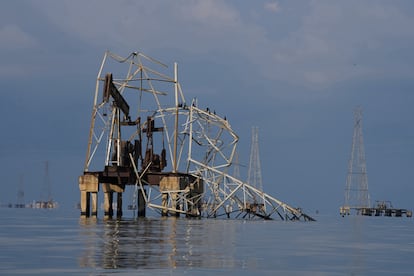
The oil agreement announced between the United States and Venezuela has been touted with great fanfare for the many benefits it is supposedly set to deliver. At the same time, it has been met with surprise, skepticism and disappointment by public opinion in both countries.
In some sectors of Venezuelan politics, concern is growing over the strengthening ties between the United States and the Venezuelan government. The unease remains largely personal and has yet to find organized political expression. There is a growing perception that Washington is maneuvering to shore up the political status quo and has little interest in Venezuela’s opposition leadership.
Discontent is also evident among dissident supporters of the ruling United Socialist Party of Venezuela (PSUV), who have voiced frustration with the government’s decisions. The government and the PSUV party establishment, led by Diosdado Cabello, have closed ranks in a characteristically disciplined show of support for the agreement.
What does the agreement involve?
The United States has announced a deal to develop 17 Venezuelan oil fields containing an estimated 65 billion barrels of proven reserves, a figure equivalent to roughly 22% of the country’s total reserves based on the Venezuelan government’s estimate of around 300 billion barrels.
The arrangement takes the form of a long-term grant of development rights. However, the duration is disputed. Venezuela’s government, led by acting President Delcy Rodríguez (Nicolás Maduro’s former vice president), has described it as a preferential 25-year concession, while Washington maintains that the rights will extend for 100 years.
The figures cited so far include about $100 billion in investment and an estimated $209 billion in royalties and tax revenues for the Venezuelan state during the first 25 years of the project.
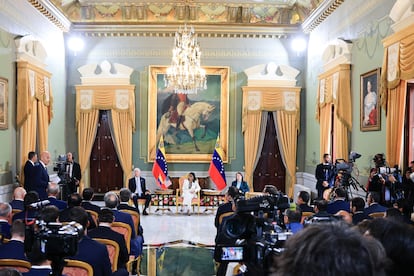
Economist Leonardo Vera, from the Central University of Venezuela, acknowledges that, if realized, these investments could be very positive for the national economy. However, he warns: “We are so desperate for investment in Venezuela that even a deal like this — murky, flawed, and takes the country back to forms of contracting with foreign interests that had already been left behind — is being welcomed by some people.”
Who is Alejandro Betancourt and why is NABEP central?
The agreement will be implemented through North American Blue Energy Partners (NABEP), the company that has been granted the rights to develop the oil fields. The U.S. government holds a 35% stake in NABEP’s parent company through the Strategic Capital Office of the Department of War, while the State Department is guaranteed access to 20% of production at cost and holds a right of first refusal on the remaining 80%. The company’s board must have a majority of U.S. citizens, and Washington has veto power over board appointments.
Vera views NABEP’s concentration of power with concern, warning “it could be used against national interests; it has always been more advantageous to negotiate with several companies.” For the economist, the agreement represents a step backward in Venezuela’s relationship with oil companies and international capital.
NABEP is controlled by the controversial Venezuelan businessman Alejandro Betancourt, who was once close to Hugo Chávez’s government and is now considered an ally of Washington. U.S. Secretary of State Marco Rubio has publicly defended Betancourt, arguing that the arrangement is not an agreement between two countries but rather a partnership between the United States and a businessman with extensive experience in the oil industry and ties to Venezuela’s opposition during the era of Juan Guaidó, the leader who self-proclaimed himself president of Venezuela.
“This transaction will unleash that potential to the great benefit of both Venezuelans and Americans,” Betancourt said in a NABEP statement.
Why is Betancourt such a controversial figure?
Betancourt has been the subject of investigations in Venezuela, the United States, Spain and Switzerland. He was arrested twice in the United Kingdom in 2025 following extradition requests from Spain and Switzerland, the two countries that still have open money-laundering investigations into him. He has never been formally charged and has consistently denied any wrongdoing.
Speaking about Betancourt at Miraflores Palace on Wednesday, Delcy Rodríguez defended the businessman, saying: “He has no outstanding issues with the courts. The problem is that sometimes it is the press that passes judgment on people, not the courts.”
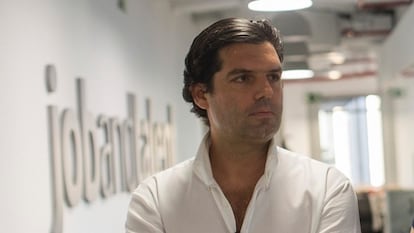
In Venezuela, Betancourt was accused of using his company, Derwick Associates de Venezuela, to orchestrate the purchase of spare parts and second-hand equipment at inflated prices, secure government contracts without competitive bidding, and profit from influence-peddling during the country’s 2011 electricity crisis.
That year, Derwick was awarded contracts by the Venezuelan state to supply, install and bring into operation equipment intended to address the emergency. The crisis would worsen in the following years, particularly by 2014, and has since become a chronic problem across the country.
Despite those allegations, Betancourt has proved adept at cultivating ties with two rival governments and now appears to be at the height of his business influence. Rubio has described the Trump administration’s experience with Betancourt as positive, saying that U.S. authorities have found no information linking him to wrongdoing.
What is the criticism of the deal?
The deal has come under fire in both countries. Critics have portrayed it as a remarkably brazen attempt by the White House to gain control over Venezuelan oil, with the acquiescence of a Chavista government that once made a point of its anti-imperialist rhetoric.
Critics have also questioned whether Washington has effectively sidelined its longstanding commitment to promoting free elections in Venezuela. In an interview with journalist Sergio Novelli, Rubio insisted that democratic elections remain a U.S. objective. But on Wednesday, Donald Trump said that Venezuela is still not ready to hold them.
In Venezuela, discontent is evident across a broad spectrum of society, including academia, labor leaders, the business community, social media, pro-democracy activists and significant segments of Chavismo, the ruling movement founded by the late president Hugo Chávez. The government, by contrast, has remained firmly committed to its optimistic narrative about the agreement.
Among opposition politicians, frustration has been tempered by a reluctance to alienate the United States. Even so, some criticism has emerged from figures who have traditionally been sympathetic to Trump, both because the agreement is seen as legitimizing Rodríguez’s government and because of Washington’s partnership with Betancourt.
In the U.S. Congress, Democrats including Gregory Meeks and Jeanne Shaheen have pressed Rubio over the absence of a clear institutional roadmap linking the economic arrangement to a democratic transition in Venezuela. Their concerns reflect a growing chorus of voices urging Trump to make a more explicit commitment to that goal.
How do Trump and the Delcy Rodríguez government defend the deal?
Both governments argue that they have secured an exceptionally advantageous deal.
The United States says the agreement significantly expands the pool of energy reserves under its sphere of influence. The White House claims that figure will rise from roughly 46 billion barrels to more than 100 billion barrels, while also guaranteeing abundant supplies of oil and inexpensive fuel for the foreseeable future. Venezuelan heavy crude is particularly well suited to the refineries along the Gulf Coast. The arrival of U.S. capital and technical expertise is also expected to curb the influence of China and Russia, which previously operated in some of these fields. This is in line with Washington’s broader strategic objectives, as expressed in the Monroe Doctrine.
For Rafael Quirós, an oil economist and graduate professor at the Central University of Venezuela, the deal is also a “headline-grabbing move to control the collateral damage from the Iran war, which has dragged on and could bog down the White House. It is an effort to improve the [Trump] administration’s narrative and regain ground in the polls ahead of the midterm elections in November.”
Venezuela, for its part, argues that it has secured a major influx of investment and revenue for state coffers. “It does us no good to have the world’s biggest oil reserves if we don’t extract them to meet our people’s needs, worsened by international sanctions and the effects of the double earthquake,” said Rodríguez.
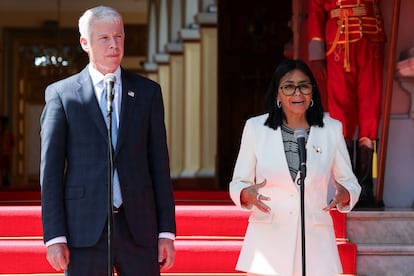
The acting president has insisted that Venezuela retains sovereignty over its natural resources and that the concessions granted under the agreement will help revive the economy once and for all. Many Venezuelans, however, fear that what is taking shape is not so much foreign investment as one country gaining control over another’s natural resources, while at the same time strengthening Chavista rule with Washington’s backing.
What other investments have been announced?
The NABEP agreement has paved the way for a series of new investment announcements by oil companies seeking to expand operations in Venezuela’s oil fields.
On Wednesday at Miraflores Palace, Rodríguez welcomed U.S. Energy Secretary Chris Wright along with representatives of several multinational companies interested in investing in the country, including GeoPark, Keo Capital, Primavera, Aspect Energy and GE Vernova.
Leading the investment push is Chevron, which announced plans to invest more than $7 billion to double its production in Venezuela to about 600,000 barrels per day within five years. The company said the funds would be directed toward its joint ventures with state-owned PDVSA, including Petropiar, Petroindependencia and Petroboscán.
Italy’s Eni also signed an agreement to expand its operations in Venezuela, including at the Junín 5 block. Meanwhile, negotiations advanced with General Electric and other companies to introduce new technology under production-sharing arrangements.
Sign up for our weekly newsletter to get more English-language news coverage from EL PAÍS USA Edition









































