
Delcy Rodríguez thanks Trump for his cooperation with Venezuela and announces elections without setting a date
The acting president spoke at the UN General Assembly — the same forum where she once denounced America’s ‘imperial claws’ — and did not once mention Nicolás Maduro, who is imprisoned near UN headquarters
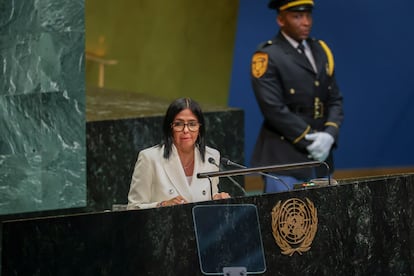

Venezuela’s acting president Delcy Rodríguez has formalized the handover of the Chavista regime to the United States under Donald Trump. The ceremony consisted of two parts. The first took place on Tuesday afternoon at the Lotte New York Palace Hotel, where Rodríguez met with her former nemesis, the president of the country she had previously accused of sinking its ‘imperial claws’ into her nation. The second act took place on Wednesday at United Nations headquarters, where she addressed the 81st General Assembly. “I want to thank President Trump for his willingness to take the path of diplomatic relations and cooperation,” she said, speaking from the same podium where Hugo Chávez once declared there was a smell of sulfur because U.S. President George W. Bush had just spoken. The handover is now complete.
In a speech of less than 20 minutes, Rodríguez spoke in general terms about her commitment to peace, rejection of violence, respect for the rights of nature and energy security. But she saved the most significant announcement for the end of her remarks: “There will be elections in Venezuela. We have initiated a political dialogue in that direction.” However, she did not set a timetable for those elections. The most she said was that the Venezuelan people will determine “the right moment.”
The announcement is striking because it breaks with the Chavista regime’s tradition. In response to criticism from various sectors about the lack of free and fair elections, Chavista leaders used to say that Venezuela held more elections than any other country in the world. That principle no longer applies. Regarding the deal signed with Trump under which Venezuela cedes 20% of its oil reserves to the United States, Rodríguez said it is one of the most important ever reached. “Today Venezuela is reborn,” the country’s leader concluded.
Rodríguez’s tone on Wednesday was very different from the one that permeated her remarks at the same forum in 2019. “I come in the name of the only Venezuela, the dignified, brave Venezuela that will not kneel before any imperial power. I bring the greetings of President Nicolás Maduro Moros and the Venezuelan people,” Rodríguez said then at the General Assembly. The then vice president attacked Trump’s “supremacist hatred.” Seven years have passed since then and the names of the three protagonists remain the same, but their circumstances have changed dramatically.
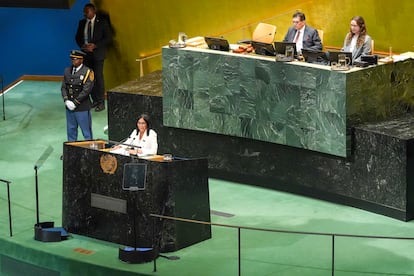
Maduro, the president that Rodríguez then praised, is currently being held in a Brooklyn prison, about nine miles (14 km) from UN headquarters. His former vice president has returned to address the United Nations, but now she does so as a close ally of the Republican president. Maduro’s view of this 180-degree turn by his former protégée is a closely guarded secret.
Rodríguez did not mention Maduro at any time during her address. Before her appearance at the UN, videos circulated on social media showing her refusing to answer whether she planned to visit Maduro at the Brooklyn Detention Center, a drive of about 20 to 30 minutes from United Nations headquarters.
Besides Rodríguez, Maduro and Trump, this story has a fourth protagonist, the opposition leader María Corina Machado. The fierce opponent of the Chavista regime believed she had an opportunity following the U.S. military operation that removed Maduro from power in January. But she now sees her former ally, the U.S. president to whom she once even gave her Nobel Peace Prize, posing for photos with her arch-enemy and doing everything possible to prevent her return to Venezuela.
Machado tried to enter her country from Panama on Tuesday for the third time in 24 hours. None of the three attempts succeeded. “Attention. They are preventing María Corina from returning to Venezuela. In the last few hours there have been three attempts, by sea and by air, from Panama, without success. There are seven attempts — yes, seven — in recent weeks. They are NOT letting her return to her own country,” her international relations adviser Pedro Urruchurtu posted on X. Various opposition figures in Venezuela have condemned the blockade of Machado.
The United States says it wants the country to move toward democracy, but it is clear that right now it has no interest in helping the leader of the movement that won the last elections enter Venezuela and create problems for the authorities that Washington now sponsors. According to Axios, Trump urged Rodríguez to call Venezuelans to the polls during their Tuesday meeting. “You have to have elections at the end of the day,” the U.S. president reportedly told the leader who still defines herself as Chavista, that outlet said, citing White House sources; that version has not been confirmed by any of the participants.
State Secretary Marco Rubio put it in a more convoluted way at a news conference this Wednesday. The secretary of state said the ultimate goal is “free and fair elections.” But to get there, Rubio said, work must be done to prevent the economy from collapsing.
Sign up for our weekly newsletter to get more English-language news coverage from EL PAÍS USA Edition









































