
UN team enters Sudanese city of El Fasher after paramilitary massacre: ‘It’s like a ghost town’
A brief two-hour journey was enough for the first outside witnesses to get a sense of a destroyed and practically deserted town with thousands of dead and displaced
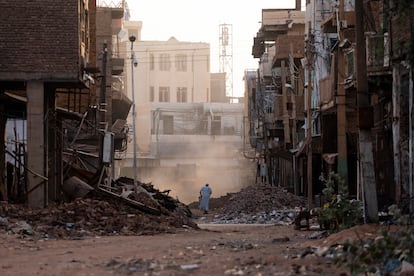

As the UN approached El Fasher, the landscape became increasingly gloomy. On the last Friday of December, UN team members entered the capital of North Darfur for the first time since it was seized by the paramilitary Rapid Support Forces (RSF) in October. The RSF takeover involved one of the worst massacres of the Sudanese war as well as one of the most horrific in recent history.
The UN team members were the first external witnesses to arrive at the epicenter of the tragedy. What they found was a destroyed and deserted city as well as abandoned villages nearby, triggering serious concerns for the civilians who remain there and for those missing. In August, the UN estimated the town’s population at around 260,000 people, of whom about 100,000 fled after the RSF seized the site. So far, no one has been able to confirm the whereabouts or wellbeing of tens of thousands of missing residents.
“What is clear is that there were no thousands of people to see. It’s like a ghost town,” said the UN humanitarian coordinator in Sudan, Denise Brown, in an interview with EL PAÍS. “We don’t know for sure how many people were left behind at El Fasher. There are missing people. Where are they? They may be dead, they may be detained, they may be injured. Sooner or later, we will have to do a triangulation.”
The team that entered El Fasher spent only two hours inside the city, visiting just a small area due it being believed parts of the town are strewn with unexploded ordnance. Their priority was the area around the Saudi Hospital, the only medical facility, run by civilian and military teams, that was operational until the fall of the city.
When El Fasher fell on October 26, the paramilitaries killed more than 460 people in this hospital, including patients and visitors. In the following days, the Yale Humanitarian Research Center (HRL) identified piles of objects that could have been corpses near and inside the compound via satellite images. Beside some were reddish marks on the ground, indicating blood and fluids. Soon, the piles were burned.
“The [hospital] building is there, but it’s clear that they’ve cleaned it,” Brown says. “There are medical personnel, but we do not ask them for credentials. There are very few patients and there are almost no supplies.” According to the African Centre for Justice and Peace Studies (ACJPS), the hospital’s staff consists of professionals who have been abducted by the RSF in El Fasher and South Darfur.
We don’t know for sure how many people were left behind at El Fasher. There are missing people. Where are they?Denise Brown, UN
Few signs of life
Brown explains that in the area surrounding the hospital there are some people living “in pretty precarious conditions,” due to the extensive destruction in El Fasher over the year that included a siege by the RSF before the final takeover. Those who remain live in abandoned buildings or in very basic shelters made of blankets or plastic, without toilets or access to drinking water.
In that same corner of the Daraja Oula district — the last neighborhood in El Fasher to fall where most of the civilian population took refuge in recent months — the UN team found a small market selling a smattering of produce such as onions, tomatoes, and also bags of rice and biscuits. It was unclear how the food got there. There were no open schools or public services. “There’s nothing that works and no one works, so it’s really a ghost place,” Brown says.
The situation witnessed on the ground is consistent with what has been indicated by the satellite imagery. In November, HRL did not identify activities that suggested a significant civilian presence in El Fasher. There were no signs of daily life, such as transport, commercial movement or people gathering for water. In the city’s markets, weeds had sprung up.
Brown believes the team’s visit has shown they can achieve their priority of safely getting in and out of El Fasher. And she considers that they now have to start sending in basic resources. “We must return as soon as possible with basic supplies, not in weeks, but in days. These will not be large convoys, but essential supplies in a handful of vehicles.”
Brown is aware that it has taken too long to enter El Fasher, but she argues there was a need to act with caution. “It was absolutely clear that we had to enter, but it had to be on our terms: we were not going to rush and let them politicize us,” she says. “There are people who are detained and injured who need to be evacuated, but with every step we take I hope a door will open to do more without endangering those who stay.”
Since the start of Sudan’s civil war in 2023, the two main warring factions — the regular army and the RSF — have systematically obstructed the delivery of aid in the areas hardest hit by the conflict. They have also repeatedly obstructed and interfered with the work of humanitarian organizations, forcing them to maintain difficult balances amid widespread international indifference.
The missing
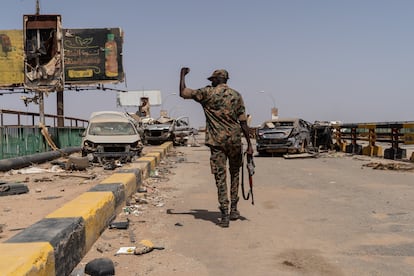
The fact the UN team found so few people alive in El Fasher raises fears about the scale of the massacre by the UAE-backed RSF. In a December investigation, HRL concluded that the RSF committed mass killings of civilians trying to flee or taking refuge in Daraja Oula. HRL also observed how the RSF destroyed evidence by burying, burning, and disposing of human remains on a large scale.
In total, the HRL identified 150 piles of objects compatible with human remains, of which 83 lay on the outskirts of El Fasher, suggesting that these were people killed as they tried to flee. Another 52 were in Daraja Oula, where paramilitaries appear to have carried out door-to-door killings. The rest were in spaces converted into detention centers, such as El Fasher University, and military installations.
The response of the international community, at all stages of this crisis, should fill us all with shameNathaniel Raymond, Yale Center for Humanitarian Research
On the other hand, the HRL acknowledged the burning of objects — visible in satellite images due to charred marks on the ground — at 20 locations in the city. All were observed in Daraja Oula, including at the Saudi Hospital, except for one near one of the main checkpoints erected by the RSF on the earthen wall that completely surrounded El Fasher. They also identified evidence of eight mass graves, six of them again in Daraja Oula.
“The UN team’s visit to El Fasher corroborates and confirms the findings of the Yale HRL that there are few civilians left in the city and that there have been a large number of fatalities as a result of the carnage perpetrated by the Rapid Support Forces,” says Nathaniel Raymond, the executive director of the research center.
More than two months after the RSF takeover of the city, however, no agency has been able to calculate the death toll, although it is widely considered to be in the tens of thousands. British MPs told The Guardian in December that they had received private information pointing to some 60,000 deaths in three weeks. If this figure is confirmed, it would be one of the largest massacres in recent history within such a short space of time.
By comparison, the death toll in the Gaza Strip due to Israel’s bombardment officially exceeded 60,000 in July 2025 after a year and nine months. The situation there is considered a genocide by numerous international organizations, leaders, and experts. In 2023, the RSF and allied groups killed between 10,000 and 15,000 people in Geneina, the capital of West Darfur, according to a panel of UN experts.
“Any current debate about figures and about what is happening in the city is outrageous because we knew what was going to happen, what has happened, and what is happening,” Raymond states. “The response of the international community, at all stages of this crisis, should fill us all with shame.”
Besides the murdered masses, there are also thousands arrested and missing. In a mid-December report, the ACJPS said that on the day El Fasher fell, paramilitaries captured more than 4,000 people fleeing north and transferred them to the former Children’s Hospital, which has been converted into a makeshift detention center. After three days, the number of detainees had risen to more than 7,300.
At the same time, large numbers were kidnapped while trying to escape from El Fasher, most of them by herdsmen and members of Arab communities allied with the RSF, who held them in areas around the city, as documented by Sudanese media such as Atar. Ransom demands have been increasing as the days have passed, but it is currently unclear how many people are being held in this way.
“The only thing that remains to be seen is whether we’re going to do anything about it, and, for now, it seems that the answer is still no,” Raymond says.
Sign up for our weekly newsletter to get more English-language news coverage from EL PAÍS USA Edition









































