
In Colombia, Petro prepares for a transition without De la Espriella
With meetings suspended indefinitely, the outgoing government is seeking legal safeguards through oversight bodies and plans to publicize its record directly via social media
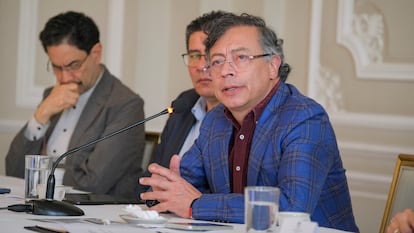

Over the past week, pivotal decisions concerning the final stretch of Gustavo Petro’s presidency have been made at the Casa de Nariño, Colombia’s seat of government. The transition process, which began two weeks ago with a pledge to be “orderly, auditable, verifiable and transparent,” was suspended indefinitely on Tuesday amid disputes between the outgoing and incoming presidents. Faced with that breakdown, Petro is seeking ways to legally safeguard the conclusion of his administration.
Early Tuesday, President-elect Abelardo de la Espriella ordered his vice president, José Manuel Restrepo, to suspend the transition meetings immediately. He said the move was prompted by what he described as Gustavo Petro’s and defeated candidate Iván Cepeda’s refusal to recognize his election victory. Hours later, Finance Minister Germán Ávila, who is coordinating the handover on behalf of the government, announced that the administration was also suspending the talks, citing a lack of institutional guarantees.
Immediately afterward, Petro’s lawyer, Alejandro Carranza, filed a criminal defamation complaint against Carlos Alonso Lucio, a member of the incoming administration’s transition team and a former comrade of both Petro and Ávila in the now-defunct M-19 guerrilla movement. The complaint was filed after Lucio said that Petro should be put on trial.
Faced with the unprecedented uncertainty over a legally mandated transition process, the government took its first step to protect itself legally. On Tuesday, Petro’s transition team formally requested that the Office of the Inspector General oversee the process “as a guarantor.”
In the formal request, read aloud during a televised statement announcing the decision by Petro’s left-wing government to suspend the talks, the administration asked the oversight body to assign any officials it deemed appropriate to attend the transition sessions. A similar request was made to the Office of the Comptroller General, which is responsible for monitoring the management of public funds.
The aim is for both institutions — which had already been supervising the process — to serve as guarantors of the transfer of information, a process that currently appears far from reaching a mutually agreed conclusion.
But that is not all. The presidential team already has a contingency plan in place should talks with the incoming administration fail to resume: broadcasting each ministry’s and agency’s handover reports through official social media channels. The move would be aimed primarily at the government’s rank-and-file supporters and would also serve as a way of publicly documenting that the government fulfilled its legal obligations.
The idea of broadcasting the transition process is consistent with a president who has repeatedly sought direct visibility with Colombians throughout his time in office. That has included not only frequent and lengthy televised addresses, but also appearances on public media, social networks and, over the past year and a half, the live transmission of Cabinet meetings.
In fact, Petro himself proposed making the transition meetings public from the outset. On July 2, when the first sessions were held at the Casa de Nariño in his absence — he was in Rome at the time — he wrote on X: “I support broadcasting all transition meetings on television.” He also called on the public broadcaster to handle the live coverage.
The proposal was incorporated into a presidential directive signed by Ávila, which stipulated that all meetings “must be recorded and may be broadcast through digital platforms.”
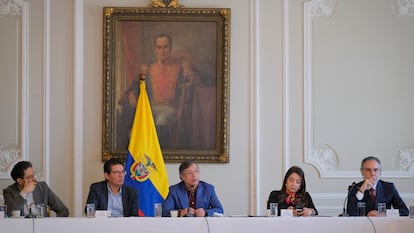
That proposal, however, found little support within Abelardo de la Espriella’s team. Restrepo, who is leading the transition effort on behalf of the president-elect, has argued that the handover process cannot be allowed to “turn into a media spectacle.”
By contrast, Lucio, De la Espriella and other figures in the incoming administration have continued to level corruption allegations against the outgoing government. In fact, they have described their transition team as an “anti-corruption transition committee,” a label that Ávila firmly rejected in his remarks on Tuesday.
Even so, a source close to Petro acknowledges that this line of attack is not entirely without basis and could prove more significant than it appears.
“You can’t ignore that. Some cases are public and well known and others are not. There are matters for which officials must answer,” the source said, stressing that the problems extend beyond the high-profile corruption scandal involving Colombia’s National Unit for Disaster Risk Management (UNGRD). “The government is not infallible because mistakes are always made.”
At the same time, the source adds that there is fear that the incoming administration will use isolated cases to discredit entire areas of Petro’s record, particularly the flagship policies that form a key part of the government’s positive legacy.
“They will magnify them, they will try to discredit all social policies: agrarian reform, education, etc.,” the source warned. “There is intent to plant evidence and create difficult situations for some officials out of pure vengeance.”
With those concerns in mind, Petro has instructed his transition team to prepare to present the results of his administration directly to the Colombian public, regardless of whether the incoming government returns to the negotiating table. The order builds on a presidential directive signed by Ávila on July 1, requiring each ministry and agency to upload its performance reports to a public platform managed by the National Planning Department and ensuring that any transition meetings that do take place are recorded for later publication.
Petro is preparing to leave office in his own way, following a script that allows him to retain control over the narrative, as well as the flow and emphasis of information. On the other side, the incoming administration appears unwilling to relinquish that ground or to forgo presenting a critical assessment of the left-wing government’s record.
The transition will continue. So, too, will the battle over how its story is told.
Sign up for our weekly newsletter to get more English-language news coverage from EL PAÍS USA Edition









































