
Jason Hickel: ‘As long as capital controls production, we will have perverse results’
The economic anthropologist proposes reducing the consumption of unnecessary items to avoid a social and ecological collapse
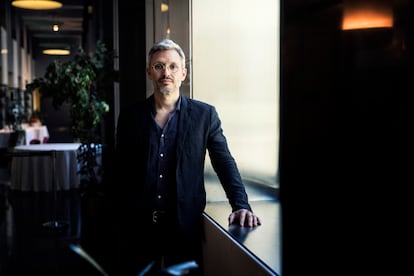

He says that when he was a child, the front grille of the family car would be filled with bugs when he traveled through his native Eswatini, formerly Swaziland. Now, professor and economic anthropologist Jason Hickel, 42, barely sees half as many insects in the southeast African country. It’s symptomatic. “Global warming is extremely dangerous. It’s a failure of our ruling classes,” he declared in Madrid a few hours before participating in the Beyond Growth conference at the Spanish Congress. The author of Less is More: How Degrowth Will Save the World establishes that capitalism is based on brutally enriching the wealthiest at the cost of generating inequality and destroying the planet, and that GDP doesn’t measure the real wellbeing of the population. He proposes solutions.
Question. How do you assess the fact that there are fewer and fewer insects?
Answer. It’s unacceptable. And it’s just the tip of the iceberg. Ecological collapse is an emergency, and we need a response. Emissions reduction policy is woefully inadequate, and capitalism is incapable of solving this crisis because its purpose is not to meet human needs or achieve ecological goals. It’s solely to maximize and accumulate profits. As long as capital controls production, we will have perverse results.
Q. What does this capitalism entail?
A. Markets, business, and trade existed thousands of years before capitalism. There’s nothing wrong with that. But this capitalism is a system based on anti-democracy. Decisions about what to produce and how to use our labor and resources are made by capital: big financial firms, large corporations, and the richest 1%, who own most of the investment assets. They produce only what is profitable for them, even if it’s harmful to the population or the planet.
Q. Capitalism has also instilled in people the idea that you’re worth what you have, not what you are. And that leads to consumerism.
A. It’s largely because of advertising. We’re convinced that we’re worthless unless we own a particular item or brand. This causes anxiety and unhappiness. And ultimately, that consumption is for the benefit of big business. There are many studies of cities that have banned advertising, where people end up being much happier and living more fulfilling lives, with less anxiety, less self-harm, less mental illness, and so on. So we need to understand that consumer behavior is actually a consequence of production. It’s a consequence of capital.
Q. And what would degrowth bring?
A. It focuses on reducing harmful and unnecessary forms of production that don’t benefit the majority of people and reorganizing them around social and ecological needs. And it’s particularly aimed at countries in the Global North, where we produce a lot of SUVs, mansions, private jets, and fast fashion. This is very energy-intensive, very destructive, and doesn’t meet human needs.
Q. Who would decide what to produce?
A. It should be done democratically. We already know that people want renewable energy, public transportation, affordable housing, and nutritious food. We can impose rules on commercial banks to steer investment in those directions. And we should have citizen assemblies that represent the population geographically and can effectively decide what is harmful and what is necessary.
Q. Why isn’t this being done?
A. What I see is that the popular will is there. But political action isn’t. And the reason is that most of our politicians and governments are aligned with the interests of capital, not those of the people.
Q. What do you say to those who ask you what would happen to the jobs of people working in industries producing unnecessary items or products with planned obsolescence?
A. A very easy solution is to promote a guaranteed public employment program for things we already know improve society. And it would be with decent wages, with a shorter workweek... For example, in rural areas of Spain, massive soil degradation and mass unemployment coexist. There’s no reason not to provide jobs in regenerative agriculture. In our current economy, it is assumed the only way to address unemployment is through growth, but these public policies were already implemented in the U.S. during the Great Depression and in the UK after World War II.
Q. And how would it be financed now?
A. With a public financing mechanism. Of course, there’s a limitation: if you issue money to produce too much and it competes with private production, it will drive inflation. So you have to fight inflation with degrowth, reducing harmful and unnecessary industries, taxing the rich, or reducing consumption among the elites... and thus limiting their control over our productive capacity.
Q. In Spain, the [political] right has just overturned the law to reduce the working day.
A. I think it’s terrible. It can be extremely beneficial for people and the planet. It’s been proven.
Sign up for our weekly newsletter to get more English-language news coverage from EL PAÍS USA Edition









































