
Erin Brockovich: ‘To combat the climate crisis we must first look in our own backyard’
The eco-activist, played by Oscar winner Julia Roberts in 2001, talks to EL PAÍS about her life since winning the largest civil lawsuit US history
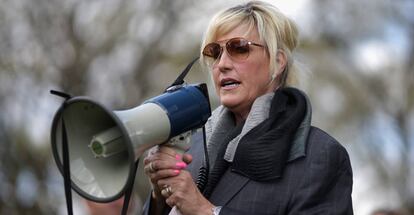

The name Erin Brockovich is now so symbolic in the U.S. that it is also used as a verb: to Erin Brockovich something means to investigate it to the bitter end; in other words, refusing to give up. “I think that to change something in the upper echelons of power and reduce their influence on the planet, we have to look at what is closest to us, otherwise we will have a problem. We must first look in our own backyard,” she says.
After winning a case in 2000 against Pacific Gas & Electric (PG&E), the energy company responsible for water pollution in the small town of Hinkley, California, her commitment to social and environmental justice remains intact. Her story reached the big screen and won Julia Roberts her first and only Oscar while consolidating Brockovich as a benchmark for climate activism. Two decades later, from her desk in Los Angeles, Brockovich, 65, speaks to EL PAÍS of her vision on environmental protection within the framework of the Healthy Cities event, organized in Barcelona by the private healthcare group Sanitas.
“Protecting the planet is not woke, it is self-defense,” Brockovich said on X. The activist acknowledges that people have tried to discredit her all her life. After the car accident she had in 1990, she began working for the law firm that helped her make her case. One day, while organizing paperwork, she noticed that many of the documents contained reports of sick people in Hinkley’s community. After tireless investigation, Brockovich got the victims a historic compensation of $333 million.
“Being a woman was very difficult at the time, and it still is. I don’t like to be pigeonholed, so I’ve tried my best to distance myself from that. When I became known, they told me that I was neither a scientist, nor a lawyer. But I don’t have to be any of those things to see the evidence and speak out against what is wrong,” she points out.
Brockovich doubts whether now, given the authoritarian drift of Donald Trump’s administration and his personal crusade against the separation of powers, the sentence of what was the largest civil lawsuit in U.S. history would have been the same.
“It is true that it happened in California, which has a Democratic tradition and is much more progressive than other areas of the country, so I trust that with the tenacity with which I carried out the investigation it would have been resolved in the same way. But you have to take into account that at that time there were practically no regulations in this area,” she says. “I grew up in the American Midwest, so I learned everything I know through my connection to the environment. I have never been able to wait for the weather to attack me, although it does, nor big companies or the powerful. I learned at a very young age that I had to fend for myself.”
Brockovich neither waits for the attack or the rescue, whether for herself or for the planet. And this is how she puts it in her book Superman’s Not Coming, published in the middle of the pandemic in 2020. “We are always looking for someone to solve things. And it’s you who should do it, because Trump won’t. The message is to find yourself and believe in yourself. That is the most profound message of all,” she insists.
“For many years, there have been no references, at least in the field of climate justice. That is why I think we have arrived late. I believe that you should be your own role model. Strengthen your message and find yourself. I think that my references were always my mother and father, the values that they instilled in me. Love through nature. When I talk about my book, nothing scares me because we can all be Superman,” she says.
Used to prejudice in court for the way she dresses and expresses herself, Brockovich calls the spirit with which she has litigated against large corporations or environmental causes the ‘gladiator factor.’
“We definitely live in a world where the future is right in front of us. But the past is still very close. On the one hand, we have very advanced technology, and on the other, we still operate in a very primitive way. That reminds us that we have the gladiator factor which refers to the constant conflict for dominance and survival in a competitive and savage world. Every interaction becomes a brutal fight for attention and validation,” she says.
According to Brockovich, the right to decide for ourselves comes with the responsibility of keeping properly informed. Otherwise, we get the likes of Elon Musk, the richest man in the world, in the Oval Office, albeit briefly. “We must let the people decide, but it is essential to provide better information about the threats we face. It is the citizens themselves who put these characters in these positions. We are the ones who allow it,” she observes.
Brockovich currently leads Brockovich Research & Consulting, a firm that advises communities affected by pollution, and informs on the water crisis. Many already consider her one of the most influential women of the last century in the U.S. regarding environmental issues. “I don’t think the relationship between feminism and social justice is something I reflect on when I take sides on something. But I do feel it in a way because I think we all have that fighting instinct and that’s what really guides us,” she says. “Feminism and struggle go hand in hand because it is what our mothers have done, and what they have told us. They have always protected that instinct,” she says.
Sign up for our weekly newsletter to get more English-language news coverage from EL PAÍS USA Edition









































