
The Metropolitan Opera of New York seeks billionaires to survive
Saudi Arabia’s refusal to inject $200 million into the prestigious cultural institution deepens its financial problems, despite going through a strong artistic moment
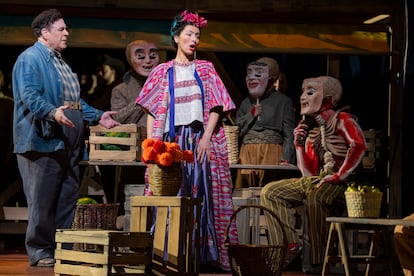

On stage, the performers are playing Frida Kahlo and Diego Rivera. He is about to die. She has returned to the world of the living, but only briefly, to be reunited with her beloved/loathed husband. “Life is brief, but the light will remain,” sings the chorus surrounding them, framed by a luminous staging and the baton of music director Yannick Nézet-Séguin. The music has not even finished when a near-capacity Lincoln Center erupts in applause, with ecstatic shouts of “viva,” in Spanish.
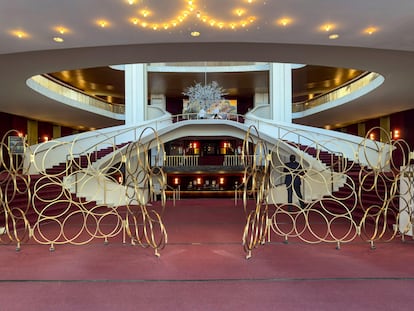
Among the audience were many longtime opera lovers with decades of productions behind them, but also a significant number of young people, some dressed with echoes of Mexican folk dress in tribute to the piece they had just witnessed, El último sueño de Frida y Diego (The Last Dream of Frida and Diego). During the intermission, a crowd strolled past the two impressive Chagalls hanging on the walls. It did not feel like the scene of an institution in crisis. And yet the Met, the highly prestigious temple of opera in New York, with 142 years of history behind it, is going through a difficult moment.
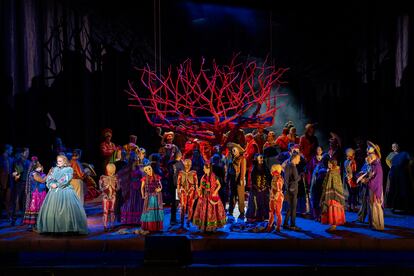
No one questions Peter Gelb’s artistic credentials. The man who has led the Met for nearly 20 years has managed to renew the institution with new—and successful—productions such as Innocence, by Finnish composer Kaija Saariaho, about a massacre at a high school, or this Spanish-language staging about Kahlo and Rivera, written by Gabriela Lena Frank. He has also brought a modern edge to classic operas, such as this season’s Tristan und Isolde, a hit both at the box office and with critics.
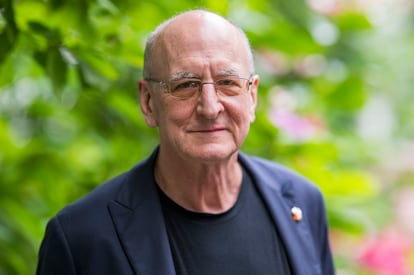
Despite these artistic achievements, Gelb must steer a ship through a financial crisis with no clear way out. The New York Times has just asked whether his is the toughest job on Earth. Marc Scorca—president of Opera America for 26 years, the association that encompasses major U.S. companies—analyzes the situation lucidly: “I would separate the business, which has not recovered since the pandemic, from opera itself. Because I think opera in the United States today is more alive, more vibrant than ever.”
The Met is known for doing things on a grand scale, accustomed to an era when genuine billionaires enjoyed being generous to the arts. Its 3,800 seats are an anomaly among the world’s great theaters. It stages performances virtually year-round. It is a monster that never stops, with an annual budget of $326 million (€282 million), the largest of any opera house in the world. To keep it running requires people working 24 hours a day, seven days a week. Costs have soared in recent years and, despite some box-office hits, ticket sales have not returned to pre-pandemic levels.
Gelb himself admits it. “As the most expensive opera company in the world and with virtually no public funding, the financial challenge is to generate new revenue sources that complement ticket sales—both in the theater and at movie theaters—and generous donations from individuals, foundations and corporations. Since activities resumed after the pandemic, the gap has widened between operating costs, driven by inflation, and the institution’s usual revenue streams; hence the need to identify new funding avenues,” he wrote in an email to EL PAÍS.
The Met’s leader explains that he is pursuing licensing agreements abroad, sponsorship opportunities through naming rights for theater spaces, and other initiatives that can generate income. “We are encouraged after one of our most successful seasons yet—which has reinforced our reputation as an artistic pillar of a civilized society and as an indispensable cultural asset—and we are confident we will reach our long-term financial stability goals,” Gelb concludes.
As a belt-tightening measure, next season will feature 17 productions, the lowest number in at least 70 years. But that’s not all. The company is offering its two magnificent Chagalls to the highest bidder, but the sale is complicated because the buyer must agree to keep them hanging where they are. There have been pay cuts and layoffs. Moody’s has downgraded the quality of its debt. The final blow came from Saudi Arabia, which pulled back at the last minute from a deal to inject $200 million (€173 million) in exchange for three annual performances in the kingdom. The agreement seemed done, but the Saudis reconsidered after the war with Iran and its economic turbulence. Gelb even wrote a letter to Elon Musk, one of the world’s richest men, offering—it’s unclear whether in jest or in earnest—to produce an opera in space if he opened his wallet. Musk did not respond.
Karen Henson, a musicology professor at the City University of New York, reflects that not much has changed deep down. “The Met was founded by the equivalent of the technobros at the end of the 19th century. Great industrial families like the Vanderbilts and the Morgans in New York’s Gilded Age.” Opera and money have always gone hand in hand, from the Renaissance to today. The problem, Henson notes with a touch of irony, is not that you have to call Musk to ask for money, but that the man who controls companies like Tesla or SpaceX feels he should not contribute: “In another era he would have wanted to because it would have made him look good. But today that has changed.”
The fundamental question is whether an art form so expensive to produce is sustainable in the long term in a world where cultural consumption is changing at breakneck speed. The new paradigm emerged during the coronavirus pandemic, and although many audience members have returned, the numbers still don’t add up. “The audience hasn’t dropped much, but what used to be common among people who enjoyed opera was buying a subscription and going many times a year; now, most go once or twice at most. The reasons for this change are very complex: from the rising cost of living to the enormous variety of cultural offerings of all kinds,” Scorca analyses. “It pains me that all these problems arrive just when the Met is offering so much that is new artistically. It manages to attract incredibly powerful singers. But the most interesting thing is the artistic energy and the relevance it is achieving with contemporary works,” says Naomi André, a musicologist at the University of North Carolina.
The people interviewed for this story, all great opera lovers, acknowledge the severity of the situation but insist the Met, which has weathered many crises, will get through this one too. Actor Timothée Chalamet was widely criticized recently for saying opera no longer interests anyone. But the idea of a declining artform that has lost its cultural prestige has been circulating since the 19th century, Professor Henson recalls. The question, however, is not that. It is whether a pachydermic model—one with many very expensive productions—is sustainable in an era when cultural consumption is conceived as instantaneous. And whether the Met will have to sacrifice part of its tradition, reinvent itself in some way, to move forward.
Sign up for our weekly newsletter to get more English-language news coverage from EL PAÍS USA Edition









































