
Spain’s victory, the world’s victory
La Roja’s second World Cup is a triumph for an exemplary group and a lasting moment of collective emotion
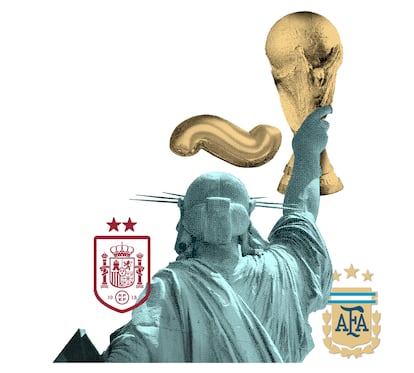

It was no dream. Spain are world champions once again after defeating a spirited Argentina in an agonizing, heroic final in New Jersey and overcoming the greatest legend in soccer history, Lionel Messi. It is the triumph of coach Luis de la Fuente and an extraordinary group of players who, in a sport dominated by stars and social media divas, have put team values, collective intelligence, and a commitment to hard work above all else. But soccer is never just soccer, and La Roja’s victory, 16 years after the team’s win in South Africa, has sparked a moment of shared emotion that runs counter to the bad temper dominating public discourse, and which need not fade once the celebrations end. It is not difficult to see in this team, in the diversity of its origins and regions, in the character of its stars, in its style of play, and in its ability to connect with supporters and citizens alike, a reflection of what this country is and what it can become in the 21st century.
The World Cup that will be remembered as Messi’s farewell and as the tournament of Spain’s second star began as the World Cup of superlatives: the first featuring 48 national teams and the first hosted by three countries. It started amid fears that everything would ultimately be overshadowed by spectacle, business, and politics, and while there has been some of that, what prevailed was the quality that makes soccer an incomparable phenomenon.
For the stadium need not be, as Orwell believed, a battlefield for nationalism, “that lunatic modern habit of identifying oneself with large power units and seeing everything in terms of competitive prestige.” In a world saturated by rhetoric of hatred and division, it can also be the opposite: one of the few universal languages, a space in which vast and tiny nations, historic powers and newcomers alike, aspire to the same goal, as the dreams of Cape Verde and Norway reminded us. Success is not always measured by lifting the trophy, nor by the size of the flag.
The tournament leaves lessons for its organizers, lessons that will be useful for the 2030 edition, which will be held in Spain, Morocco, and Portugal. The expanded format with more teams worked better than expected, and stadiums were filled to capacity, defying the gloomiest predictions, although the price of tickets made attendance a prohibitively expensive privilege for many. If this trend continues, the risk is that a popular sport will increasingly become an exclusive product.
Even so, fans ultimately made the tournament their own, both inside and outside the stadiums. This happened last night in New Jersey and New York, the “Nueva Yol” celebrated in the hit song by global pop superstar Bad Bunny, and the backdrop for a World Cup final played in Spanish in a United States that is increasingly Latino, even as Latinos are often singled out or targeted.
Special mention must go to Mexico, which offered an unforgettable demonstration of its ability to turn competition into a massive and welcoming celebration. Its streets and festivities reminded us that a World Cup belongs as much to those who play it as to those who live it.
In the end, neither Donald Trump, who cast a shadow over the tournament by intervening to have a red card shown to a player from his national team overturned, nor his ally, FIFA president Gianni Infantino, could overshadow soccer itself: the goals, the victories, the defeats, and everything that connects people across the globe, who remained captivated right up to that unforgettable final between Spain and Argentina. It was the fans, filling streets, stadiums, and homes, who showed that, at least for the duration of a match, it is still possible to feel part of a shared experience. And Ferran’s extra-time goal, together with an ending that will linger long in the memory, is proof of soccer’s enduring miracle: 22 players, two goals, a ball and millions of people around the world suffering and celebrating along with them.
Albert Camus, who as a young man played as a goalkeeper for Racing Universitaire d’Alger, once said that everything he knew about morality he had learned on the soccer pitch. And in Spain’s triumph, echoing the success of Putellas, Bonmatí and Jenni Hermoso’s La Roja in 2023, it is possible to see more than a sporting achievement.
There is something, perhaps not strictly moral, but certainly exemplary about it: the maturity of the group and the way it competed reflected an open, plural, self-confident country, one shaped by different accents, origins and life stories. It is a valuable snapshot at a time when narratives that reduce identity to exclusion, or idealize an imagined past, are on the rise. No national team can, on its own, heal the divisions within a society, but it can offer a mirror in which a country may recognize itself, if only for a moment. It is an image worth preserving long after the tournament has come to an end.
Sign up for our weekly newsletter to get more English-language news coverage from EL PAÍS USA Edition









































