
The delicate balance of María Corina Machado in Trump’s Washington
The exiled opposition leader finds herself divided between those who prioritize stability in Venezuela and believe she could jeopardize it, and those who support a democratic transition with her at the helm
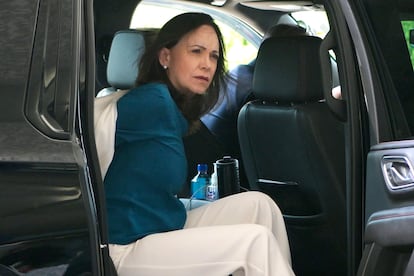
Like something out of one of those experimental films from the 1970s that made excessive use of split-screen techniques, Venezuela’s interim president, Delcy Rodríguez, and opposition leader and Nobel Peace Prize laureate, María Corina Machado, spoke in the United States last week just hours apart. Rodríguez spoke in Miami at an investment forum sponsored by Saudi Arabia’s sovereign wealth fund, while Machado spoke in Houston at an influential global conference on the energy industry.
Rodríguez, who is still subject to U.S. Treasury sanctions, participated via videoconference. A visit to the country that captured her leader, Nicolás Maduro, on January 3 seemed unlikely. Machado, who has been lobbying in the United States for several months, traveled to Texas in person and greeted hundreds of people, including many Venezuelans in exile.
The coincidence spoke to the extent to which Venezuela’s future is decided more in Washington than in Caracas, and how that future is structured around two priorities that don’t necessarily align: the stability sought by the White House and the democratic transition demanded by the opposition. And it is within this intersection of interests that María Corina Machado operates.
The country’s most popular leader was catapulted to fame when she left Venezuela clandestinely and dramatically to collect her Nobel Peace Prize in Norway last December. After a year and a half in hiding—following the elections that, according to the official records, her candidate Edmundo González won—and after nearly three decades waiting for change, it seemed that something was finally going to shift. So when, on January 3, elite U.S. troops entered the compound of Nicolás Maduro and his wife, Cilia Flores, the 58-year-old opposition leader thought her moment had arrived. But Donald Trump had other plans.
Trump speaks highly of Machado—appreciating the fact that she presented him with her Nobel Peace Prize during their first face-to-face meeting—and has received her twice in the Oval Office. His Secretary of State, Marco Rubio, met with her this Tuesday. But Trump has also legitimized Delcy Rodríguez as the acting president and showered her with praise, highlighting how good it is to work with her and with what remains of Chavismo, which is suddenly so accommodating to Washington’s interests.
María Corina Machado has been moving around Washington for weeks with a mixture of urgency and calculation. In recent months, she has held several meetings with high-ranking officials from the White House and the State Department, as well as with 17 senators, 27 members of Congress, and diplomats from 51 countries. The agenda has been frenetic, but the outcome is more uncertain. Her priority is to return to Venezuela as soon as possible—in February she even said she would return in “a few weeks”—and to push for new elections in which, according to polls, she would win by a landslide. But Trump, at a breakfast they had on March 6, asked her for patience and advised her not to return for now, as revealed by The New York Times.
This caution in Washington is compounded by a warning from Caracas. Delcy Rodríguez asserted that if Machado returns, she “will have to answer to Venezuela” for having—according to the Chavista accusation—encouraged the U.S. intervention that ended Maduro’s government.
“María Corina has had a fairly successful stint in Washington, but she hasn’t managed to press the button she needed: for Trump to give her permission to return to Venezuela,” warns the essayist Moisés Naím, one of the most influential Venezuelans in Washington. “The priority for the United States government in this crisis is to avoid chaos; to prevent a power vacuum from leading to a crisis of ungovernability. That’s why they are so cautious about her return.”
According to several U.S. media outlets, her constant appearances have generated some frustration within Trump’s circle, where some believe she is prioritizing her own agenda over the president’s goals of stabilizing the country and opening it up to U.S. interests. As reported by The Wall Street Journal, the White House believes that Machado does not benefit from insisting on a democratic transition or attacking Rodríguez on television.
Some actions in Washington have unsettled Machado and her inner circle. One of the most recent was Trump’s decision to invite opposition leader Enrique Márquez to his State of the Union address. The appearance was laden with symbolism, as it was interpreted as the president’s support for other figures who could lead the opposition to Chavismo. Hours after the event, Magalli Meda, one of Machado’s closest collaborators, shared a cartoon in which the opposition leader appeared relegated to the background while Trump, like a magician, pulled Márquez out of a hat.
Machado isn’t the main focus, as she had hoped, but she’s still very much present. “It would be a mistake to say she’s completely isolated,” notes Geoff Ramsey, a Venezuela expert and nonresident senior fellow at the Atlantic Council. “Machado retains allies in Congress, support within Trump’s own circle, and an active international network,” he states. But part of this shift has to do with who wields real power in Venezuela today. And with the divisions within the White House.
“Some sectors are wary of holding competitive elections in the short term due to the risk of destabilization, while others warn of the enormous political cost of normalizing relations without demanding reforms,” explains Ramsey. Figures like Marco Rubio, with a strong base in Florida and a good relationship with Machado, are pushing in that direction. Meanwhile, economic lobbies—primarily oil, mining, and financial—are pressuring for normalization, although they “prefer to deal with those who truly hold power,” namely, the Rodríguez siblings. According to a Washington source, this impasse suits these pressure groups, as long as Chavismo remains subservient to the White House.
Meanwhile, the clock is ticking. Machado continues to defend the need to set an election date now, and her inner circle fears that, without pressure, that promise will fade away. But the White House is going at a different pace, constrained by its own priorities. “Right now, Trump is fighting for his political survival; he’s not exactly thinking about Venezuela,” argues Naím.
Elections, any analyst asked about Venezuela agrees, will come. The question is when. And what role will María Corina Machado play in them?
Sign up for our weekly newsletter to get more English-language news coverage from EL PAÍS USA Edition









































