
El Paso resists ‘Lone Star Lockup,’ the new largest immigration detention center in the United States
Progressive activists and politicians denounce extreme conditions and legal restrictions at the immigration jail located on a military base in the Texas border city
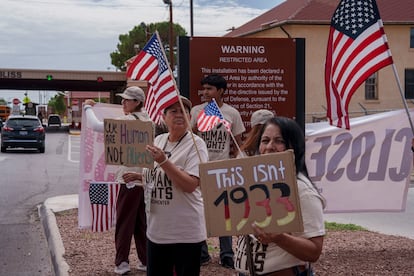
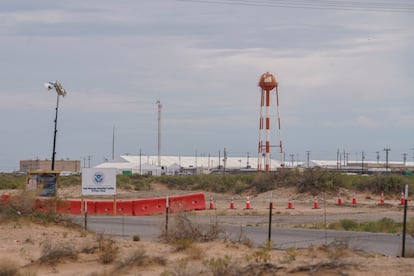
El Paso, Texas’ quintessential border city, has begun its resistance against the implementation of the Camp East Montana immigration detention center, built on the Fort Bliss military base, less than 15 minutes away from downtown. The facility — whose first inmates arrived in mid-August — is projected to be the largest of its kind in U.S. history, with a capacity for 5,000 people. To this end, the Department of Defense has approved an investment of approximately $1.2 billion for its expansion over the next two years.
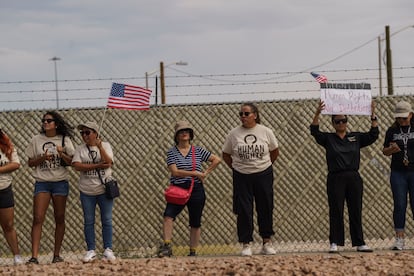
Around the military base in the Texas desert, hundreds of protesters have been demonstrating for days against the extreme conditions at the site, a vast open-air tent facility. The accusations center primarily on the heat experienced by detainees in a desert region of a state suffering a heat wave since early August, with temperatures almost constantly above 40°C (104°F). Furthermore, deficiencies in the water and food supply, as well as inadequate medical care, have also been reported.
The center, informally known as the “Lone Star Lockup,” began operating with an initial capacity of 1,000 people. According to Immigration and Customs Enforcement (ICE), it will eventually include medical services, recreational areas, and libraries. However, local activists report that its current conditions are precarious and detainees’ rights are systematically violated.
Melissa López, director of Estrella del Paso, an organization that provides legal assistance to migrants, highlighted at a press conference Thursday the contradiction between what ICE told Democratic Congresswoman Jasmine Crockett — who had visited the site shortly beforehand — and the reality her organization deals with every day. For example, Crockett was informed that in-person legal visits were already possible without supervision, while Estrella del Paso attorneys have only been authorized for telephone contacts. “Yesterday we were told one thing, today the congresswoman was told another. This contradiction is dangerous, and we will continue to demand that access to legal representation be guaranteed,” López stated.
At the meeting, Jovanny Sebastián Hernández, organizer of the New Mexico Dream Team, a support group for undocumented immigrants, highlighted the enormous expense involved in the construction of the site. “The opening of this concentration camp violates our shared values. That money could be used for healthcare, education, and housing, not mass detention,” he argued. He also recounted the testimonies of detainees suffering from weight loss, lack of medical care, and limited access to clothing and shoes.
Meanwhile, attorney Becca Sheff of the American Civil Liberties Union (ACLU) stated that the opening of this detention center “is not about security, but about instilling fear and accelerating deportations without due process.” Sheff recounted the case of a Venezuelan immigrant who was found unconscious after not receiving timely medical attention and was also denied visits from his legal representatives. “Each bed is not a number; it’s a person who came seeking dignity and safety. History has taught us what happens when we let fear dictate policy. We cannot repeat those horrors,” the attorney said.
A military installation with a long history of housing civilians
During World War II, Fort Bliss housed people considered “enemy aliens,” primarily of German and Italian descent. While it was not one of the main internment centers for people of Japanese descent, it was part of the military system that managed prisoners of war and targeted detentions. Decades later, during Trump’s first presidency, it was used to house unaccompanied migrant minors. And, following the withdrawal of U.S. troops from Afghanistan in 2021, it welcomed thousands of refugees as part of Operation Allies Welcome.
Now, the use of military facilities to detain migrants en masse is causing fear among activists and progressive politicians. Human rights organizations such as the ACLU and Human Rights Watch have warned that the Trump administration is using sites designed for war and national defense to detain civilians. This is a problem, they say, because it complicates oversight and limits transparency.
These two oversight mechanisms were demanded by El Paso County Commissioner Jackie Butler in a resolution filed this month. In the document, Butler warned that the multimillion-dollar contract for the construction and operation of the facility was awarded without public consultation to a firm with no experience in civil detention (called Acquisition Logistics LLC). She also emphasized how the center will affect the area’s infrastructure and public services.
Democratic Congresswoman Verónica Escobar of El Paso also visited Camp East Montana this week and criticized the waste of resources used for its construction. “How much good would that money do if it were spent on childcare, healthcare, or preschool education?” she asked. Meanwhile, Republican politicians like Texas Senator John Cornyn have supported the initiative. Cornyn recently toured the facility and called it an improvement over previous conditions. He also asserted that the new center will alleviate the overcrowding that exists at other immigration detention centers and allow for more efficient processing of cases.
The Trump administration has repeatedly announced that it is seeking to expand its detention capacity for migrants in the deportation queue, which already exceeds historic records with some 60,000 detainees, which is also well above the 40,000 total beds available to ICE. In recent months, some of the largest, previously unused facilities have reopened and new migrant prisons have been built; the most notable of which has been the so-called Alligator Alcatraz, built in just days in the middle of the harsh swamp and mangrove ecosystem of the Everglades, west of Miami. If those who oppose it fail to halt its expansion, Camp East Montana at Fort Bliss will dwarf all others.
Sign up for our weekly newsletter to get more English-language news coverage from EL PAÍS USA Edition









































