
The religious community of El Paso mobilizes in support of immigrants
In the Texas border city, religious leaders and organizations denounce the consequences of the Trump Administration’s immigration policy: ‘I really don’t believe fear adequately describes it. It’s terror,’ says a bishop
This story was co-published with Puente News Collaborative, KTEP public radio in partnership with the Craig Newmark Graduate School of Journalism at the City University of New York (CUNY). Puente News Collaborative is a bilingual nonprofit newsroom, convener, and funder dedicated to high-quality, fact-based news and information from the U.S.-Mexico border.
Six months into President Donald Trump’s second term, sweeping changes to federal immigration policy have escalated deportations, cut millions of dollars in federal funding to nonprofits providing legal aid for immigrants, and revoked protections for sensitive spaces, including churches.
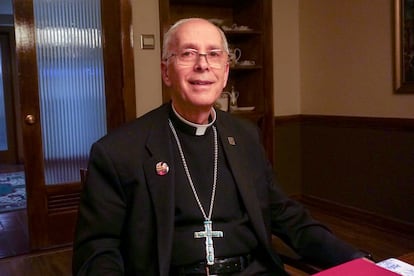
In El Paso, Texas, faith leaders and organizations that have long provided resources for migrants are raising alarms over new policies they say are instilling fear and undermining humanitarian efforts. “People are afraid to go out for groceries. They’re afraid to go to church,” said El Paso’s Catholic Bishop Mark Seitz. “I really don’t believe fear adequately describes it. It’s terror.”
The polarizing issue of immigration has morphed into mass protests in Los Angeles and multiple cities across the country against sweeping ICE raids that include work sites and other locations. At least one person was on church property when they were picked up by agents, according to reports. Pope Leo XIV, a Chicago native and a descendant of Sicilian immigrants, has called for the protection of immigrants, the poor, and the most vulnerable, following the legacy of his predecessor, Pope Francis.
“No one is exempt from ensuring the dignity of every person,” the pontiff said. “From the unborn to the elderly, from the sick to the unemployed, citizens and immigrants alike.”
In rescinding the sensitive locations policy, a spokesperson for the U.S. The Department of Homeland Security said, “The Trump Administration will not tie the hands of our brave law enforcement, and instead trusts them to use common sense.”
Sensitive locations
For Bishop Seitz, the diocese’s mission to protect the vulnerable has never been clearer as the Trump Administration carries out what critics, including Seitz, have called mass deportations based on racial profiling. “It was the intention of the administration so that people would leave — to appeal to those who don’t want anybody in this country except people that look like them,” Seitz said. “You have to be constantly worried. Constantly on guard.”
In October 2021, the Biden Administration expanded the definition of sensitive locations to “protected areas” that imposed greater restrictions for ICE to enter spaces such as, schools, healthcare facilities, social services establishments, disaster relief centers, and places of worship. Now, no space is off-limits.
On his first day in office, President Trump rolled back the nonpartisan “sensitive locations” policy, dating back to the Clinton Administration, which encouraged immigration and customs agents to use “good judgment” to engage in enforcement in sensitive areas.
The policy reversal has sparked multiple lawsuits from faith groups across the country, including the Quakers in Maryland and in Oregon, arguing that the new policies violate the Religious Freedom Restoration Act and the First Amendment.
In January, a federal judge in Maryland blocked parts of Trump’s executive order. U.S. District Judge Theodore D. Chuang ruled that the policy imposed a “real and substantial burden” on religious organizations that historically aid migrants. “The burden imposed by the policy is far from speculative,” Chuang wrote in his opinion. “It is already happening.”
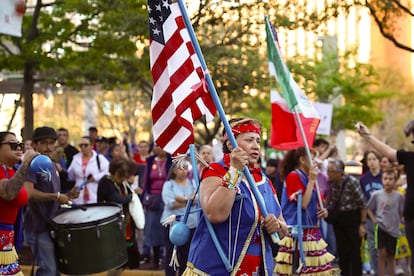
In the border city El Paso, one of the largest binational communities in the country, the immigration crackdown has sowed fear among many people of color, generating multiple protests. More than 80 percent of El Paso’s population is Hispanic.
“A moment of hopeful resistance”
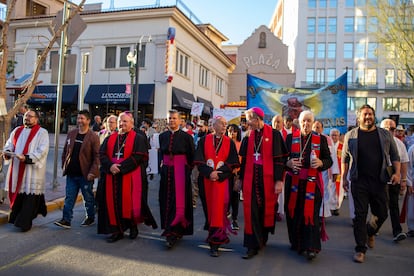
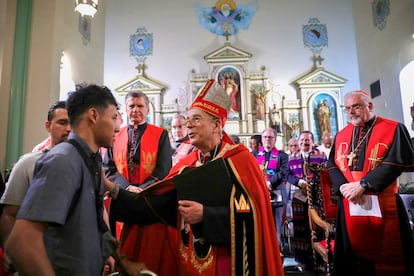
This spring, Bishop Seitz led a candlelight vigil through downtown El Paso to Sacred Heart Church, which served as a shelter for migrant families during a large influx of migrants seeking asylum in 2022. He was joined by faith leaders from across the U.S., Mexico, Central America, and the Vatican.
“It was a moment of creative, hopeful resistance,” said Dylan Corbett, executive director of the Hope Border Institute. “The testimony of people affected by these policies has to be at the center of our response.”
That resistance comes with growing risks, as faith-based nonprofits fear they could be swept up in a crackdown. Operation Lone Star, Texas Gov. Greg Abbot’s border enforcement initiative which included deployment of 10,000 National Guard troops and Texas state troopers along the U.S.-Mexico border. Faith-based nonprofit organizations fear they could face consequences for providing humanitarian aid to undocumented migrants.
“We’ve got a target on our back now,” Corbett said. “They may go after us for smuggling or trafficking charges.”
That threat became real last June when Texas Attorney General Ken Paxton attempted to shut down Annunciation House, which provides temporary shelter to migrants in El Paso. Paxton called the Catholic organization a “stash house” and requested records detailing those who received services. Annunciation House pushed back, arguing that disclosing those records, which include medical files and sensitive personal information would violate clients’ privacy rights and the organization’s religious freedom.
In late May, the Texas Supreme Court ruled unanimously that Paxton has the authority to demand records needed to proceed with his lawsuit targeting the migrant shelter. The court, however, did not weigh in on the merits of the case.
Meanwhile, advocates say that some immigrants, including asylum seekers with pending cases, are increasingly choosing to go back to their home countries rather than risk arrest.
“What they are returning to may be worse in terms of the actual danger to their lives, but somehow to be in a place like the United States today, feels more dangerous,” said Seitz.
As the threat of mass deportation looms, Corbett’s Hope Border Institute has pivoted to help migrants plan voluntary returns to their home countries.
“We helped a family get back to Venezuela safely,” said Corbett, the group’s executive director. “That’s where we are now, not just defending people’s right to stay, but helping them leave with dignity when they no longer feel safe here.”
Legal aid in crisis
Estrella del Paso, the legal aid ministry of the Catholic Diocese, holds “know-your-rights” workshops that are now treated with caution since many migrants are afraid to attend in person. “If people need a ‘know your rights’ presentation remotely, or they need to do a consultation remotely because they’re scared, we can make those accommodations,” said Melissa Lopez, Executive Director of Estrella del Paso.
At a time when their services are in high demand, the nonprofit organization lost $5 million in federal funding and had to furlough nearly half its staff. “We were a team of 78,” Lopez said. “Now, 30 of those positions are on furlough.”
In early May, the organization received a $25,000 emergency grant from the Border Refugee Assistance Fund, a joint initiative of Bishop Seitz and the Hope Border Institute, to help sustain workshops and pay for legal representation for asylum seekers. “This grant is a lifeline — not just for our organization, but for the thousands of vulnerable people we serve,” said Lopez in announcing the funding.
Calling this an urgent time of unprecedented demand for legal representation, Seitz said the gospel challenges the faithful to “stand with the vulnerable and ensure that hope and justice remain alive at our border.”
“I don’t think I’m speaking about politics. I’m speaking about faith. Politicians are messing with my faith,” the Bishop said.
—
Adelina Romero is a bilingual multimedia journalist based in Brooklyn, NY. She covers immigration, labor, health, and faith communities. @aderomero
Rebecca Raghunath is a New York City–based journalism student at the Craig Newmark Graduate School of Journalism, with a focus on immigration and faith-related reporting. @rebecca_raghunath_reporter
Angela Kocherga is the news director and reports for KTEP public radio in El Paso. She’s a contributor for NPR, cohosts Texas Standard, a weekday, statewide news program. She served as Mexico bureau chief and correspondent for a group of leading television stations. Her award-winning multimedia career, includes the Maria Moors Cabot prize awarded by Columbia University for courageous reporting in Latin America. @AngelaKBorder
Alfredo Corchado is the executive editor for Puente News Collaborative and the former Mexico/Border Correspondent for The Dallas Morning News. He’s the author of “Midnight in Mexico” and “Homelands.” He is a 2009 Nieman Fellow at Harvard and Maria Moors Cabot winner. @ajcorchado









































