
Dancing cows and tigers hatching from eggs: The impact of AI-generated videos on children
Such content is often riddled with visual flaws and inconsistencies that could negatively affect young viewers
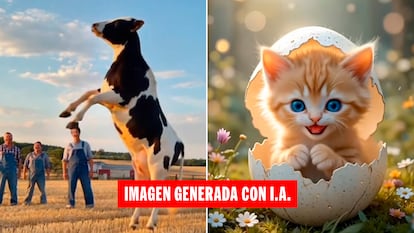
YouTube, TikTok, and Instagram are facing a flood of AI-generated content aimed at children. It’s easy and quick to create, and production is rampant. But it has the inherent flaws of AI-generated video: visual inconsistencies, narrative gaps, and a lack of realism. While it’s still too early for comprehensive studies, experts have already raised concerns about the impact of these videos on children’s cognitive development.
In an animated video intended to teach road safety, two children run through a busy street. Then, one of them transforms into a balloon and floats away. The YouTube account that posted it was created on April 5, 2025, and has already uploaded more than 4,000 videos. It currently has over a million views. Another video shows a wolf cub hatching from an egg, followed by a tiger cub, and then a baby goat. In between, there’s a chick, the only truly egg-laying animal in these 10 seconds, which have accumulated 445,000 views.
These videos are proliferating. The phenomenon is new because until recently it wasn’t possible to generate videos with AI so easily. The question is how this type of content might affect young children. The NGO FairPlay, focused on protecting children in the digital environment, has published a letter addressed to YouTube and Google urging them to curb AI-generated content on the YouTube Kids platform, designed to feature only videos suitable for children.
This is the starting point of a campaign that asks YouTube to remove poor quality, AI-generated children’s content, as well as modify the algorithm to prevent it from recommending this type of video to minors.
“It can be very confusing for them. When children are young, they try to absorb as much information as possible about the world, and every little moment they see or experience something helps them build their understanding of how things work,” says Rachel Franz, program director at Fairplay.
In one of these animated videos, a dog plays in a colorful setting. A ball glides unnaturally across the water, appearing in the dog’s mouth and then suddenly vanishes without explanation. There’s also a frisbee skimming across the grass, seemingly about to fall but never quite landing, bouncing in the air like a haunted ball.
“If children are regularly exposed to videos like this, where things suddenly disappear, their brains start trying to understand what happened to the ball and question whether balls can actually do that. This could affect their understanding of what a ball can do and how a dog plays with it. Their brains may focus on the anomalies in these videos and they may have difficulty processing information and learning from what they are shown,” Franz points out.
The account that posted this video uploaded more than 60 videos, ranging from two to 16 minutes each, in just a few days. A pace impossible for any traditional production company. These types of profiles on social media use AI as a tool to mass-produce and publish videos. The more, the better. The goal is to get views and, with them, increase the chances of monetization.
For Ana Rojo de la Vega, an early childhood education teacher, member of the Aragonese Association of Psychopedagogy, and author of the book Neuroeducation in the Classroom and at Home, these videos often suffer from excessive speed: “Everything moves so fast, like a flash. And life isn’t like that; sometimes you have to wait.” Added to this is the disconnect from reality that these types of videos sometimes present, such as the one showing a tiger and a goat that have just hatched.
“The one about the animals all hatching from an egg is shocking, because of course, children have a hard time understanding the different animals, their sounds, and if you confuse the content and show them all the animals hatching from an egg, the learning becomes more complicated,” Rojo de la Vega points out.
The educational psychologist refers to the confusion that can arise in children’s symbolic play, which is their ability to imitate the reality they perceive around them. This could be playing at cooking or imagining that a cardboard box is a car. “Sometimes they have trouble distinguishing between fiction and reality because, in their symbolic play, they give life to many objects, for example, plastic ones. If you’re going to confuse them even more with these kinds of videos, it will make learning much more difficult for them,” she states.
Confusion between reality and fiction
The video of animals in eggshells is a plotless clip designed to hook the viewer. It only lasts a few seconds, and then the next piece of content appears. Once the first one has been watched, the algorithm is more likely to recommend other content along the same lines. A study by the video editing platform Kapwing indicated that 20% of what the algorithm shows new YouTube users are low-quality, AI-generated videos. Among the most popular channels worldwide, the company identified 278 that contained only this type of video. Collectively, they had accumulated 63 billion views, 221 million subscribers, and are estimated to earn around $117 million annually.
Another finding from the Kapwing study is that channels originating from Spain had the most subscribers, with over 20 million. However, some of these channels are no longer available. In recent months, YouTube has suspended several accounts producing AI-generated content aimed at children.
Nicolás Matji, producer and co-founder of the Lightbox studio, is well aware of this surge. His production company has just finished the fourth installment of the Tadeo Jones adventure-comedy animation movies, which will premiere in August. The approach is very different. “As content creators, we have always been very aware that what we do has a significant impact, that we have a moral and ethical obligation, and therefore, we are conscious of the values we instill in what we do,” he emphasizes.
There are also AI-generated hyper-realistic videos that add to the confusion. Many of them show animals performing acrobatics or impossible movements. In this TikTok video, a cow is dancing on its hind legs. “Over time, children come to understand that animation is different. However, videos that look realistic can confuse them even more,” says Franz.
@sara.doll867 #fypviraltiktok🖤シ゚☆♡ #foryouu #challenges_tiktok #grow #dontunderreviewmyvideo #fyp #growmyaccount #fyyyyyyyyyyyyyyyyyyy #unfreezemyacount #viralvideos #aitools #houseoftiktok #foryoupage❤️❤️ #cows #beautiful #dancechallenge #dancer #ai #aivideo
♬ オリジナル楽曲 - アフネコ! - アフネコ!
This can have undesirable effects on a young audience, still in the midst of cognitive development. “It takes several years for children to distinguish fantasy from reality. Before the age of five, they are not capable of doing so. Their brains are programmed to treat everything as if it were real, and this also applies to video content,” explains Franz.
Unlike traditional audiovisual content aimed at young children, AI-generated videos are designed to capture a child’s attention without regard for the consequences. “Children learn through images, and I’m concerned about the garbage that overshadows all the worthwhile content out there,” Matji reflects. “When I make a Tadeo video, I can consider the values we instill in what we do and have control over it. And that’s something we’re very proud of. But if your goal is volume, anything goes, because you get paid for reaching a lot of views. So the result is that you generate trash.”
Here, Matji refers to the incentives that social media platforms offer content creators. The number of views is prioritized, and these are achieved through attention-grabbing tactics at all costs. The music in these videos — also generated with AI — accompanies the images to achieve the same goal. Franz also focuses on the economic aspect: “Often, the intention is to make money and, in a way, hijack children’s attention so they spend more time on the platform. That way, the creators, and ultimately YouTube, obtain more data and more money.”
One of the problems is that AI-generated content isn’t clearly identified. It also can’t be filtered; there’s no option to do so on YouTube or any other social media platform. Rojo de la Vega’s general recommendation is to avoid screens as much as possible. “And if you’re going to let your child use a screen for a little while, it’s best to be with them and make sure you know what they’re watching. Otherwise, they might watch one video after another and you won’t even know what they’re looking at,” the educational psychologist concludes.
Sign up for our weekly newsletter to get more English-language news coverage from EL PAÍS USA Edition









































