
Human development in Gaza has regressed 77 years due to the war, according to an international report
The EU, the UN, and the World Bank estimate the cost of recovery and reconstruction in the Gaza Strip at $71.4 billion. The EU insists that a two-state solution is the only path to a stable and lasting peace

Rebuilding Gaza will require a collective effort and substantial financial resources: according to official estimates from the EU, the UN, and the World Bank, the cost of the Strip’s recovery from the devastation wrought by the Israeli military offensive in response to the Hamas-led attacks of October 2023 amounts to $71.4 billion over the next decade. Even more challenging will be restoring human capabilities and dignity: the damage assessment estimates that human development has regressed 77 years due to the setbacks caused by the conflict in terms of living conditions, livelihoods and income, food security, gender equality, and social inclusion.
The final report, Gaza Strip Rapid Damage and Needs Assessment (RDNA), prepared by the three multilateral institutions and analyzing the damage, economic losses, and recovery and reconstruction needs in Gaza after more than 24 months of conflict, does not mince words: “The escalation of conflict over the last two years has engendered the collapse of the systems that sustain people’s daily survival and dignity,” the 63-page report emphasizes.
It is a multi-sectoral collapse — lack of housing, food security, health, education, or income — happening “simultaneously,” so the problems “reinforce each other, driving hunger, disease, learning loss, loss of income, gender-based violence (GBV), and social fragmentation.”
“The report highlights catastrophic impact on human development across Gaza, which is estimated to have been set back by 77 years,” the EU stated in a press release. It noted that around 1.9 million people have been displaced, “often multiple times,” and more than 60% of the population has lost their homes. Over 50% of hospitals are now inoperable, almost all schools are destroyed or damaged, and the economy has contracted by 84%. The greatest burden is borne by “women, children, people with disabilities, and those with pre-existing vulnerabilities.”
Achieving a physical recovery of the devastated Strip will also be far from easy: the report estimates recovery and reconstruction will require at least $71.4 billion. Of that, a third, $26.3 billion, will be needed in the first 18 months to “restore essential services, rebuild critical infrastructure, and support economic recovery.” Physical damage to infrastructure is estimated at $35.2 billion, while economic and social losses amount to an additional $22.7 billion.
Promises
The stark report comes amid renewed efforts to curb the actions of Benjamin Netanyahu’s government in Gaza, as well as in the West Bank and southern Lebanon, using the EU-Israel Association Agreement — which EU foreign ministers will discuss this Tuesday in Luxembourg — as leverage. It also coincides with a renewed push by Brussels to promote the two-state solution, which the EU advocates as the only viable option for the region.
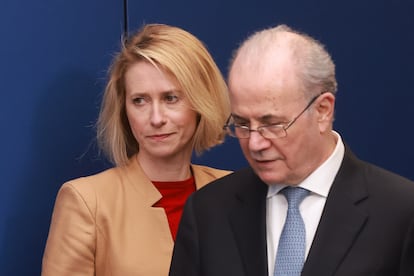
“After years of war, we must be honest and admit that the two-state solution has not made much progress, even though it remains the most viable path to a war-free Middle East,” acknowledged EU High Representative for Foreign Affairs Kaja Kallas, in a joint appearance with Palestinian Prime Minister Mohammad Mustafa and Norwegian Foreign Minister Espen Barth Eide. On Monday, Kallas and Eide co-chaired a meeting of the ad hoc committee that coordinates the delivery of international aid to the Palestinian population and the Palestinian Authority. Earlier, a new meeting of the Global Partnership for the Implementation of the Two-State Solution had been held, where the EU’s top diplomat made it clear that both sides, Israel and the Palestinian Authority, must “fulfill” their commitments to make progress.
“For the two-state solution to have a chance, both sides must deliver on their promises: Israel must halt settlement expansion, settler crimes must be punished, and Israel must release the withheld tax revenue that belongs to the Palestinians,” Kallas summarized. But at the same time, the Palestinian Authority “must make progress on reforms in Gaza,” she added, while also noting that Hamas’s refusal to disarm “remains a major obstacle to peace.”
“We can and must do more to guarantee respect for human rights and accountability, in order to protect the Palestinian people and firmly put the two-state solution back on the table,” the Estonian stressed. Because this solution, she emphasized, “is the only way both Palestinians and Israelis can live in security.”
Very productive meeting with @PalestinePMO discussing the full implementation of #UNSC Resolution 2803. We are both committed to the coordination needed to ensure that as decommissioning and handover to @NCAG happens in Gaza, #Palestinians can benefit from full reconstruction,… pic.twitter.com/ukQ656LOsT
— Nickolay E. MLADENOV (@nmladenov) April 20, 2026
“War will not bring peace, a blockade will not bring security, occupation will not bring stability, forced displacement will not bring legitimacy, and annexation will never allow for coexistence. Only a just and political solution will work,” confirmed Mustafa, who met for the first time in Brussels with a high-ranking representative of Donald Trump’s Board of Peace, Nickolay Mladenov.
Sign up for our weekly newsletter to get more English-language news coverage from EL PAÍS USA Edition









































