
When Europe can no longer look the other way: The slow hardening of the EU’s position towards Israel
Spain, France and Belgium are calling for greater forcefulness after the review of the framework governing bilateral relations was approved
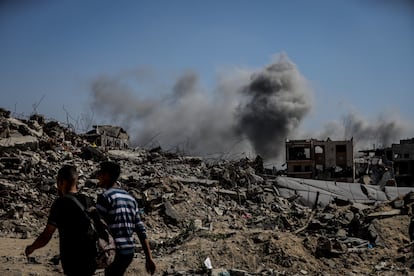

Europe is preparing to review the association agreement governing relations between Israel and the EU to assess whether Benjamin Netanyahu’s government meets the human rights standards required by this bilateral framework. The process, announced by High Representative for Foreign Affairs Kaja Kallas, is not likely to be delayed. Given the brutality of the events in Gaza, compounded on Wednesday by Israeli forces firing on a delegation of diplomats in the West Bank, several countries (including France, Spain, Belgium and the United Kingdom) are calling for further measures. Germany is not among them, as Berlin favors maintaining the association agreement with Israel as it stands.
Beyond the daily images of devastation and humanitarian catastrophe in the Gaza Strip, especially since Israel broke the ceasefire in March and blocked the entry of international aid, much of the analysis has already been done: shortly before leaving office, Kallas’ predecessor, Josep Borrell, presented the EU member states with an exhaustive report documenting how Israel had not responded “sufficiently” to European concerns about “possible violations” of international humanitarian law in Gaza.
It was November 2024, and very few in the EU, except for Spain, Ireland and Borrell himself, seemed to consider — or dared to say so out loud — that Israel’s actions in the Strip in response to the horrific Hamas terrorist attack of October 7, 2023 (the severity of which no European country has ever questioned) warranted a review of the agreement that has governed relations between Israel and the European Union since 2000. And it constitutes one of the few levers of pressure Brussels has on Netanyahu’s government, as the EU is Israel’s largest trading partner, supplying 32% of Israel’s total goods in 2024, according to data from the European Commission.
At that time, countries were even less willing to support a step as forceful as the one Borrell proposed: suspending political dialogue with Israel. The initiative was immediately rejected by countries such as Austria and Germany, allergic due to their past association with Nazism to any criticism of Israel that could earn them accusations of antisemitism. But many other states also expressed their fear of forcing a vote that would reveal the deep division this conflict provokes among the Twenty-Seven, which so far have only offered rather timid unified responses, despite the fact that Borrell’s report already warned in November that there was a “risk of a deepening humanitarian catastrophe in Gaza.”
Six months later, and with that prophecy more than fulfilled, those qualms seem to be fading. Not only has Kallas — whom the Netanyahu government hoped would take a different path than the uncomfortable Borrell — opened up to analyzing whether Israel complies with human rights. She is doing so at the urging of a “huge majority” of member states — 17 out of 27 — including solid allies of Israel such as Austria and Poland. The numbers are in sharp contrast, although it is already too late for many Palestinians.
Unanimous condemnation
“When Spain and Ireland requested a review of the Association Agreement [in a letter to European Commission President Ursula von der Leyen in February 2024, which the German politician ignored], there were 28,000 dead. Now there are more than 50,000. It took this increase for some to say they can no longer close their eyes,” Borrell laments. However, he notes in a telephone conversation, it will be difficult for Brussels not to provide a response it has eluded for more than a year despite the compelling internal reports — signed by the then EU Special Representative for Human Rights, Olof Skoog, now Deputy Secretary General of the External Action Service headed by Kallas — that were presented months ago. These are now joined by the growing number of international complaints — even from countries that remain reluctant to act against Israel — for “intolerable” actions that are receiving unanimous condemnation, even from friendly countries.
“The Austrian government is fully committed to Israel’s security […] But the [Palestinian] civilian population does not have to pay the price for Hamas’s terror: international law must be respected under all circumstances,” Austrian Chancellor Christian Stocker told Netanyahu, after his Foreign Minister, Beate Meinl-Reisinger, surprised the Israeli prime minister by joining the Netherlands — another of Israel’s former almost unconditional supporters — in Brussels to call for a review of the association agreement, using arguments similar to those employed by the Spanish government 15 months earlier.
Held my first phone call with Israeli Prime Minister @netanyahu. The Strategic Partnership between Austria and Israel has developed well in the last years. The Austrian government is fully committed to Israel's security and to the fight against all forms of antisemitism.
— Christian Stocker (@_CStocker) May 20, 2025
Hamas’… pic.twitter.com/PEjh9NOxtY
“I can assure you that all states have expressed serious concerns about the humanitarian crisis in Gaza,” Polish Minister for European Affairs Adam Szlapka told the European Parliament on Wednesday. Poland holds the rotating presidency of the EU Council this semester and is another major country that has made a U-turn on the issue.
But despite the new challenge to Israel, which sparked renewed international protests after Israeli soldiers fired on a diplomatic convoy in the West Bank on Wednesday — “If they treat our diplomats like this, imagine how they treat the Palestinians,” commented Irish MEP Barry Andrews — not everyone concurs. Key countries, such as Italy and Germany, are missing.
Despite also making it clear that it is concerned about the humanitarian situation, Berlin continues to avoid questioning the EU’s relationship with Israel, arguing that channels of communication must be maintained to address potential disagreements over the war in Gaza. “We are convinced that these issues must be addressed in dialogue with the Israeli government,” explains a Foreign Affairs spokesperson. “The association agreement is, therefore, an important forum for discussing critical issues,” reports Marc Bassets from Berlin.
German Chancellor Friedrich Merz was not among the signatories of the letter in which French President Emmanuel Macron and British and Canadian Prime Ministers Keir Starmer and Mark Carney threatened sanctions against Israel if it did not halt its new military offensive and lift restrictions on humanitarian aid. London has already taken the first step, announcing its decision to suspend current negotiations regarding a future trade agreement with Israel.
Unlike the United Kingdom, France, a historic ally of Israel and with strong ties to the Jewish community — although it has also supported revising the agreement — did not specify what these measures would entail. But they could include sanctions targeting individuals or entities responsible for violations of international humanitarian law. Furthermore, Macron plans to officially recognize the State of Palestine in June, during an international conference in New York co-chaired with Saudi Arabia. At this conference, Belgium is also expected to take the step that Spain, Ireland, Slovenia, and Norway took a year ago, Daniel Verdú reports from Paris.
Despite growing international pressure, it remains unclear when Brussels’ verdict on Israel will be issued or what its consequences will be. Any action proposed following the review will require the approval of the Commission and the member states if it is a political decision (which requires unanimity, which is still a long way off).
Meanwhile, the number of those calling for more forceful action is growing. In Brussels, Spanish Foreign Minister José Manuel Albares called on the EU to “go beyond words and take action, which could include the suspension of the agreement or sanctions,” which he did not specify. Belgium also called for the expansion of European sanctions against violent settlers, Hamas officials, and political and military leaders from both sides in response to the abuses committed, according to national media. Attempts to extend sanctions to extremist settlers in the West Bank or even to some Israeli ministers, as also proposed by Sweden, have so far failed due to the fierce opposition of at least one member state, Hungary, according to diplomatic sources.
Despite this, Brussels is increasingly indignant at Israel’s actions. In a heated debate in the European Parliament, several political groups, especially on the left, called for immediate action. “Enough with the euphemisms. The review is not enough. Let’s suspend the association agreement. Let’s impose a total arms embargo on Israel. Let’s ban trade with illegal settlements. And let’s establish individual sanctions against senior officials in the Netanyahu government,” summarized the leader of the Progressive Alliance of Socialists and Democrats, Iratxe García.
Sign up for our weekly newsletter to get more English-language news coverage from EL PAÍS USA Edition









































