
Valeria Luiselli, writer: ‘Not to succumb to the temptation of catastrophe is also a political stance’
The Mexican author reflects on memory and imagination in ‘Beginning Middle End,’ a novel that explores alternative narrative forms — from the visual to the auditory — through the story of several generations of women and their encounter with Greco-Roman classics and the volcanic landscape of Sicily
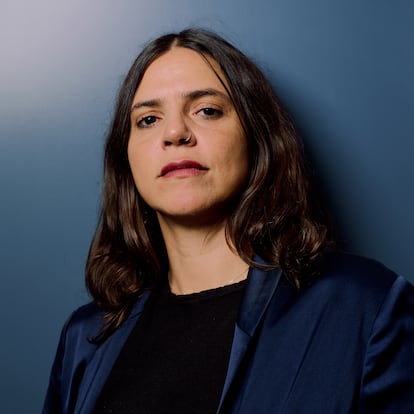

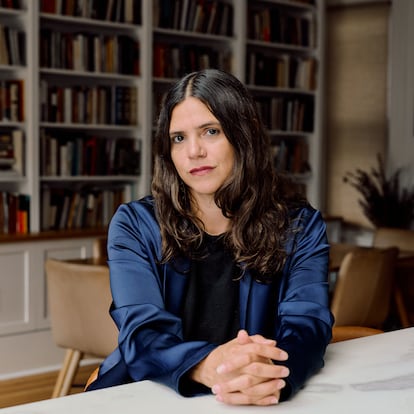
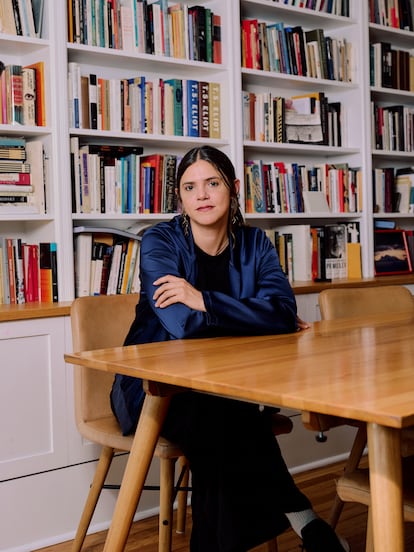
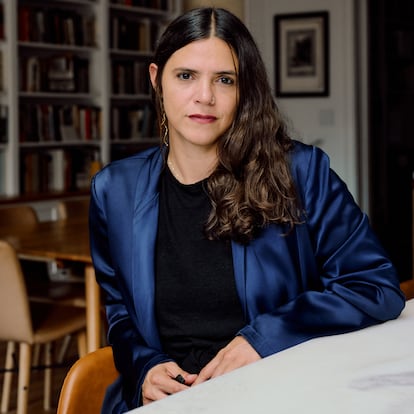
Today is the first day Valeria Luiselli has spoken about Beginning Middle End, so the Mexican writer, sitting a couple of Fridays ago in the bright living room of her Bronx home with its suburban feel, apologizes for not yet knowing “what her new novel is about.” “I’ll come to understand it as I talk to other people,” she says. “But I already know it’s a novel about a mother, a daughter, and a grandmother, whose relationships are explored in depth. I know that in it I question imagination and memory — the memory that is lost and the memory that is forming.”
That mother, who is a writer and has just separated, takes her daughter to Sicily, where the Greek and Latin classics join them as fascinating travel companions, while the grandmother, who lives in Baja California, is gradually losing her memories. Like Luiselli (Mexico, 42), journalists often ask her protagonist how much of her life is in her book. And like Luiselli, she writes without knowing whether what she is writing will be a novel or an essay on autofiction, archaeology, volcanology, or life as “the middle part,” without beginnings or endings.
The book marks the author’s return seven years after Lost Children Archive, in which she gave voice to children lost at the Mexican border against the backdrop of a couple’s separation. It is also her first book with a new publisher — the Italian house Feltrinelli, which is making its Spanish-language debut with her — after more than a decade with the Mexican imprint Sexto Piso. The novel goes on sale on May 6 and will be published in the United States in July, where Luiselli — who has lived in New York for two decades — is one of the most respected authors of her generation, thanks to a reflective prose that is not afraid of experimentation.
This time, she delves into narrative forms she already touched upon in her previous book, such as the Polaroids that await at the end to offer a new perspective on the story previously told, consecutively, by mother and daughter. The collection is rounded out by an audiobook, which readers can access via a QR code. On the other side, the sounds of tides, Mediterranean winds, rain, and fishermen’s songs recorded by her and her partner, sound engineer Charles de Montebello — as well as by Ricardo Giraldo during his own trip to Sicily — resonate.
Question. What is the principle behind Beginning Middle End?
Answer. I began writing the novel at a time when many things were shifting for me — three of them, in particular, were fundamental to my practice as a writer. The first is the arrival of sound in my life, and of recording and listening as essential parts of my process of paying attention to things. I began with that in Lost Children Archive, though in a more theoretical than practical way. Second: my family life was restructured in a very beautiful and unimaginable way, because this house filled up with women from my family across all generations. Suddenly there were eight of us: my mother, my nieces, friends who were getting divorced and spending time here before moving on, my daughter, our dog Lola… Then my other daughter was born, and we found ourselves compelled to reimagine life with this new family structure. Many conversations about our history began. And the ghosts of the past started to circulate. Above all, my grandmother, whose stories I began to understand a little better thanks to the presence of my nieces, who asked my mother questions.
Q. Does that experience make you rule out getting back into a relationship?
A. Not at all. I plan to move in with my partner one of these days, but we’re taking it slow.
Q. What was the third transformation?
A. A very deep need to completely redefine my daily relationship with writing. During my thirties, it gradually changed and deteriorated; it became a very draining, very destructive relationship. It was a very torturous and unsustainable way of continuing to do something that is one of the few things I do with absolute passion.
There comes a point when life has dealt you enough blows — or you’ve gained enough maturity, or both — to make you rethink important questions
Q. You used to write in the early morning…
A. Yes. Now I wake up before sunrise. I think it also has to do with age. There comes a point when life has dealt you enough blows — or you’ve gained enough maturity, or both — to make you rethink important questions, like your relationship with the things you’re passionate about. The key is the discipline of waking up early and writing for a while every day, before the chaos of the house begins. Then I continue at the office.
Q. The protagonist of your novel looks up the love stories of great female writers on Wikipedia and discovers that many of them go through a string of long relationships and end up with the third one.
A. I think that as you get older, you value relationships differently. Maturity brings less urgency. Perhaps also the ability to make more room for love because the anxiety that you’re missing out on something disappears. Love is a strange and miraculous thing.
Q. Why the Greeks?
A. I studied philosophy, and that’s what I was most passionate about — especially the pre-Socratics. I ended up, out of habit, going in a direction I didn’t really want to: analytical philosophy and contemporary political philosophy. So the classics are something I owe myself. I always wanted to learn Ancient Greek. I tried again a few years ago, but all my classmates were Harvard medical students, and they were moving too fast. I was like the old lady in the room. This semester I took the plunge and started teaching a class on the pre-Socratics, and I’ve never been happier.
Q. And what does it cover?
A. We read about volcanoes, seas, rivers, winds, the Moon… The course explores how Hesiod, Heraclitus, Thales of Miletus, Anaximenes, Anaximander, and my favorite, Empedocles, conceptualized the origin of the world. Empedocles’ ideas are the ones that have stood the test of time the best. Specifically, the theory of the four elements — water, earth, wind, fire — where there is a force that unites them, love, and another that separates them, discord. Based on that seemingly very simple theory, he wrote a feverish and fascinating poem in which he describes the formation of the world as a giant vortex, where the first humans emerge. They were incomplete: there were arms searching for torsos, heads searching for eyes. I like that idea of our origin in a state of incompleteness and dismemberment. By the way, Empedocles supposedly died by throwing himself into the crater of Mount Etna.
Q. Your books are always interwoven with other books. Do you need to rely on reading to write?
A. I think I write not about what I know, but about what I don’t know — things that intrigue me and that I want to try to understand more deeply. One thing I appreciate about writing is that there are always thresholds left uncrossed. When I finish a novel, there are things I began to consider but didn’t explore as deeply as I would have liked. Beginning Middle End sparked a deep love for geology, archaeology, and volcanology. That’s where I am now: immersed in volcanoes.
Q. Whoever wrote the text on the back cover describes the book as your “new work.” Isn’t it a novel?
A. Yes, of course it is. Which doesn’t mean I’m any less of an essayist than I am a novelist. For many years, I didn’t know either whether this was going to be a novel or an essay on how to observe the world at this critical moment we’re in, when we have a sense of time so different from what it was not so long ago. I feel we’re at the end of a road, beginning a profound civilizational shift that makes us feel on the brink of the abyss and catastrophe, or also with the possibility of starting over and imagining new forms. That is part of the heart that beats in the novel. And it is also the reason why the ancients are present in it; they were the first people to document the natural world and wonder about it. We resemble them, because we, too, face a world that is unrecorded, unexplained. Pliny the Younger was the first to document a volcanic eruption in writing, that of Vesuvius. Nowhere in that story does he use the word “volcano.” They didn’t see them [as volcanoes] yet; they saw a mountain that suddenly began behaving in a very strange way. We, too, are facing a reality we don’t understand.
Q. What would the volcanoes be today?
A. I asked my students that very question the other day. One replied that it’s the glaciers, which are disappearing and we don’t really know what’s happening. It could be deep-sea exploration and the extremely dangerous greed of mining the ocean. But also, though it’s not my favorite topic, artificial intelligence. That is the true paradigm shift.
Q. Why don’t you like it? Are you afraid it will put an end to your work as a writer?
A. Well, it’s just that I belong to another century. People in the past felt a loving curiosity about the natural world. What I feel, rather, is bewilderment and panic about the artificial world. But I’m not afraid for literary writing. Those of us who dedicate ourselves to this — both writing and reading — value the creative process and not just the result. And above all, we value the human soul. I’m not interested in what a robot has to say. I don’t think the most basic part of the creative craft is at risk, but so many parts of our delicate ecosystem certainly are: translators, proofreaders, editors…
I think I write not about what I know, but about what I don’t know — things that intrigue me and that I want to try to understand more deeply
Q. Have you ever used AI to see if it might be useful to you?
A. Never. At some point, I decided I had to be like an old-fashioned fundamentalist. Now I belong to a small but growing group of nerds, currently known simply as the Anti-AI Group. We get together to come up with solutions to the problems we’re facing.
Q. You should know that you can no longer use a long dash without arousing suspicion that you’ve used AI.
A. That doesn’t surprise me: the definition of psychosis is not being able to distinguish between what is real and what is not. And it’s terrifying to think that we’re all in that state when we look at a screen. Luckily, you can step away from them and look out the window instead, or distract yourself with a cloud.
Q. Is the distinction between fiction and non-fiction one of those that, like left and right, no longer works?
A. [Laughs] I’m not particularly interested in that distinction between fiction and non-fiction as such. The point is that fiction tends to be understood as untruth. And that isn’t true either. Fiction arrives at the truth by other means.
Q. As journalists, we’re always curious about how much of a writer’s real life is reflected in their books. Do you think readers feel the same way?
A. I think we all share that curiosity. But does knowing what is and isn’t true shed any light on a work? I don’t think so.
Q. An essential ingredient of your book is the protagonist’s reflections on autofiction. Let’s say that this time you’ve put yourself in that position…
A. Deep down, everything fiction deals with is true; its subject matter is the same as that of life. So, in the end, you’re always dealing with reality.
Q. In your last interview with EL PAÍS, when asked about the parallels between Lost Children Archive and your personal life after separating from the writer Álvaro Enrigue, you said that you always write about divorces. What makes them so interesting?
A. It’s much harder to write love stories; that’s well known. When I’m older, more mature, and have more tools at my disposal, I swear I’ll write a great love story.
Q. You wrote your previous book in English and had it translated. Why not this one?
A. I wrote this one in both languages. I’ve always felt — and will continue to feel — somewhat like a foreigner in both. It’s often frustrating. But I also believe that this sense of being a foreigner is the very driving force behind my writing.
Q. You had a nomadic childhood because of your father’s career as a diplomat. Does that also make you feel like a foreigner beyond the language?
A. I don’t feel like a foreigner in New York. I do in the United States. And my soul, my deepest roots, are in Mexico.
Q. What did you learn about your Mexican identity or your identity in general when you moved here?
A. Before going through this country’s brutal identity machinery, I considered myself not Latina, but Latin American. But now, after 20 years and with a daughter born in the United States, who is half African and half Mexican, I have also become Latina. I remember that shortly after arriving to study for my doctorate, at a conference, they spoke of García Márquez as “minority literature.” And I thought: What the hell are they talking about? Since when are we a minority? The ignorance and insularity of this country are enormous. They forget that south of the Rio Grande there are 500 million people who speak Spanish. We are the majority on this continent, not the minority.
Q. When you started publishing here… did you feel that people expected something from you that was closer to that stereotype of “minority literature” than what you actually had to offer?
A. Well, they had read a few authors from the [Latin American] Boom [of the 1960s and 1970s] and skipped an entire generation. And then suddenly [Roberto] Bolaño arrived, as if nothing had happened in between. After Bolaño’s success, there was an explosion of translations, and a greater variety of independent publishers emerged in Latin American countries. Now the landscape is much richer. When I moved to the United States and my agent circulated Faces in the Crowd, some responses were that the book wasn’t Mexican enough. Others said it was too cerebral — a criticism, incidentally, that I’ve always received, but that they never direct at a man.
Those of us who dedicate ourselves to this — both writing and reading — value the creative process and not just the result. I’m not interested in what a robot has to say
Q. That generation you mentioned — the one that says they broke free — tried to shake off the legacy of the Boom. What have you had to shake off?
A. The antiquated patriarchal structures, of course, but more so in Latin America than here, where the challenge has been more about identity than gender.
Q. Should we fear setbacks like the ones we’re seeing in the United States since Donald Trump’s return to power?
A. We mustn’t let our guard down, because a few will always try to control thought and seize control of the discourse.
Q. Speaking of Trump and your crusade to learn to listen: how do you manage not to get carried away by the distraction of the news?
A. By thinking about volcanoes. By recording underwater soundscapes. Reading Pliny the Elder. Drawing with my four-year-old. Remembering that we cannot afford the luxury of despair and hopelessness. It is also a political stance not to succumb to the temptation of catastrophe.
Q. Do you feel more optimistic now than, say, six months ago, when the Trump administration seemed even more unstoppable?
A. To some extent, but sometimes it’s hard to tell if we’re less terrified or simply more accustomed to it — which is the great danger of living under authoritarianism; you end up having to normalize things, because you can’t live in a state of emergency every single day. It’s exhausting. That doesn’t mean we shouldn’t throw ourselves into the task of continuing to create spaces of beauty by making films and writing novels. It’s not escapism, but a response to the emptiness and horror we feel. I believe the human spirit prevails through stubbornness, through the foolish desire for life to be a beautiful place.
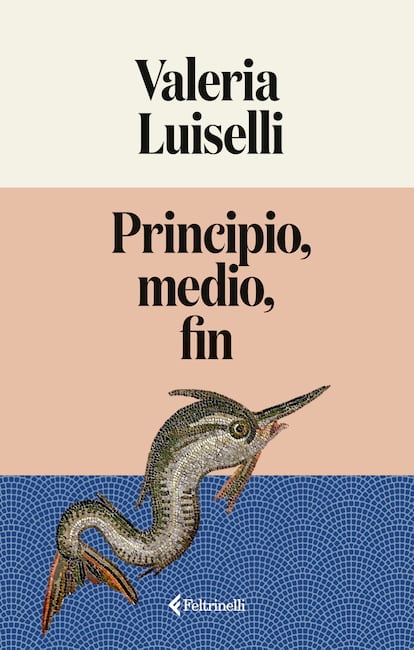
Principio, medio, fin
Feltrinelli, 2026
A la venta el 6 de mayo
360 páginas, 21,90 euros
Sign up for our weekly newsletter to get more English-language news coverage from EL PAÍS USA Edition









































