
Concha Cardeñoso, ‘Hamnet’ translator: ‘It took me many years to find out what it’s like to make money from a bestseller’
The woman behind the Spanish-language adaptations of Maggie O’Farrell is currently working on the Irish author’s next book
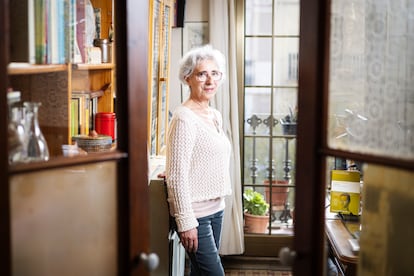

It’s been more than five years since Concha Cardeñoso Sáenz de Miera, 69, first read the original version of Hamnet by Irish author Maggie O’Farrell. At the time, she wasn’t able to say if it would be a hit or not. Nor was she able to stop the tears that streamed down her face when she got to the ending of the historical fiction based on the life of Agnes Hathaway, William Shakespeare’s wife, which Cardeñoso found “so well-rounded and balanced.” She understands the unpredictability of the literary market. Cardeñoso, a native of Spain, is a translator, primarily of English texts into Spanish, and she has racked up some 300 books over a 30-year career. She has handled remarkable, moving works with prior acclaim in the English-speaking world. She has also seen how many them subsequently went unnoticed. But we already know this was not the case with Hamnet; it has become her biggest seller, with 225,000 copies sold in Spain and Latin America, according to numbers provided by its publisher, Libros del Asteroide. Her second-biggest hit might be El retrato de la casada, the Spanish translation of The Marriage Portrait, from the same author and publishing house, which saw some 100,000 sales.
Cardeñoso’s name accompanies that of O’Farrell, in relatively large letters, on the cover of the latter’s seven titles that have been published over the last decade by Libros del Asteroide. But neither the translator’s face nor biography appear on the dust jackets. The hundreds of thousands of people who have read the Irish writer in Spanish are actually reading Cardeñoso, but the majority don’t know a thing about this woman. Nor are they aware of her many colleagues, who have translated so many other books. It is for this reason that she accepts the request for this interview, which takes place by video call. She hopes that the more people who know about their trade — she repeatedly insists on calling it a trade — the more it will be valued, and the better it will be paid. Especially now, in these “turbulent times” brought on by artificial intelligence.
‘Land’, O’Farrell’s next novel
Cardeñoso is pleased with her work on O’Farrell’s literature, though she also finds it challenging. The writer’s prose is restrained, but in a constant dance with verb tenses; she possesses an “exquisite vocabulary” and makes very precise historical references that occasionally require her translator to do research.
In fact in mid-March, when Cardeñoso speaks with EL PAÍS, she has been consulting topographic maps of Ireland. She needs them to verify a few references that appear in Land, O’Farrell’s next book. It will be published in English this June; in Spain, Libros del Asteroide estimates that it will be released in early 2027. Cardeñoso has translated about 100 pages out of its total of 400. She has about four months to finish. She reads as she goes, without getting ahead of herself, which she finds more motivating. The story is set in the years following the Great Potato Famine of the 19th century, and is partially inspired by the author’s ancestors. “It’s infuriating if you have even a modicum of a sense of justice,” is one of the few details she reveals about the plot. That, and the fact that she’s struggling, has yet to decide how to resolve, the term “distemper”, which in one scene is used for a play on words between “discomfort” and “bad mood”.
Chloé Zhao’s film adaptation of Hamnet, which premiered this winter, didn’t impress Cardeñoso as much as the rest of O’Farrell’s literary universe. She didn’t agree with the prominence it gave to Shakespeare. And there’s something else she didn’t care for, in both the film and the novel: the title, which takes its name from Agnes and William’s son. She mentioned this to O’Farrell on one of the two occasions they’ve met in Barcelona.
“Shouldn’t it have been titled Agnes, instead of Hamnet?,” she asked. Cardeñoso recalls that O’Farrell responded that it wouldn’t have had as much reach. “It’s a marketing component,” says Cardeñoso, understandingly.
Cardeñoso studied teaching in León, lived in England in the 1970s and ‘80s, and for the last 40 years has been a resident of Barcelona. In the ‘90s, when her two daughters were little, she quit her degree program in English and Germanic Studies with four courses left until graduation, to begin working as a freelance translator. Her first project was a Choose Your Own Adventure-type book, and then a few children’s stories. Now, six bookshelves in Cardeñoso’s crowded office are full of “her” titles. At one point in the conversation, she holds up some of her favorites to the camera. She recommends Robert Macfarlane’s Bajotierra (originally titled Underland; Random House, 2020); Miles Franklin’s Mi impresionante carerra (My Brilliant Career, on which Cardeñoso worked with Amado Diéguez), D.E. Stevenson’s El libro de la señorita Buncle (Miss Buncle’s Book) and Daphne du Maurier’s Mi prima Rachel (My Cousin Rachel, for which Cardeñoso received the Esther Benítez prize; the latter three titles were published by Alba Editorial). And though her speciality has been translating English works, one of her library’s bookshelves is dedicated to her translations from Catalan. Among them is one that competes for her career’s silver medal, in terms of sales: Irene Solà’s Canto yo y la montaña baila (Anagrama, 2019).
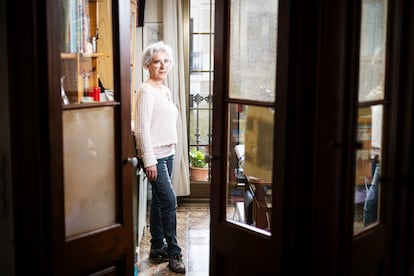
Hers is a female-dominated profession, with women making up around 80% of university students who study translation. It is also, according to Cardeñoso, “ancient, indispensable and overlooked”. Ancient, “because it has existed since peoples first began interacting with one another.” Regarding its indispensability, she quotes the theorist George Steiner, “who said that, ‘Without translation, we would be living in provinces bordering on silence.” Which is to say, “every culture in its own bubble, with us never having known The Thousand and One Nights, nor they having heard about Cervantes.” She feels the profession is overlooked, among other reasons, “because people only remember us when the translation is bad. The Italians have a saying: traduttore, traitore [translator, traitor].”
In Spain, translators have gone from not even being mentioned in credits — this was the case until the country’s 1987 intellectual property law — to being paid as authors of “derivative works”; and to the relatively recent practice of featuring them on book covers, as Libros del Asteroide, Alfaguara and Anagrama do. But many do not feel that they are benefiting from the Spanish book industry’s boom, which is apparently in progress: according to the annual survey by consulting firm Gfk, several revenue records have been broken since the pandemic. By 2025, earnings in the country are projected to reach nearly $1.44 billion, 4% more than in 2024. Rather, translators feel like they’re the last link in the chain. According to Cardeñoso, “You can barely tell. Many fees have been stuck at the same level for 20 years. For a book to earn us royalties, it has to sell a very large amount. You only find out if you’re lucky enough to have a bestseller. It took me many years to find out. Few of us have been able to make a living solely from literary translation; many colleagues turn to work that pays better, like legal texts. In my case, my husband has always had a job, and that has allowed me to get by.”
The main fear now is, like in so many other fields, the use of artificial intelligence (AI). To cite just one source, the 2025 Microsoft Research report ranked translation and interpretation among the professions most at risk of being affected, based on data from the United States. “There are publishers who are already relegating us to the role of AI editors. At the last Planeta Literary Prize, I don’t know how many works were submitted [1,320 according to the organization, the highest number in the competition’s history]. I’m telling you, it’s because many were submitted using ChatGPT. And this is only going to get worse. The problem is that people aren’t noticing it, and that AI is feeding off our work. All of that needs to be regulated,” laments Cardeñoso, who is in contact with many young people in precarious situations.
She isn’t going to be retiring, at least not yet. She loves her trade, but her main reason is that her retirement pension would be on the low side if she did. “What I want is to work a little less, so I can finally enjoy it all to the fullest,” she says. From the perspective gained through all these years, and with the realism that comes from recognizing the complexity of the age of AI, she quotes one of her colleagues to argue that a human translator brings “soul, life and heart” into a work of translation. Someone who racks their brain trying to convey exactly what a writer is looking for when she uses the word “distemper.”
Sign up for our weekly newsletter to get more English-language news coverage from EL PAÍS USA Edition









































