
Back to school in crisis-hit Cuba: families contend with shortage of uniforms, teachers and basic equipment
Many parents are choosing not to send their children to class amid the persistent blackouts, water cuts and other daily difficulties in the impoverished nation
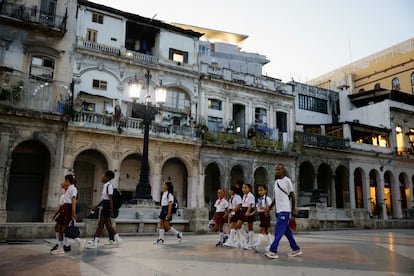

His Revolution had not yet reached its first year and Fidel Castro, wearing the same military uniform he would use for the rest of his life, spoke to the crowds on September 14, 1959: “Do you think the Revolution is already done?” he asked the children gathered that day, when he turned the Columbia Camp—the military headquarters of Fulgencio Batista’s government—into the Ciudad Libertad school. Education was one of the cornerstones of his social project: free, universal schooling to make Cuba “the first territory free of illiteracy in Latin America.” During that speech Castro asked the children again: “Do you want to be good revolutionaries? What is the first thing you have to do?… Ah yes, study. So the child who does not study is not a good revolutionary.”
The new Cuban government democratized education, reduced illiteracy to 3.9%, trained contingents of teachers, brought learning to the countryside, and Castro, as he did with the health sector, boasted that Cubans were, in his words, “the most cultured people in the world.” Certainly, the Revolution had guaranteed education—until the Revolution could no longer provide. The most recent school year on the island, more than half a century after that speech, began with too few teachers, little study material and mothers prepared to stop sending their children to class.
Paying to cut her child’s hair for the first day of school would cost La China 1,000 Cuban pesos (just over a dollar), says this woman who prefers to use only her nickname. “No economy can withstand it,” the mother says in a telephone conversation from Cuba. Electricity has been out at her home in the Regla municipality of Havana for more than 30 hours, and she does not want to wake her nine-year-old son to start the fourth grade already feeling tired. “How was I going to cool his soda and water? And to make matters worse, there was no bread again at the bakery,” she complains. “The hardest part of this school year is that children have to go hungry and cannot sleep at night.”
La China could list other calamities she must face: she hand-washes clothes (when there is water, that is) because she cannot run the washing machine; she has to obtain school uniforms at exorbitant prices (blouses and shirts between 1,000 and 2,000 pesos, skirts and shorts between 2,000 and 4,000); and she watches her son, who has attention-deficit hyperactivity disorder, become upset when he has no medication, cannot watch television or drink cold water. “Only a mother knows the weight on her soul when she sees her own child struggling to study amid so many blackouts, shortages and deprivations,” she says. “Behind every notebook and behind hours of sleep stolen by the heat and the power cuts, there is an exhausted mother.”
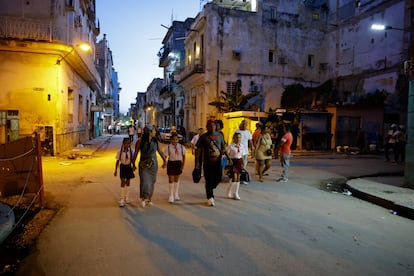
Even so, at the Camilo Cienfuegos primary school in Pinar del Río province, many students woke up this past Tuesday to a patriotic ceremony celebrating their return to the classrooms. Children recited verses and danced in front of parents and Communist Party officials while the principal welcomed them: “They said it couldn’t be done but your presence here today confirms that it can,” she told everyone. She was referring, without naming it directly, to Washington’s economic stranglehold on the island. In the same country that has suffered at least seven total collapses of the National Electric System this year, the government reverted to its usual rhetoric: the Communist Party described the return to school as “another act of heroism,” and President Miguel Díaz-Canel defended on X the fact that Cuban students began the school year “that the empire sought to prevent with its strangulation plan.”
The start of the school year on September 1 could not have been otherwise in a country burdened for years by a systemic crisis, compounded by the oil blockade and the multiple sanctions the Donald Trump administration imposed from the end of last January. People cannot go on. The results of a recent study by the Cuban Observatory for Human Rights (OCDH) show extreme poverty at 94% of the population; 68% of respondents reported monthly incomes under 20,000 Cuban pesos (about $30) and eight out of 10 Cubans said they have stopped having breakfast, lunch or dinner because of lack of money or food shortages. The figures come to life on the streets: people begging, parents asking for help for their children, many on the brink of despair.
The Cuban government even acknowledged days before classes resumed that schools would operate under “very difficult” conditions and “tremendous difficulties.” Education Minister Naima Trujillo said it has been a challenge to meet the uniform demand for almost 1.4 million Cuban students. “Without power, no workshop can function. Without fuel we cannot move the fabric from one place to another in the country. Without money and without import possibilities, we cannot get fabric either,” she said.
A teacher shortage has also been a problem the government has been dealing with for years due to professionals migrating to better-paid sectors, and the gap left by emigration in recent years. Trujillo reported a shortfall of 21,000 teachers, so that current teacher coverage reaches only 73%. In Havana about 3,000 teachers have had to be relocated from the eastern part of the country, and other official figures report nearly the same number of teachers missing in provinces such as Camagüey and Holguín. Low salaries (about $12 a month) and lack of transportation have led some to quit teaching.
Jessika’s son (she has asked to be identified only by her first name) will attend 12th grade this year at the Vladimir Ilich Lenin Vocational Preuniversity Institute of Exact Sciences, one of the Revolution’s flagship projects, a school to train elite students in Havana. Although, according to the mother, the center still guarantees quality teaching, keeping her son as a boarding student has been very difficult. This year the school will delay receiving students for a week because of lack of water. “Right now there is no water supply because the turbine is broken,” the mother says. She and other parents have also reported a shortage of 400 mattresses for sleeping. The school principal, for his part, has demanded that each student bring a rechargeable lamp. “So they can light themselves at night to study, because Lenin suffers the same 20- to 22-hour blackouts as the rest of the country,” the mother says.
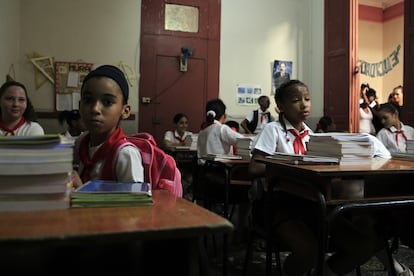
There are days when Jessika feels she cannot go on. She has had to start “selling whatever comes up,” meaning croquettes, empanadas, and making crafts. “Just today I bought the school sneakers for 15,600 pesos (more than $22) and I still need all the hygiene items he must bring, plus socks, underwear and food. Honestly, some days I want to die because I feel frustrated as a mother for not being able to give my son everything he needs, only the basics.”
Sociologist Elaine Acosta González, an associate researcher at the Cuban Institute of Research, told this newspaper that the consequences of the current crisis and the worsening living conditions in Cuba are “incalculable,” especially in recent months. “This is having severe effects on mental health, not only in children and adolescents but also in the caregivers, mainly women,” she says. “There is a very high daily stress cost, high levels of depression, students cannot meet academic demands, changes in family routine and the atmosphere of worry they perceive at home—these are a set of problems that only worsen the existing care crisis for which the Cuban state has not offered a sustainable, reasonable package of measures that can adequately respond to the seriousness and urgency of the situation.”
These days an entire black market has emerged to perform the role the state cannot currently fill: businesses selling all kinds of school supplies brought from abroad at prices unattainable for many; others offering to reprint the schools’ own textbooks, which schools often cannot provide; mothers choosing to send their children in regular clothes for lack of uniforms; and others accepting that their children will not attend class. The government can barely guarantee the well-being of Cubans anymore.
“It is another manifestation of the structural crisis into which the existing political, economic and social model is plunged,” Díaz says. “Faced with the withdrawal of the state, many of the services offered in the labor sphere have been commodified. Families have been transferring the provision of food, clothing and other necessities required to receive an adequate education. That promise of universalism as equity is increasingly affected under the structural crisis conditions facing Cuban society.”
Sign up for our weekly newsletter to get more English-language news coverage from EL PAÍS USA Edition









































