
A Cuban theater group’s defiance against censorship: ‘We will no longer submit’
Tired of oversight and institutional suffocation, the members of El Ciervo Encantado, a benchmark of Cuban performance, have broken away from the state apparatus and are continuing their work in independent venues
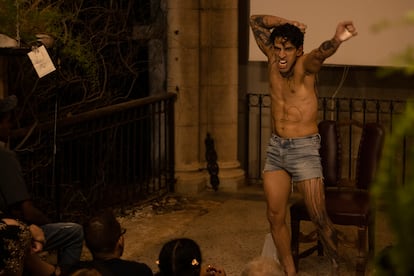
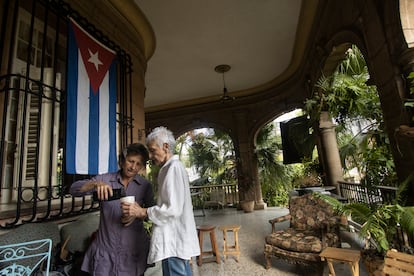
It is an average day in February 2026 in Havana. As the daily lives of Cuban families are reshaped, cast into uncertainty, by the oil embargo imposed by Donald Trump and the worsening economic crisis that had been burdening their lives for years, a woman climbs a ladder in a large house in Vedado. She carries a can of black paint and intends to paint over a wall. The scene might seem insignificant if the woman were not the actor and playwright Nelda Castillo (Matanzas, 1953), and if for more than a decade the wall had not read Grupo Teatral El Ciervo Encantado, one of the most untamed reference points of contemporary Cuban theater and performance art on the island.
Every brushstroke Castillo applies to cover the inscription of the theater group she founded 30 years ago is just another bitter gulp she must swallow, the result of her constant confrontations with the Ministry of Culture and the bureaucratic institutions that control, regulate, and monitor the development of the arts on the island. “We will no longer subject our work to the rules, regulations and evaluation and approval mechanisms practiced by these institutions toward our work,” reads the statement the group circulated on social media on February 3, which made clear the decision that “El Ciervo Encantado will no longer be based at the Línea and 18 headquarters in Vedado.” But they will keep making art and presenting it wherever they can.
That was the final fist on the table by a group of artists fed up with institutional oversight and the continuous control exercised over their works by “commissions” that demanded to see their premieres in advance and then refused to “approve” them. It is another chapter in a three-decade history that its members want to continue writing as a political gesture in a country where speaking and hearing truths is often grounds for persecution and repression.
El Ciervo Encantado is a metaphor for freedom. It has been since its original conception, based on the short story of the same name by Cuban writer Esteban Borrero, published in 1905, in which a group of aborigines pursue an enchanted stag at all costs and, to capture it, are willing to hand over their own land to a “great neighboring nation.” That story inspired Nelda Castillo and Mariela Brito, among others, to found El Ciervo Encantado as a creative laboratory, a project that has occupied three different venues amid pressure and attempts at institutional domestication. Through it all, they developed a project centered on performances, public interventions, installations, and artistic collaborations. Irrupciones (Outbursts) is a catalog published by the group that brings together 69 of these projects carried out between 1997 and 2022.
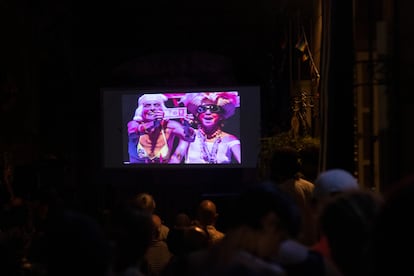
El Ciervo Encantado has become a leading figure in the world of performance art in Cuba, with a body of work that has sought to piece together the fragments of Cuban identity and national reality, bringing them into dialogue and prompting reflection among an audience that lacks access to this kind of art and experience. This was the case with works such as Triunfadela (2016), which confronts the viewer with the authorities’ triumphalist rhetoric; Guan Melón!! Tu Melón!! (2016), which plays with the idea of a country adrift and up for sale, coinciding with the thaw in relations between Cuba and the United States; and Departures (2017), which addresses the issue of Cuban migration since 1959. It has also served as an open space for voices marginalized from official circles, such as actor Alexander Diego — who was detained during the massive protests of July 11, 2021 — and who brought his experience as a victim of state repression to the stage in El corcel de mi esqueleto (The Steed of My Skeleton, 2023).
The art of El Ciervo is free, nomadic, critical, incisive and reflective, despite the shadows that have always stalked it. Since leaving the Vedado headquarters, they have performed in private homes; the Norwegian embassy served as the setting for Madres (Mothers), a performance in which, one by one, images of political prisoners, women who have been victims of femicide, and people who migrated appear before the audience: the forced absences of Cuban families.
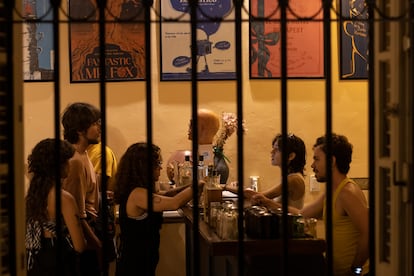
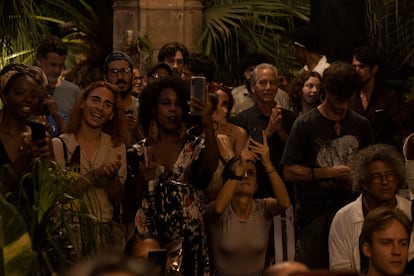
El Ciervo just celebrated its 30th anniversary at El Proyecto, a bohemian, luminous space — in a darkened Havana, in spirit as well as literally — that has earned the attendance of a citizenry bereft of cultural spaces and safe zones for political dialogue and expression. There El Ciervo Encantado once again played its tricks, once again gathered an audience hungry to be engaged by creation. Before those present, a man in the throes of ecstasy asserts a truth that seems unspeakable in a rational state of consciousness: “El ciervo no está herido. El ciervo galopa, galopa… (The deer isn’t hurt. The deer is galloping, galloping).”
Sign up for our weekly newsletter to get more English-language news coverage from EL PAÍS USA Edition









































