
The future of many Cubans in the US depends on a long legal saga
Between 2019 and 2023, 500,000 migrants fleeing the island were released with a I-220A document, which does not provide a path to legal status and now puts them at risk of deportation. Lawyers argue they should have received parole papers instead
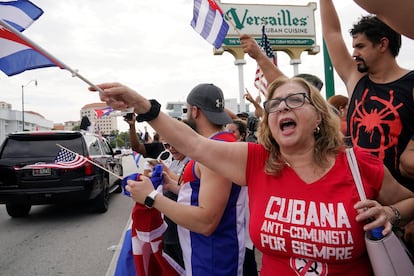

Some say they were simply unlucky, that before this, all you had to do was show the border guards a Cuban passport, and you got to stay. They know many people who arrived in Miami by raft, or came for a visit and stayed, and they are now residents, even citizens. The worst part, they say, is that other Cubans entered the United States just like them, crossing the border on the same date, and have been able to adjust their immigration status, while they themselves haven’t.
An estimated half a million Cuban immigrants who arrived in the United States between 2019 and 2023 now find themselves in an unprecedented legal limbo, according to experts. This is due both to the sheer size of this group and to the existence of the Cuban Adjustment Act, which historically offered Cubans a path to residency after one year in the country. The obstacle has been the document they received upon being released by immigration authorities, known as an I-220A—an Order of Release on Recognizance—while others received parole, which has allowed them to adjust their status.
This difference, which lawyers say was essentially arbitrary and whose logic has never been clarified by the authorities, left families divided between those who are now residents and those who remain in limbo. And today it is the focus of several lawsuits seeking to have the courts recognize the I-220A as equivalent to parole, a legal battle that could redefine the future of hundreds of thousands of people and which experts warn will face resistance amid the climate created by the anti-immigrant policies of the Donald Trump administration.
Some Cubans with I-220A visas initially managed to adjust their status in court under the Cuban Adjustment Act. But in 2022, the Department of Homeland Security (DHS) challenged those decisions, arguing that, on a technicality, the document does not constitute parole. In 2023, a federal appeals court ruled in the government’s favor, closing that door for hundreds of thousands of people in the same situation.
Mark Prada, an immigration attorney in Miami, is leading several lawsuits seeking to have the courts recognize the I-220A as equivalent to parole, which would open the door to adjustment of status for hundreds of thousands of Cubans. “The fact is that these people presented themselves at the border to immigration authorities to request asylum, and were released,” says Prada. “And, according to how the law works, that could only have happened through parole. However, the government issued them different documents.”
Prada is trying to get a federal lawsuit in Miami certified as a class action, while other appeals in the 2nd Circuit in California and the 11th Circuit in Georgia are proceeding as individual cases. “We are seeking the broadest possible legal remedy,” he explains. “It’s up to the judge to decide whether or not to grant that certification. For now, we are waiting for a decision.”
The lawsuits have generated great anticipation among Cubans with I-220A visas, but Prada expresses cautious optimism because, even in the event of a favorable ruling, the government is likely to appeal. “Given the impact of what we are doing, I would assume that [the government] would want to appeal,” Prada notes. The DHS did not respond to a request for comment from this newspaper.
Living with I-220A
For Cubans with I-220A documents, this limbo translates into legal setbacks and bureaucratic hurdles, but also into a constant fear of being detained and deported. The Trump Administration eliminated protections and humanitarian programs and suspended immigration processes for citizens of several countries, including Cuba. Thus, the detention and deportation of Cubans—something unthinkable until recently given their historical advantage under the Cuban Adjustment Act—have become increasingly common. Last year, the government deported more than 1,600 Cubans, a record number, while others have been detained during immigration hearings or routine checks and taken to detention centers.
Liryenne Bello, a 37-year-old Cuban doctor who arrived in 2022 and has an I-220A visa, says she is “terrified” of being arrested at a transit stop for not having residency. “Every day they continue to detain so many Cubans with I-220A visas who have no criminal record,” she says. She says she has put plans to have children on hold because of her immigration status and remains hopeful through ongoing legal proceedings, although sometimes it seems “so far away.”
Yaser Betancourt Hernández, a 43-year-old Cuban who crossed the border in 2022 and was released with an I-220A after five days in detention, recounts that, having no family in the U.S., he drifted through several states and endured “very difficult” times. He spent days living in his car before getting his teaching degree recognized and settling in Texas, where he now works as a special education teacher and teaches English at a university in the evenings. Although he considers himself an exemplary citizen who has followed all the rules, his immigration status remains uncertain.
His attempt to obtain residency was rejected because his I-220A keeps his case active in court and does not constitute parole, preventing him from finalizing the immigration process. He estimates he has spent nearly $6,000 on legal fees: “It hasn’t been more because I went to both courts without a lawyer; they were asking for $10,000,” he says. As part of his status, he must appear before Immigration and Customs Enforcement (ICE) annually, where he says many Cubans are being arrested. He witnessed arrests at the courthouse and admits he lives in fear, clinging to the hope that a lawsuit will change his situation.
Authorities have never clarified why some immigrants received I-220As and others parole. An AP report suggests hasty decisions due to lack of space. The ambiguity has fueled confusion and conflicting accounts, especially on social media, where lawyers, paralegals and influencers weigh in on the issue. “There are a lot of TikTok lawyers out there,” says Yurisleidy Ávalos, manager of a Facebook group with more than 33,000 Cubans with I-220As, who warns that misinformation on immigration “can cost a person their freedom.”
The Cuban exile community, shaken
The migration relationship between Cuba and the United States since 1959 has been marked by successive waves of refugees. After the Freedom Flights and the Mariel boatlift, the 1994 rafter crisis led to the “wet foot, dry foot” policy, which allowed those who reached land to remain in the country. Raúl Castro lifted travel restrictions in Cuba in 2012, which increased the flow of Cubans across the southern border. Barack Obama ended the “wet foot, dry foot” policy in 2017, and Cubans began seeking asylum. Between 2019 and 2024, an unprecedented surge occurred, with nearly one million Cubans arriving in the United States—more than in all previous migration periods combined. Of these, an estimated 400,000 to 500,000 were released under I-220A asylum applications.
The number of Cubans with I-220A visas has placed the issue at the center of political debate in South Florida, especially in Miami, considered the exile capital. Republican Congresswoman María Elvira Salazar championed efforts for years to allow these migrants to adjust their status, including a formal request in 2024 to then-Secretary of Homeland Security Alejandro Mayorkas, and bipartisan efforts that ultimately failed.
In recent months, however, she has faced criticism for her apparent silence regarding the Trump Administration’s immigration offensive. In this instance, however, Salazar has placed the blame on the previous Biden Administration and called his government’s decision to release so many Cubans with I-220A visas “inexcusable.” “They handed hundreds of thousands of Cubans fleeing communism a useless piece of paper,” she told EL PAÍS. Now her focus is on her Dignity Act proposal to provide a path to legalization under the Cuban Adjustment Act. She asserts that she has “maintained pressure at all levels” and continues “to press the Trump Administration on this issue.”
For historical figures of the exile community, the conflict reflects a broader shift in U.S. immigration policy. Ramón Saúl Sánchez, of the Democracy Movement, stated that the Cubans with I-220A visas “escaped Cuba for the same reason we escaped in other eras,” but they face a different political context. He also expressed concern about the treatment migrants are now receiving, detained in centers like “the infamous Alligator Alcatraz,” and warned that a potential political change in Cuba could be used as justification for mass deportations, which, he believes, would exacerbate the crisis on the island.
Sebastian Arcos, interim director of the Center for Cuban Studies at Florida International University, points out that processing Cubans with I-220As “was arbitrary, rushed, and unjust,” and that considering the I-220A not equivalent to parole “is also unjust and illegal.” These individuals are not to blame for the decision to grant them that document instead of the other, Arcos notes. “Those with parole are safe; those in limbo are the ones with the I-220A. It’s not fair.”
Sign up for our weekly newsletter to get more English-language news coverage from EL PAÍS USA Edition









































