
Freed dissident artist Luis Manuel Otero Alcántara: ‘Cubans are desperate for something to happen, anything’
After five years in prison and now living in exile in Miami, he reflects on the island’s crisis, a possible US intervention, and what he sees as a decisive moment for Cuba


Luis Manuel Otero Alcántara, one of the island’s best-known dissident artists and founder of the San Isidro Movement — which drew international attention after several artists, intellectuals, and citizens undertook a hunger strike in response to political repression — is convinced that Cubans are willing for “anything” to happen as long as the system changes.
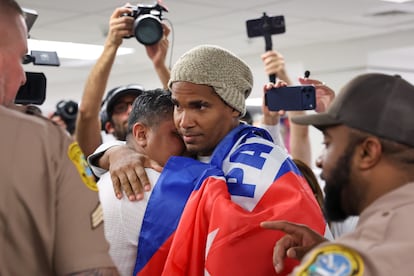
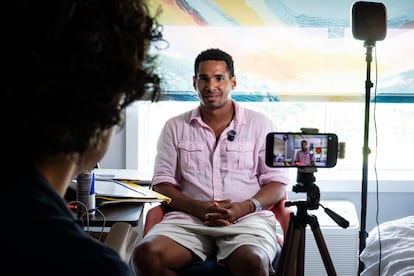
“What people say is that they’re desperate for something to happen, anything. People don’t even know what they want, nor do they know what democracy is, but they want something to happen to relieve the suffering in Cuba caused by the dictatorship,” he says in an interview with EL PAÍS at the hotel in southwest Miami where he has been living since arriving in the United States just over a week ago. The move marks the beginning of a forced exile after five years in prison.
For Otero Alcántara, the island has reached a state of extreme exhaustion, and the people are in “an extremely precarious situation.” “It’s a country that is suffocating,” the artist says, reflecting on a possible U.S. intervention, the expectations raised on the island by Nicolás Maduro’s capture in Venezuela, and Donald Trump’s policies.
He says his commitment to Cuba remains with its people. “The homeland is not what [Cuban independence hero José] Martí wrote in a book a thousand years ago. The homeland is the people who walk the streets. That homeland is malnourished,” he says. “In Cuba there is a kind of total cannibalism that stems from a system’s dehumanized indifference. If the system can’t solve your hunger, your medical needs, if it doesn’t protect you but expels you and you have no representation or sense of protection, who would want that? Of course the leadership would —the very small clique that lives off it and is corrupt.”
Question. How do you see relations between Cuba and the United States under Trump?
Answer. We are at a decisive moment for Cuba, where first we need to know what the real negotiations are between the Cuban government and the U.S. administration. But I think Cubans have to seize this moment. Because this moment did not arrive solely because the U.S. administration wanted it. It also comes from years of work — activism, the opposition, and influential people who pushed Cuba in this direction.
Q. After five years in prison following the 2021 protests, how do you view the fact that people on the island are once again taking to the streets?
A. Cuba has shown a high level of defiance over the past five years. People have not stopped protesting. Most of the political prisoners from the July 11 protests [in 2021] were released, and new prisoners — young people, teenagers — went in. That tells you Cuba is learning to be a civic country. It also depends on us to steer that reality toward democratic paths. That is democracy: that you can go out, speak, put whatever you want on your TV station, on your YouTube channel, in your independent story, but inside Cuba, without it costing you prison or persecution.
Q. Do you consider the cooperation of other countries essential to Cuba’s future?
A. The only way Cuba can truly prosper is for there to be freedom of expression and democracy. The only way a president is a public official is if they do not have absolute power to entrench themselves. That is generated through institutions. Of course, we will need cooperation from international institutions, European and North American organizations, and other nations that must teach us how to build democracy or how to create solid institutions that transcend individuals.
Q. Recent negotiations between Cuba and the U.S. have been very opaque, while Trump has threatened to “take” the island.
A. People are very afraid, because the Castros might remain in power, [Cuban President Miguel] Díaz-Canel might stay, and there could be a kind of transformation with a transition that could last 10 or 20 more years. If the United States, which should protect human rights, allies itself with the power that crushes us, who will protect us? Who will give us a voice? You must forgive, yes, but forgiveness does not mean keeping quiet or excluding critics of the previous system. On the contrary, those are the people who must be restored — those who sacrificed their lives and who have more to say. Not from a place of hatred, but from dialogue and from an opposing perspective, which is what truly generates development.
Q. If there were a transition in Cuba in which the United States played a role, would there be room for the Castros or for the communist government?
A. I think justice will have to be implemented, because there have been nearly 70 years of injustices, cruelties, and many people carry deep pain and open wounds. There should be a commission that knows how to manage that, because it cannot be a case of “If the shopkeeper didn’t give me two pounds of rice, I have to execute him,” — that’s the kind of distortion that could turn into a bloody massacre. There should be democratic international institutions that are highly prepared to deal with these situations. We are neither the first nor the last dictatorship to fall in the world. We will need a lot of support from abroad.
Q. Would you agree to a U.S. military intervention?
A. I’ll tell you what I heard in Cuba: people are desperate for something to happen, anything. The Maduro episode, the idea of someone going in and removing him, influenced people, who said, “Damn, look how they went in and took him away.” It’s not that they’re going to bomb the entire country, because as part of the indoctrination in Cuba they tell you we will all die, “to the last drop of blood.” Cubans are learning that a surgical intervention could save the country, and people are asking for it to happen now.
Q. But what do you think?
A. I’m a pacifist, and I believe there should be no bombs and no one should be killed. But what is needed is a radical structure to go in, sneak in, and remove him, because he’s like a rat, like an abusive strongman who has kidnapped everyone and is threatening to kill them, and people are dying. Imagine it’s a kidnapping of nine million victims who are dying every day. We will stand up to it, but we need someone to help us. People, in their own way, are asking for help. I don’t know if it will be Americans, Europeans, the U.N., or even extraterrestrials, but we need help — especially because the process of social unrest can take months and could cost a great deal of blood.
Q. Do you think Cuba will respond peacefully?
A. On July 11 [in 2021], people took to the streets and showed they did not want that system, and they were killed, and people were sentenced to 20 or 30 years in prison. Because they do not respect human beings, someone has to help us reduce the bloodshed. Hopefully it will be peaceful, with people in the streets and the authorities accepting it, but it seems unlikely. They will put tanks on the streets. Many members of the military are afraid because they are asking themselves: “Well, when this changes, what will happen to me?” They know what they are defending is wrong, but they are protecting their own lives.
Q. What do you think about the claim that the U.S. blockade is to blame — that it is suffocating Cuba with an oil embargo?
A. People know that is a fallacy. When I was in prison, a Russian ship arrived with oil, and people were depressed thinking: “If these people get a little oxygen, we are going to be stuck like this another hundred years.” People said: “We need the oil to run out completely and for the whole country to shut down, so we can see what happens.” People want that system to end now, for it to collapse and for whatever happens to happen. People expected a military intervention on a Friday. Every Friday, everyone would wake up asking: “Did it happen or not?” When what happened in Venezuela occurred, people were happy.
Q. And what do Cubans on the island think of Trump?
A. People pay more attention to what Donald Trump or [U.S. Secretary of State] Marco Rubio say than to Díaz-Canel. Look at the anthropological damage the dictatorship has caused in Cuba, that people prefer to listen to a U.S. president than a Cuban president. A dictatorship has to be shut down in some way. It could be with sanctions — I don’t know, because I’m not a politician. But I do know people want it to end.
Sign up for our weekly newsletter to get more English-language news coverage from EL PAÍS USA Edition









































