
Cuba’s medical missions accused of ‘modern slavery’
An IACHR report denounces labor rights violations, including unfair pay, long working hours, and reprisals against medical staff and their families
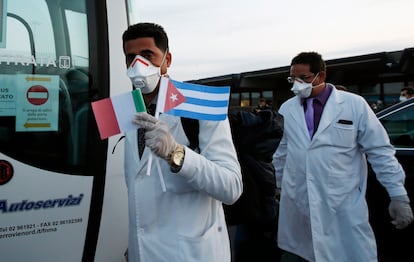

What began in the 1960s as a cooperative initiative has, over time — and with Cuba’s economic decline — become a major source of revenue for the Havana regime. Cuban medical missions began in 1963 with the deployment of the first permanent brigade to Algeria, and since then, Cuban doctors have been an essential export for the island’s coffers. A report published on Tuesday by the Inter-American Commission on Human Rights (IACHR) denounces labor rights violations against this state workforce, including allegations of “modern slavery” and complaints of unfair compensation, excessively long working hours, and reprisals against medical personnel and their families.
In a 200-page document, the IACHR expresses its concern regarding the working conditions faced by some Cuban workers participating in medical missions. Among the complaints received by the organization are the lack of fair compensation for a dignified life, the imposition of excessively long working hours, pressure to join the program without receiving a copy of their employment contract, and reprisals against personnel and their families for non-compliance with the imposed conditions. The IACHR also warns of human rights violations, particularly regarding allegations of modern slavery and human trafficking of those working in the Cuban healthcare system. The Cuban government has denied these allegations, according to the document.
The purpose of the missions is to offer medical cooperation to countries that request it through bilateral agreements. Official figures show that at least 165 countries have opened their doors to Cuban medical personnel in Latin America, Africa, Asia, and Europe. The Cuban government has deployed more than 600,000 healthcare professionals over six decades. “This practice has experienced sustained growth, to the point that it is now estimated to be the main source of revenue for the Cuban state,” states the IACHR. “The missions, in addition to being considered an expression of international solidarity by some recipient countries, are recognized and valued by some host states for contributing significantly to strengthening their public health systems.”
The objective of these agreements, according to the IACHR, is to improve medical training, strengthen health education, offer the population quality care, exchange experiences, provide technical assistance, offer healthcare to patients, and conduct training and research. However, the doctors consulted by the OAS body report appalling working conditions, unequal treatment compared to workers in the host countries, and situations of labor exploitation.
One of the most controversial allegations concerns the confiscation of wages by the Cuban state. The report warns of precarious working conditions “driven by the retention of a significant portion of their salaries by the Cuban state,” severe restrictions on the doctors’ fundamental freedoms, and a widespread lack of legal protection. It also notes the existence of control mechanisms over their private and professional lives, including sanctions for establishing personal relationships with local citizens or giving statements without prior authorization. According to the report, “in the event that they abandon the mission, medical personnel may face serious reprisals, such as being barred from returning to the country, which results in forced family separations and pressure on their relatives in Cuba.”
Other human rights organizations, such as Human Rights Watch (HRW), have also denounced the Cuban government’s tight control over these medical brigades. HRW has described the working conditions of Cuban doctors as “draconian” and has urged the authorities receiving this assistance to demand reforms and changes to the regulations governing these programs.
The IACHR report explained that it received “detailed information” about serious human rights violations, including “situations consistent with contemporary forms of slavery or forced labor, including practices such as contractual fraud, withholding of identity documents, confiscation of wages, and control and surveillance of private life.”
These medical missions are now also facing pressure from the United States, where President Donald Trump is demanding a change in the island’s leadership. Countries like Guatemala, Honduras, and El Salvador have expelled Cuban personnel. Even allies of the Havana regime, such as Nicaragua’s Daniel Ortega, have canceled contracts. “This situation is unfolding within a context of profound socioeconomic crisis facing the country, characterized by shortages of essential goods, sustained inflation, the deterioration of public services, and a decline in the population’s purchasing power,” said the IACHR report.
The Organization of American States (OAS) has urged the Cuban state and host countries to reform the model of international medical missions to eradicate practices that violate the fundamental rights of healthcare personnel. The organization demands guarantees of voluntary participation, full and direct payment of fair wages, respect for freedom of movement, and the elimination of all forms of forced labor, reprisals, and union restrictions. It also recommends establishing independent inspection mechanisms and regulatory frameworks that ensure dignified, safe, and transparent working conditions, “in line with international human rights standards.”
Sign up for our weekly newsletter to get more English-language news coverage from EL PAÍS USA Edition









































