
Peru strengthens its security alliance with the US and joins Trump’s Shield of the Americas
The visit of Secretary of State Marco Rubio comes amid tension with China over influence in the region


U.S. Secretary of State Marco Rubio on Thursday drew to a close a three-country tour of South America to strengthen Donald Trump’s alliances in the region by visiting Peru. Before arriving in Lima, he met with Colombia’s president, Abelardo de la Espriella, where he spoke of opening a “golden age” in the bilateral relationship. In Ecuador, after meeting with Daniel Noboa, he praised that country as the most “aggressive” partner in the Trump administration’s push to toughen the fight against drug trafficking and transnational criminal groups. In Peru, after his Thursday meeting with President Keiko Fujimori at the Government Palace, Rubio said: “These are transnational terrorist organizations that do not respect sovereign borders and operate in multiple countries with the same aim and the same goal of exploiting countries and exploiting their people and harming them. [...] For more than 20 years, unfortunately, administrations of both political parties, they’ve ignored the region. [...] But for this administration, this hemisphere is a priority, and you will continue to see it demonstrated over and over and over again”
As he had foreshadowed days earlier, Rubio confirmed that Peru is joining the Shield of the Americas, an initiative launched by the United States earlier this year to coordinate actions against organized crime in the region. The announcement affects one of the world’s main cocaine-producing countries, where international drug trafficking networks operate. However, the initiative has also drawn criticism over the risk that closer cooperation could subordinate national decisions to Washington’s interests.
Fujimori said that, for Peru, joining the Shield of the Americas is fundamental because “it relaunches the joint work of both countries” and denied that the alliance could threaten national sovereignty. “With regard to the entry of troops, there is a special provision in the Constitution. Every time there is this kind of entry, a special authorization is requested to the Congress of the Republic. Of course, we will uphold this rule. Peru’s sovereignty is intact. We will recover order, tranquility, and peace for all of the Peruvian people. For this reason, we thank Secretary Rubio for his presence and to be here to be able to announce that Peru will be part of the Shield of the Americas,” she said. She also stressed that Rubio’s visit is confirmation that the United States has its sights on Latin America.

In that regard, the top U.S. diplomat also dismissed the idea that the Shield of the Americas will affect the sovereignty of the 14 member countries. “People make up these problems that don’t exist. They’re getting ahead of themselves with these ridiculous sort of things that no one’s even contemplating. The bottom line is the reason why we have a Shield is because we choose to act in partnership with our partners,” he emphasized.
China’s concern
Rubio landed in Lima in a sensitive context. Peru has become caught in a geopolitical dispute between the United States and China. Hours before his arrival, the Chinese embassy posted several messages on its social networks criticizing Washington, without naming it directly. “China has never acted with geopolitical calculations, never interfered in the internal affairs of other countries, and never demanded that other countries take sides or choose a camp. the Western Hemisphere is no one’s ‘backyard’,” the diplomatic mission said.
China also took the dispute to its relations with Peruvians. It reminded people that holders of ordinary Peruvian passports can travel there visa-free and stay up to 30 days, while “a certain country” does not offer the same facilities. “Why do Peruvians, when applying for a visa for a certain country, have to undergo rigorous checks and even face threats of visa cancellation for their entire family?” it asked. Beijing also noted that Peru is the second-largest destination for Chinese investment in Latin America, with a stock of $30 billion.
The messages were a response to a column Rubio published earlier in the week in the Peruvian newspaper El Comercio. There he accused China of “entering our region with promises that hide predatory practices.” The secretary of state argued that Beijing usurps national sovereignty, disregards Peru’s legal frameworks and that its participation in other countries often “takes the form of nontransparent contracts, unsustainable debt, worker exploitation and environmental destruction.” In contrast, he presented U.S. private investment as respectful of Peruvian property and the hemisphere’s security interests.
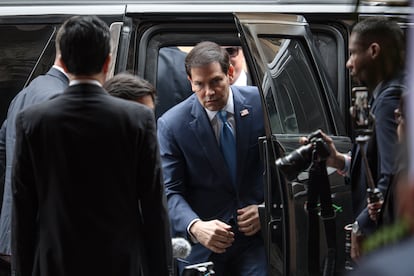
The tour of Colombia, Ecuador, and Peru marks Washington’s largest diplomatic move in South America since Donald Trump returned to the White House. Although the official agenda focuses on drug trafficking and security, China’s growing influence in the South Pacific looms in the background. In Peru, the most visible point is the Chancay megaport, inaugurated in 2024 and 60% controlled by the Chinese company COSCO Shipping Ports Limited. Its development has alarmed Washington, which questions whether infrastructure of that scale could become logistical support for Chinese naval forces.
For Peru, the challenge is to avoid letting that competition reduce its room for maneuver. Former foreign minister Hugo de Zela has said that the country does not benefit from being trapped in a confrontation between the United States and China and that it must act according to its own interests. Some recent decisions suggest the Fujimori administration is tilting the balance toward Washington. In early September, Peru broke diplomatic relations with Iran. Fujimori also appointed Carlos Espá as foreign minister, a politician who is not part of the diplomatic corps and who worked for 15 years as director of communications at the U.S. embassy in Peru.
Added to this is the prominent role of Bernie Navarro, the U.S. ambassador to Peru. During the last presidential elections, he acted as an observer and pressured the government of José María Balcázar to approve the purchase of U.S. combat aircraft. Rubio’s presence now reinforces a political and security relationship that Washington seeks to consolidate with the new Peruvian government. For Fujimori, the visit opens the possibility of tightening that alliance but also forces her to manage the tension between two powers.
Sign up for our weekly newsletter to get more English-language news coverage from EL PAÍS USA Edition









































