
August Hanning, the German spy who sold his services to the highest bidder
The former head of Germany’s foreign intelligence service is suspected of having worked for dictatorial regimes for years
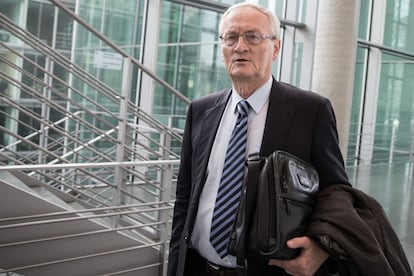

“What makes a good intelligence officer is that they do not attract attention.” This was one of the mottos that August Hanning repeatedly invoked in public appearances during his tenure as head of Germany’s intelligence services. Hanning, now 80, has been in custody since October 6 precisely for attracting too much attention. The former president of Germany’s foreign intelligence service, the BND, earned a reputation for being available to the highest bidder, whoever that might be. Germany’s federal prosecutor is investigating him on suspicion of treason and espionage on behalf of foreign countries.
Prosecutors allege that between 2010 and 2022 Hanning purchased more than 2,000 confidential documents from Germany’s federal intelligence services. The alleged source of the material was his former chief of staff during his presidency of the BND from 1998 to 2005. That individual, identified by authorities as Manfred D., is also being held in pretrial detention. According to the federal prosecutor, Hanning, after retiring and working as a private consultant, prepared a report for the intelligence service of a foreign country that authorities have not yet disclosed. Investigators are now trying to determine whether the material was ultimately delivered to the client. Prosecutors also allege that Hanning “maintained intensive contact” with a member of another foreign intelligence service.
The German newspaper Der Spiegel reports that the report prepared by Hanning was intended for Azerbaijan’s intelligence services. It also says that the foreign intelligence official with whom he maintained “intensive contact” was the retired Chinese general Wang Jianzheng.
Die Welt has also pointed to a possible Russian connection. The conservative newspaper published excerpts from a letter Hanning sent in August to the current BND president, Martin Jäger, demanding an explanation as to why Germany’s foreign intelligence service had opened an investigation into him on suspicion of collaborating with Moscow.
1986, East Berlin
The story begins in East Berlin in 1986. At the time, Hanning was a promising senior civil servant with a doctorate in law who had spent the previous five years overseeing environmental policy and nuclear energy security in the office of Social Democratic Chancellor Helmut Schmidt. In 1986, he was assigned to West Germany’s Permanent Mission to the German Democratic Republic (GDR). Hanning was part of the intelligence team and was responsible for handling cases involving detentions in communist East Germany.
It was on the other side of the Iron Curtain that Hanning began cultivating some of his most valuable contacts. According to Der Spiegel, he may already have met Wang there. The Chinese general was posted to the GDR between 1987 and 1990, the year Germany was reunified. He later served, in two separate stints, as military attaché at the Chinese embassy in Berlin, ending his service in 2013.
The relationship between Hanning and Wang continued until at least 2023, the last year in which they appeared together in public. In 2017, Wang translated into Mandarin a book of interviews with former chancellor Gerhard Schröder. In the foreword, the Chinese military officer thanked his friend Hanning for his assistance.
Hanning led the BND throughout Schröder’s two terms in office and was a key figure in the chancellor’s close relationship with the Kremlin. His tenure is still remembered for the ties he cultivated with his counterparts at Russia’s Federal Security Service (FSB).
Working across party lines
German reunification in 1990 brought Hanning back to the Chancellery, this time under the government of Helmut Kohl. It was then that his intelligence career truly took off. As the right-hand man of Bernd Schmidbauer, the Chancellery’s coordinator for Germany’s intelligence services, Hanning was entrusted with responsibilities related to the former Soviet sphere as well as missions in the Middle East. According to Der Spiegel, he served as a mediator between Israel and the Lebanese militia Hezbollah. In 1996, Hanning succeeded Schmidbauer in the post.
Hanning moved with ease through German politics, working equally comfortably with both the Social Democratic Party of Germany (SPD) and the Christian Democratic Union of Germany (CDU). Kohl was succeeded by Schröder, who promoted him to president of the BND. When Angela Merkel took office, Hanning remained influential, serving in her first government as a state secretary under Interior Minister Wolfgang Schäuble.
Hanning left public service in 2010 with a vast network of contacts and sources that would prove highly lucrative in his new private-sector career. He went on to establish at least two intelligence consultancies, Hanning Consult and GSC4. The latter, which ceased operations in 2026, generated €2.2 million ($2.5 million) in revenue in its final year of operation, according to the investigative outlet Correctiv.
Some of Hanning’s most lucrative contracts came from acting as an intermediary between the Interior Ministry and suppliers of technology for the police. But it was his years working with Russia and the former Soviet republics that brought him his most sensitive clients. It is publicly known that Hanning served in senior positions at two diplomatic organizations linked to the government of Kazakhstan. In 2012, he was also hired as an adviser to Russian oligarch Oleg Deripaska during a legal dispute in the United Kingdom over ownership of metallurgical plants privatized in Russia in the 1990s.
Hanning was also recruited by the British private intelligence firm G3 as an adviser on Russian and former Soviet affairs. In that capacity, he was appointed chairman of Pluteos, a Swiss intelligence-analysis company. One of Pluteos’s subsidiaries, the security firm System 360, is the company that ultimately landed Hanning in prison.
Prosecutors were investigating System 360 in connection with what has become Germany’s trial of the year, the “Block case.” Businesswoman and millionaire Christina Block is being tried in Hamburg for allegedly hiring a group of Israeli mercenaries to forcibly recover her children from Denmark on New Year’s Eve 2023. Block’s Danish ex-husband had failed to comply with the shared-custody arrangement and kept the children with him. Block allegedly hired a team of former Israeli special-forces operatives to seize the children and bring them to Germany. Their father was beaten until he lost consciousness, and the children were transported to their mother, gagged inside a van.
The court must determine whether System 360, where Hanning served as an adviser, hired the Israeli team that carried out the abduction on Block’s behalf. System 360 is also accused of planning to hack Block’s ex-husband’s computer in order to plant child-abuse material on the device.
Hanning’s office was searched in 2025 as part of the Block investigation. During the search, prosecutors discovered that the former head of Germany’s foreign intelligence service was in possession of classified BND documents. Hanning’s lawyer has acknowledged that his client held confidential information but insists that he neither purchased it nor used it for international clients.
Sign up for our weekly newsletter to get more English-language news coverage from EL PAÍS USA Edition









































