
Ten nights, one stadium: Bad Bunny and the business of residencies
The Puerto Rican star is in Madrid to perform a string of concerts, a format also chosen by Shakira: logistically efficient, highly profitable, and at risk of turning into ‘a theme park’
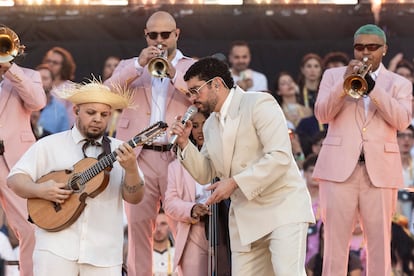

Bad Bunny performs today, June 1, at Metropolitano Stadium. He played on May 30 and 31, and will return on June 2, 3, and so on, for a total of 10 shows. In the entertainment industry, this is known as a musical residency — a series of concerts an artist stages in the same venue over a short period of time. There’s no exact number that defines one, but one of the core ideas behind the concept is impact: the more shows, the better.
Some 500,000 tickets have been sold to see the Puerto Rican star, who chose Madrid for strategic reasons: Spain acts as a bridge between Latin America and the rest of the world, especially Europe. Another relevant factor: according to Spain’s National Statistics Institute, 3.2 million people born in Spanish‑speaking Latin American countries live in Spain, and 1,038,671 of them live in Madrid — an audience likely to be drawn to the composer of Debí tirar más fotos.
Beyond those major reasons, there are others that explain why this model of massive, multi‑date concerts in a single city has taken hold. In September, Shakira will also join the trend with 12 shows at Madrid’s Iberdrola venue, the same space that hosts the Mad Cool festival.
Manuel López, co‑founder of Sympathy for the Lawyer, a leading firm in music‑business management, outlines the advantages of residencies: “One factor is cost savings. Everything has become more expensive after the pandemic and especially since the war in Ukraine, the tensions in Venezuela and now the United States–Iran conflict. These turbulences in international politics translate into higher costs that are especially noticeable in live music in transportation, logistics, materials, equipment availability… If instead of touring many countries you settle in one city, expenses go down.”
In this case, just one day is needed to set up and another to tear down. Technically, structurally, and financially, this format offers far more efficient performance conditions than a traditional tour. It’s like a 50,000‑seat theater operating with the same routine every night. “You might make a mistake on the first day, but you refine it, and by the third everything runs perfectly,” López notes.

This system involving top-tier artists is so unusual in Spain that Nacho Córdoba, from Live Nation, the promoter organizing Bad Bunny’s and Shakira’s concerts in Spain, clarifies: “Bad Bunny’s tour in Spain cannot be considered a residency, since it has gone through Barcelona and will go to Madrid after its stop in Lisbon, to continue across Europe and the United Kingdom. It is an international tour that, due to unprecedented demand in Spain, has had to schedule 10 concerts in Madrid and two in Barcelona. At present, the only true residency announced in Spain is Shakira’s.”
But the idea of a residency is not new. Its origins probably lie in Las Vegas, a place where fading stars saw an opportunity to make money by squeezing the last breath out of their artistic careers. Yet the first major rock example did the opposite: Elvis Presley reinvented himself in Las Vegas starting in 1969. Later, the city’s casinos did become a retirement home for artists with healthy bank accounts. That lasted until 2003, when Celine Dion, far from retiring, generated $700 million with her shows. And then there’s the case of Michael Jackson, who in 2009 scheduled 50 concerts at London’s O2 Arena. While preparing for that grueling challenge, Jackson died at age 50.
In recent years, artists at the peak (or near‑peak) of their careers have embraced the model with great success: Adele, U2, BTS, Harry Styles, Lady Gaga, Drake, and others.
Pascual Egea, president of Spain’s Association of Music Promoters (APM), believes this system “turns music into more of a destination phenomenon and less of a proximity‑based experience that reaches different cities.” He adds: “A residency creates an event you have to go to. I think many people attending Bad Bunny’s concerts will go because they feel they must be there — people who don’t know many of his songs, people who aren’t really fans. That doesn’t happen as much on a tour that travels through different cities.
Egea highlights the economic impact that the Puerto Rican’s 10 shows will have on Madrid: “It is going to generate a lot of wealth.” ”Estimates suggest that at least 30% of attendees will come from outside Madrid. “There’s a wide range of origins among ticket buyers: Canada, Latin America, the United States, other parts of Europe…,” Live Nation reports. Bad Bunny’s concerts will leave €150 million ($174 million)in Madrid through transportation, hotels, restaurants, and shopping. The core age group attending the concerts ranges from 18 to 30, with a similar proportion of men and women.
A string of back‑to‑back performances may seem physically and emotionally exhausting — and it is. But Rosana Corbacho, a clinical psychologist with 15 years of experience in the music industry, considers residencies less demanding than tours: “Psychologically, where the body is subjected to more stress is in everything related to logistics, where people — including workers — are at greater risk of accidents and injuries. That happens on tours that change city or country. Setting up, dismantling, moving 300 people, a stage of that scale…”
Corbacho explains one of the incentives for artists: “They see they can try a new format, and it gives them a sense of success — something very hard to achieve when you’re already at the top. You’ve done everything: sold tickets, sold records, won awards. But residencies are something new, a different kind of success that breaks the monotony. It’s very stimulating for them.”
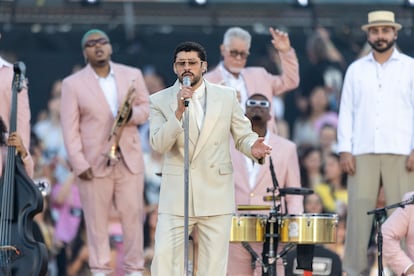
Bad Bunny arrived in Madrid with a team of 350 people, plus local staff. His inner circle includes a doctor, physiotherapists, psychological support… a full body‑and‑mind care team, because the concerts are tightly packed together, and if the star gets sick — a vocal issue, for example — he could end up canceling several shows. When dates are more spread out, as in a traveling tour, there’s more time to recover.
The current boom of this format raises the question of whether it could replace touring — or at least become a permanent fixture. Egea offers his theory: “If residencies become too common, the model could lose its sense of exceptionality. It won’t feel as novel and will turn into a machine for maximizing revenue, a kind of theme park. Like going to Warner Bros theme park once because it’s new.”
Bad Bunny’s concerts will coincide with Pope Leo XIV‘s visit to Madrid. José Cobo, vice president of the Spanish Episcopal Conference, did not rule out a meeting: “If he wants to speak with the pope, the pope will surely receive him.” Another unexpected perk of residencies.
Sign up for our weekly newsletter to get more English-language news coverage from EL PAÍS USA Edition









































