
Mexico’s murder rate: a snapshot of a debate
President Claudia Sheinbaum is celebrating a reduction in homicides of over 50%. However, experts urge caution when looking at the statistics, and demand that more attention be paid to the big picture
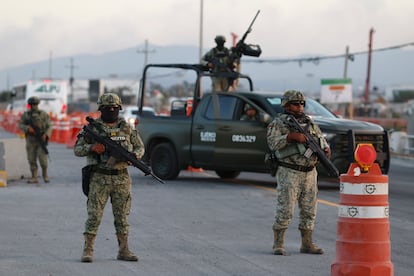

In mid-March of 2025, the Mexican Navy arrested José Remedios Araiza — alias “R1” — in the state of Yucatán. He led the group of “hitmen working for the Santa Rosa de Lima Cartel” (CSRL), one of the most violent criminal organizations in the lowlands of central Mexico, particularly active in the states of Guanajuato and Querétaro. Authorities simultaneously announced the arrest of nine other individuals, all part of the same criminal network. One of the detainees was even accused of committing a massacre in Querétaro in late 2024.
The arrests made headlines for a few hours, before fading into the background of current events. But members of the Secretariat of Security and Citizen Protection (SSPC) — a cabinet-level agency — sensed that this would have significant consequences for the region.
The arrest of R1 and Alfa 1 — the latter being the perpetrator of the massacre of 10 people in a bar in the state of Querétaro, in November of 2024 — ushered in a new era for the region (at least, statistically speaking), especially in the state of Guanajuato. The lowlands’ major industrial engine had suffered for years due to the violence of organized crime. Since 2012, the number of murders in the region has steadily increased, sometimes at a very high rate. From 600 in 2012, they rose to 800 per year. Then, 900. The number of victims climbed to 1,200 per year, then 2,220, then 3,500, eventually reaching more than 5,000 annually. The clashes between the CSRL, an organization dedicated to fuel theft and drug trafficking, and the Jalisco New Generation Cartel (CJNG) fueled the spiral. Until very recently, no solutions were in sight.
In early March of 2025, the governor of Guanajuato acknowledged a 33% increase in murders in the state. In the preceding months, there had been several massacres, high-profile assassinations and attacks on police officers. Even the case of the bar massacre in Querétaro seemed to have originated in Guanajuato, the neighboring state. Federal Security Secretary Omar García Harfuch indicated that it was a fight between criminal cells. By then, it was already known that the attackers were from the CSRL, while the targets were members of the CJNG.
Harfuch and his team had a new approach: they would go after the leading perpetrators of the violence, as the first step to stopping the bloodshed. In early 2025, it was time to test whether this strategy would work. Subsequently, the aforementioned arrests took place and, starting the following month, the murder rate in the region plummeted.
The federal agency, under Harfuch’s command, is currently using the case of Guanajuato to explain the merits of this new security strategy. The security directors believe that last year’s operations are responsible for the great statistical miracle achieved by the current administration: the more than 50% drop in homicides recorded since President Claudia Sheinbaum took office in October of 2024.
This miracle has been widely discussed, especially within academia. On one side are those who assume there must be some trickery involved: they point to changes in how statistical categories are defined, as well as the increase in disappearances as possibilities for the drop. On the other hand, there are those who accept the decline, but dismiss the idea that it’s solely due to the federal security strategy. Caught in the middle is the government, which is trying to explain itself.
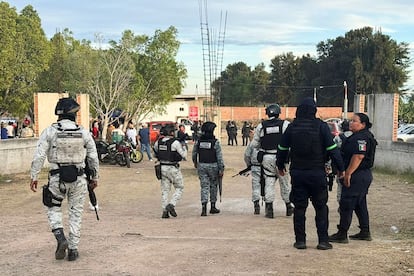
Marcela Figueroa, head of the Executive Secretariat of the National Public Security System (SESNSP), is responsible, among other things, for preparing the government’s crime statistics. “There are specific reasons why homicides are decreasing, at specific times, given specific arrests in specific states,” she explains. She points to the case of Guanajuato. “We used to have 13 homicides a day. We arrested these perpetrators of violence… and the numbers began to decrease. And we can see this in every state, in every municipality,” she argues.
In March of 2025, the state recorded 347 murders. This is according to the SESNSP, which gathers its figures from local prosecutors’ offices. In April of that year, there were 196. But the number hasn’t risen above that ever since: in July of this year, the total number of murders dropped to 97.
In his bi-weekly press conferences, Secretary Harfuch usually updates the number of arrests made to date during Sheinbaum’s six-year term (2024-2030), which amount to tens of thousands. However, the fate of almost all the detainees is unknown: whether they remain in prison, whether the arrests have led to trials, whether any have been convicted...
The statistics serve the government in its efforts to bolster its narrative of success. The claim is that it’s not just Guanajuato seeing an improvement – it’s every state. The arrests of those responsible for causing violence result in fewer murders, so goes the official narrative. And the statistics corroborate this, whether they’re from the SESNSP or the National Institute of Statistics and Geography (INEGI), which counts murders based on death certificates. From 2024 to 2025, practically all Mexican states saw decreases in homicides, with some minor increases, with the glaring exception of Sinaloa.
Figueroa maintains that there’s no trickery involved. “It’s very difficult to hide homicides,” she explains. This is how the head of the SESNSP addresses criticism over cases precisely like Sinaloa’s. The newspaper Noroeste has pointed to the possible cover-up of 133 murders by the State Attorney General’s Office, in addition to “310 discoveries of bodies and skeletal remains,” which the law enforcement agency didn’t include in the data it sent to the SESNSP. Figueroa states that “the National Information Center (CNI) monitors [statistics] to identify discrepancies. When we see them, we immediately speak with the prosecutors.” In the case of skeletal remains, the discovery “cannot be reported as a homicide, because we don’t know how many people the remains belong to,” she argues. “It takes a month, two months. But the [local] AGs have the obligation to update the information.”
Carolina Jasso holds a PhD in Social Science from the College of Mexico. A few months ago, she published a study titled Fewer Homicides, More Questions, in collaboration with the Ibero-American University. In short, the text attempts to examine the statistical decrease in homicides across Mexico, to determine why they have fallen so dramatically in such a short period of time. The most obvious conclusion is that the government’s security strategy alone doesn’t explain the drop. “I identify seven possible hypotheses,” Jasso points out, “and none of them fully explains the situation.”
“A causal relationship is being established between strategy and the reduction… but there’s no independent evaluation. We hear about destroyed labs, arrests and seized drugs, but there are no public databases that allow us to verify this,” she criticizes.
Jasso’s hypotheses certainly take the government’s recent strategy into account. But they also point to controversies, such as how exactly crimes are classified. The Attorney General’s Office and the National Public Security System (SESNSP) include categories such as “other violent crimes,” which account for more than 15,000 victims each year. Jasso and other academics suspect that this category is being used by prosecutors across the country to conceal murders.
“‘Other violent crimes’ shouldn’t include any type of violent death,” Figueroa argues. “The methodology used is clear and publicly available. And, in reality, this categorization gives us more information about each case.”
Jasso also warns about the number of murder victims recorded by the National Institute of Statistics and Geography (INEGI), a number that is increasingly higher than the figure recorded by the SESNSP, pointing to a widening gap. Figueroa responds to this: “It’s true that the difference has grown, but it’s lower than in other countries, such as the United States or Canada, where that difference can reach 40%.”
She continues: “Yes, we’ve identified states with differences greater than 15%.” This is, for instance, the case in Guanajuato, where the difference in numbers recorded climbs to more than 20%. “We want to understand why this greater disparity is occurring. Just last week, we went to the state of Mexico (EDOMEX),” she says. This region, which consists of the areas surrounding the national capital, Mexico City, has the greatest disparity between the INEGI numbers and the SESNSP numbers. Figuera notes that she and her team went there “to set up a working group, [in order to] identify possible causes.”

In addition to statistical issues, while looking at the decrease in homicides, Jasso also takes into account reasons that point to criminal groups attempting to work out a truce. “When criminal organizations, which have the capacity to regulate violence, reach agreements, homicides can decrease without their structure weakening,” she writes in her report. In such cases, reality goes beyond an Excel spreadsheet: fewer bodies may appear on the streets, but that doesn’t necessarily imply less violence. It’s possible, for instance, that criminals are making the bodies disappear. After all, Mexico has tens of thousands of missing people, a number that continues to rise.
This past March, Figueroa presented a reinterpretation of the official missing persons registry, then containing around 130,000 cases. She said that only a third of them showed no sign of activity from the missing person and actually had complete files. When looking at the rest of the cases, she suggested, it couldn’t be confirmed that they were indeed missing persons.
Jasso also criticizes Figueroa’s analysis when it comes to the reported decrease in homicides. “That exclusion criterion amounts to erasure. Instead of making an effort to corroborate [a murder], they say that, since the data is incomplete, they won’t count it,” she points out. “And, in cases where there was proof of life, I think there were many cases where this wasn’t enough to rule out their disappearance. The same goes for these cases of [people who disappear on purpose]: no matter what [the authorities] say, we don’t know what proportion they represent.
In turn, Figueroa argues: “We’ve made a great effort to better understand the registry. The work we’re done these past few years has been to begin standardizing these processes, to keep better records, to open case files… because, otherwise, no one is going to investigate. It’s not just about uploading a police report and that’s that: it’s about taking the necessary actions to search [for the missing].”
Sign up for our weekly newsletter to get more English-language news coverage from EL PAÍS USA Edition









































