
Held in hotels or detained for a year after being deported to Africa: ‘This is called human trafficking’
EL PAÍS spoke with a dozen migrants from Cuba, Honduras, Brazil and Colombia who were sent by the US to Africa and remain in a legal limbo with scant medical assistance and no knowledge of what will happen to them

Among so many faces, Roberto Mosquera remembered one in particular the day he arrived in Eswatini, a small country tucked away in southern Africa. He kept seeing that face over the following 14 months, which passed slowly and unbearably in the compressed world between the white and gray walls of the maximum-security cell at Matsapha prison. The man is serious, tall, dark-skinned and wears round glasses. His name is Jabulani Kunene and he is the prison official in charge. For more than a year, Mosquera has asked him the same question every time he passes by: “How long are you going to keep me locked up here?” Kunene has always given him the same answer: “I don’t know, Roberto, I don’t know.”
Mosquera no longer calls his cell a cell; he calls it “the little house.” He bought a coffee maker with money sent by his family in Miami; he bought a single-burner stove to fry eggs or reheat soup; there is always a bottle of liquid bleach to clean the bathroom, razors, and bottles of shampoo, because you can be imprisoned, he thinks, but you should not be left to rot. “I like to dress well, go to Miami restaurants with my daughters; I am a city man,” he says during a video call, where he sports an immaculate beard, gold-capped teeth, a high-carat chain, a blue cap and a gray pullover — not the inmate uniform they dressed him in the day he arrived handcuffed at the feet and hands, when he was given a tag with a number on the front and asked to look at the camera so they could take his prison mugshot.
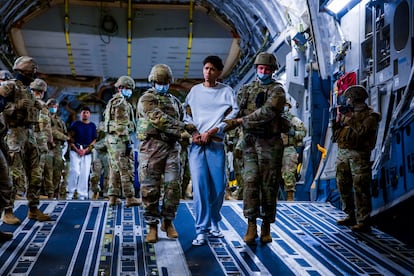
If Mosquera is not wearing an inmate uniform today, it is because of everything he has resisted in recent months, since U.S. Immigration and Customs Enforcement (ICE) detained him at one of his immigration appointments, locked him in the Krome detention center, transferred him to an airport in Texas and deported him without his consent to southern Africa. Since then dozens of people have been sent to that continent after the U.S. signed multimillion-dollar agreements with nearly 14 African countries. The flights operated by ICE mostly depart from Alexandria Airport in Louisiana or from Texas and land over 20 hours later. The mechanism so far has always been the same: no migrant knows where they are being deported to until they step onto unknown soil.
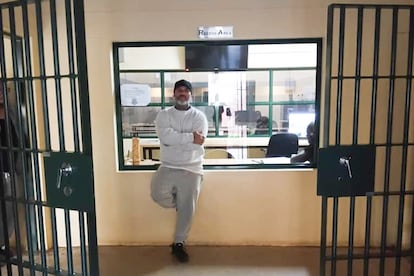
Through a 30-day hunger strike and several arguments with officers, Mosquera has won small freedoms amid his long confinement: permission to wear his own clothes, access to an interior yard from his cell, escorted trips to buy food at a nearby shop, and the right for himself and others to have cellphones to speak with family. Those are a lot of concessions for a prisoner, but none are enough for him, at 59, a father of four daughters, whom the Donald Trump administration called a “depraved monster” and expelled from the country even though he had long since served his sentence.
From Texas he was put on a flight that, because of its duration, could not be going to Cuba — the country where he was born and which has refused to take him back for nearly three decades — nor to Mexico, where so many migrants have been landing lately. Another detainee, using gestures, asked during the journey where on earth they thought they were taking them. Mosquera drew a circle with his hands in the air. He wanted to say they would likely end up on the other side of the world.
Transfers to third countries
The indirect routes of ICE deportation flights to Africa
Between July 2025 and August 2026, at least 31 confirmed deportation flights transported deportees to twelve African countries, rarely via direct routes. Almost all of them made a refueling stop in Senegal. Select a country to view all its flights; The red segments indicate confirmed deliveries.
Souce: Human Rights First, Confirmed flights to third countries (data as of August 1, 2026; includes flights through August 31, 2026). The coordinates are approximate: the nearest airport or city, or the country's center of mass when only the country was recorded. Senegal (Diass/Dakar) is listed as a refueling stop, not as a destination. Several flights in 2026 dropped off passengers in more than one country on the same route. The arcs illustrate the routing; they are not exact flight paths.
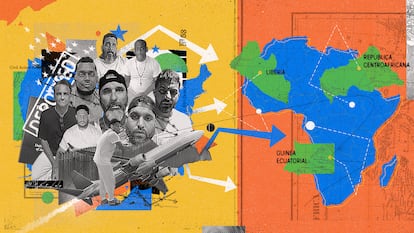
Over several weeks, EL PAÍS spoke by video call with a dozen migrants from Cuba, Honduras, Brazil, and Colombia who have been deported to countries such as Liberia, the Central African Republic, Eswatini, or Equatorial Guinea and who remain today in an indecipherable legal limbo.
No one, not even lawyers, knows how to untangle the migratory knot they are in. “These people risk being legally trapped between three states: the United States says its responsibility ended with the expulsion; the African receiving state may not grant them any lasting immigration or protection status; and their countries of origin may be places where international law prohibits their return,” explained Michael Gyan Nyarko, executive director of the Institute for Human Rights and Development in Africa (IHRDA). The concern now, according to Gyan Nyarko, lies in how the White House is using deportations to third countries to secure, indirectly, what is unlawful within the United States.
All the deported migrants this newspaper spoke with were first held in U.S. detention centers; none were notified they would be transferred to Africa, and none signed consent forms. Some were pursuing asylum cases; others had been granted protection by U.S. immigration judges under the Convention Against Torture (CAT).
Colombian Arín García Yepes, who arrived in Liberia on an ICE-operated flight from Louisiana on August 20, still recalls the moment they were about to board the plane and asked one another: “Do you have withholding of removal?” “Are you protected in this country?” Like him, almost everyone answered yes. They were being deported despite having a “stay of removal,” a form of protection in the United States.
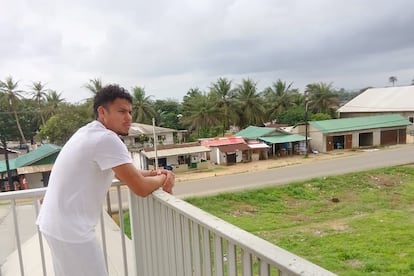
They are now held in maximum-security prisons or remain in hotels under the supervision of African authorities. So far, none of the people interviewed had documentation or identification allowing them to stay or move about legally and safely in those countries — some of which have authoritarian governments, others internal civil wars. When the African night falls and they rest their heads on pillows, all these people ask themselves again and again: Is the treatment we are receiving legal? What will happen to us next?
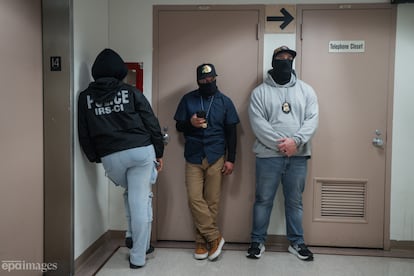
Savi Arvey, director of refugee and immigrant rights policy at Human Rights First, an organization that tracks these deportations, said these transfers to third countries — which she calls “illegal deportations” — are part of the broader Trump administration effort “to undermine the global protection system and make countries around the world accomplices in its mass deportation campaign.”
The Department of Homeland Security (DHS) is deporting migrants who not only did not identify those African countries as possible destinations during their immigration procedures, but many were also protected against removal orders. The Trump administration is also using these deportation agreements to dispose of pending asylum cases in its courts.
“Most of these Latin Americans sent to African countries had been deemed by U.S. immigration judges to be people who would face persecution or torture if returned to their countries of origin, and they had been granted protection,” Arvey says. “Now the United States is evading its international legal obligations by sending these refugees to third countries, where they have been arbitrarily imprisoned, left in indefinite legal limbo, or returned to the very dangers they fled.”
When asked about the guarantees and protections for migrants deported to African countries, a State Department spokesperson said the U.S. government “will use every legal means at its disposal to remove those who do not have a right to remain in our country.” “As Secretary [Marco] Rubio has stated, our commitment to end illegal and mass immigration and to strengthen United States border security is unwavering,” the spokesperson added.
The migration and legal limbo
Arístides Fernández García, 37, answers the call from his room at Maison Confort, an apartment lodging in Bangui, the capital of the Central African Republic, where several migrants are staying. He had never committed any crime or done anything that, in anyone’s eyes, made him a criminal. Until now he had remained in the United States with I-220A status, the same status that has prevented the legalization of more than 500,000 Cubans like him, and he was detained on the day he appeared before a judge in the immigration court in Miami. The first time Fernández spoke with EL PAÍS, a few days had passed since his arrival in Africa on July 31, handcuffed at the feet and hands on a multi-hour flight carrying about 80 people detained by ICE.
More than 40 days have passed and García speaks to this newspaper again. To date, no authority has approached them to explain what plan, if any, they have for them. “An animal has more rights than we do; this is called human trafficking, they have us kidnapped in this country, we have no papers, we are at the mercy of whatever may happen,” García says.
Other migrants interviewed said they were in the same situation. They live on the food provided at the centers, have no passports, receive no guidance, and some report suffering malaria or stomach illnesses; others have been taken to hospital in emergencies, and many find it difficult to communicate in English or French. Organizations working on the ground have documented that several have been beaten or threatened at gunpoint.
To leave Maison Confort — whether to go to the barber, the market, or to walk minimally around Bangui — Yasmani Noel Moreno de Armas, a 31-year-old Cuban who was detained in May 2025 during a beach outing in Florida, pays the hotel security guards two or three dollars. Even so, when they are seen on the street, the local police always stop them. “They told us we could no longer walk the streets,” he says. Apparently they are not detained in the same way as the migrants sent to Eswatini, but they remain under the control and at the disposal of Liberian authorities.
Recently Moreno contacted a representative of the Cuban embassy in Congo to ask what solutions were available for them. “They told me I could not return to Cuba, that Cuba does not want me; they said because I was a rafters migrant, to keep trying in the future.” The diplomat promised to help and said she would follow up, but she has not replied to any further messages. The hotel houses Afghan, Vietnamese, and Russian migrants, and some are known to have been at the facility for a year. The big question García and De Armas ask is whether time will stretch out the same way for them.
From Liberia, Honduran William Ortiz Hernández is no less anguished. He was deported on a flight that left Alexandria on August 20 with about 20 people, despite a U.S. judge years earlier granting him CAT protection, meaning the government could not send him back to his home country. As such, he was deported to a completely unrelated country. When he learned he was in a place called Liberia, he grabbed a phone provided by the authorities and typed into Google: L I B E R I A. The search results and the little he has since seen told him he is “in a very poor country. Women have approached me with their children, very needy, and I would like to have money to help these people.” At the Creed Lodge, the hotel in Monrovia where they have been housed, he has received treatment for his diabetes; he says there has been no shortage of food and they were given some clothing. Over the days they were also issued an ID that only serves to withdraw money sent by family via Western Union. But it is not enough.
“I was not hiding from immigration in the United States. Why are they taking me out now and not telling me which country I’m going to?” he asks. “Here I am without an ID; I don’t go outside; I am afraid. We met with the government and they warned us how dangerous this is. We feel stressed, we feel very confused because we are in a country where we know neither the language nor anything. I feel like they dumped me in a trash heap.”
The day Hernández got off the ICE flight that delivered them, five migrants refused with all their strength to descend the plane’s stairs. “We told them we didn’t feel safe, but they forced us to get off. They carried me between four people and beat me while I was handcuffed,” Cuban Carlos Rodríguez told EL PAÍS a few days after being deported. With him were three other Cubans and a Brazilian, whom authorities promised that if they stayed calm they would return them to the United States. Yet when the ICE plane touched down again, they were actually in Equatorial Guinea. “How can a government, in the space of a few hours, send us to another country, and that country accept us?” Rodríguez asks. “This is human trafficking, they trafficked us on a plane.”
EL PAÍS tried to contact the migrants sent to Equatorial Guinea again; some had serious medical conditions, but family members confirmed that authorities had taken away their phones so they could not file complaints with the press. “I haven’t heard from him in a week; they have cut them off,” said Caridad, the mother of Leonardo Sánchez, a Cuban deported to that country with a large abdominal hernia and an operation pending. “What they’re doing is criminal; the treatment is unfair,” his mother complained from Miami.
At the Hotel Bamy in Malabo, the capital of Equatorial Guinea, the deportees are staying. Lawyer F. — who asked not to be identified because the government of that country is retaliating against lawyers who, like him, want to represent the deportees — brought sanitary pads for women, toothbrushes for everyone, and some medicines that the authorities had not provided.
“There are people with diabetes, high blood pressure or cardiovascular diseases receiving very poor medical care, because the nurse cannot give them any medication,” he says. “We are surprised that there are several people with very dangerous medical conditions, and we are concerned that the United States is including them on deportation lists.”
Those who ended up in Equatorial Guinea are, like those sent to other countries, without any form of identification, visa, travel document or safe-conduct, EG JUSTICE director Tutu Alicante — a Guinean lawyer who works with deportees to that country — confirmed. “In practice they are undocumented: they have no legal status, no pathway to regularize their presence and there is no formal timeline for their release or expulsion.” That, according to Alicante, is the core of the legal limbo in which they find themselves: “They fall outside both asylum/immigration frameworks and any criminal process, and remain detained at the discretion of the government of Equatorial Guinea, an authoritarian government that does not respect the rule of law.”
Opacity of agreements
On March 15, 2025, with images of dozens of Venezuelans disembarking from a plane at the CECOT mega-prison in El Salvador, a new chapter began in the history of Trump-era mass deportations after the government invoked the Foreign Enemies Act. The following month, a judge ordered a suspension of these deportations until the U.S. Supreme Court issued a ruling to resume expulsions of migrants to third countries. Since then, the NGO Third Country Deportation Watch has recorded more than 23,000 people sent to some 35 countries, operations in which the U.S. government has invested more than $49 million in funding.
At least 14 African countries are willing to receive migrants: Burundi, Cameroon, Cape Verde, the Central African Republic, the Democratic Republic of the Congo, Equatorial Guinea, Eswatini, Ghana, Liberia, Libya, Rwanda, Sierra Leone, South Sudan and Uganda. All have signed bilateral agreements, or what are called “verbal notes,” which so far remain opaque. In diplomatic exchanges, the African governments commit to receive migrants sent from the United States but do not specify what benefits they receive in return. EL PAÍS obtained the repatriation agreements with the Central African Republic (which received $85 million in U.S. government funds), Equatorial Guinea (which received $7.5 million) and Liberia (which obtained $5 million to manage the reception of migrants).
The agreements state that the U.S. government has at least seven days before the deportation flight to notify the receiving government of the list of people to be transferred, and that each country is free to accept or reject the deportees. Some reserve the right to deport these migrants onward to other countries. The documents also include diplomatic assurances regarding compliance with obligations under the United Nations Convention Relating to the Status of Refugees and the Convention Against Torture, under which they agree not to persecute or torture any third-country national sent by the United States and not to send such nationals to any other country where they might be persecuted or tortured. Nevertheless, some observers have raised alarms about violations of these commitments.
“We know that, in practice, these assurances are not being upheld,” says Yael Schacher, director for the Americas and Europe at Refugees International. “Many countries that have signed agreements including such diplomatic assurances — among them Ghana and Equatorial Guinea — are detaining and mistreating people they receive from the United States and have no selection mechanism to ensure they do not repatriate third-country nationals to places where they will be persecuted.”
Schacher says U.S. law — as well as compliance with the UN Refugee Convention and the Convention Against Torture — requires an individualized assessment to determine whether a person is likely to suffer harm or be tortured if deported to certain places. Yet neither the United States nor the African countries are carrying out that personalized assessment.
The last recourse for lawyers and organizations has been to sue some African governments. After six people in Equatorial Guinea were forcibly sent to their countries of origin, a group of organizations filed a complaint with the African Commission on Human and Peoples’ Rights on behalf of 14 expelled people who had been granted international protection by the United States. Many people are concerned about what they call “chain deportation,” which occurs when the United States transfers a migrant to an African third-country, and that country in turn returns the migrant to the very country from which they had sought protection.
“The deportees have confidentially told us that law enforcement officials have said they will all be forced to return to their countries of origin,” says Gyan Nyarko of IHRDA, which represents some cases. “Therefore, it does not appear that the government of Equatorial Guinea intends to honor the agreement it signed with the United States, including the commitment to grant legal status to the deportees. The United States also shares responsibility in this situation, since authorities were informed of the government of Equatorial Guinea’s conduct toward the deportees and yet no action is being taken.”
Time passes more slowly and feels heavier than ever for everyone. Every so often, the guards at Matsapha Prison approach Roberto Mosquera and talk about what they each know about the places they come from. Sometimes the guards burst out laughing. “I tell them, ‘I had no idea what Africa was like; I’d only seen it in movies — tigers, lions, giraffes.’” The guards find it funny, but in reality, the story hides a truth: that Mosquera should never have landed, the way he did, in a place called Eswatini. “My mistakes are done; I can’t change them, but I was able to change my life,” he says. “I don’t want to stay in this country; I’m not African; this isn’t my culture. I want to be transferred to the United States so they can give me due process.”
From another cell, Jamaican pastor Junior Alves, a 64-year-old man who was also sent to Eswatini, said: “Not only have I been deported, but I’ve also been imprisoned. For what reason?” About 2,300 miles away, in Bangui, Arístides Fernández García still can’t believe it: “What am I doing in Africa? Why did I, who wanted to live the American dream, have to pay the price for this?” And elsewhere in Liberia, William Ortiz Hernández lives in fear that one day he’ll be sent back to Honduras. There, a group of men killed his cousin, then his uncle. Nothing suggests that he won’t be next.
Sign up for our weekly newsletter to get more English-language news coverage from EL PAÍS USA Edition









































