
María Corina Machado’s daughter, upon receiving the Nobel Peace Prize: ‘Democracy is essential for peace’
Ana Corina Sosa delivers her mother’s acceptance speech at a ceremony marked by condemnation of the violence of Maduro’s regime
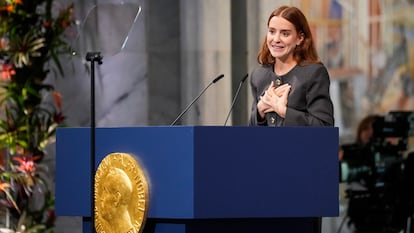

A deafening silence fell over Oslo City Hall at 1 p.m. The audience rose from their seats. The members of the Norwegian Nobel Committee took their places on the podium. And the trumpets began to sound in a solemn and triumphant tone to announce that the moment had finally arrived. Amid enormous anticipation, María Corina Machado, the main symbol of the Venezuelan opposition and the most uncomfortable figure for Nicolás Maduro’s government, was recognized on Wednesday with the Nobel Peace Prize “for her tireless work in promoting the democratic rights of the Venezuelan people and for her struggle to achieve a peaceful and just transition from dictatorship to democracy.” Machado, the main protagonist of the gala, was also the notable absentee. The 58-year-old opposition leader managed to leave Venezuela after being confined to hiding for 16 months, but she was unable to make it to Norway in time to receive the most important award of her political career in person.
Machado was not physically present at the ceremony, but her image was omnipresent on the walls of Oslo City Hall. The Norwegian capital woke up to the news that the opposition leader would not be able to attend the ceremony and breathed a sigh of relief when the Nobel Institute confirmed that she was safe and on her way to the Scandinavian country. “I will be in Oslo,” she said in a call broadcast moments before the ceremony by the Norwegian institution, the latest chapter in a drama-filled story that has marked this year’s award ceremony and whose final chapter has yet to be written.
“Venezuela will breathe again,” Machado said in her acceptance speech, read by her daughter, Ana Corina Sosa Machado. The applause from the hundreds of attendees overflowed the banquet hall of Oslo City Hall when Sosa stepped forward and received the diploma and medal in honor of her mother. “This prize carries profound meaning; it reminds the world that democracy is essential to peace,” the young woman said.
Machado said the Nobel Prize is a tribute to the suffering of the Venezuelan people and dedicated the award to those who have been subjected to repression under Chavismo. “Our political prisoners, the persecuted, their families, and all who defend human rights,” she said in her speech. The opposition leader also thanked her three children, her parents, her sisters, and her husband for their support throughout her career. “To them belongs this honor. To them belongs this day. To them belongs the future.”
In her speech, traditionally known as the Nobel lecture, the leader reviewed the political history of Venezuela and the struggle she has waged against Chavismo. “I have come here to tell you a story: the story of a people and their long march toward freedom. This march brings me here today as one voice among millions of Venezuelans who rose, once again, to reclaim the destiny that was always theirs,” she emphasized.
She also said she was ready to seek regime change in Venezuela. “During these past sixteen months in clandestinity, we have built new networks of civic pressure and disciplined disobedience, preparing for Venezuela’s orderly transition to democracy,” the opposition leader said. After finishing her speech, Sosa Machado clasped her hands together on her chest in gratitude and bowed after a standing ovation from the audience.
The Nobel Prize has been the greatest symbolic victory for a Venezuelan opposition that has been beaten, persecuted, and forced into exile. The recognition has given new life to a diminished and practically dismantled dissident movement, which sees Machado as its only viable option to challenge Chavismo for power and which received a new impetus in Oslo to think about the future.
The Venezuelan political crisis was another of the afternoon’s main topics. “Venezuela has evolved into a brutal, authoritarian state facing a deep humanitarian and economic crisis. Meanwhile, a small elite at the top — shielded by political power, weapons and legal impunity — enriches itself,” said Norwegian Nobel Committee Chairman Jorgen Watne Frydnes in a harsh speech that did not spare Chavismo from criticism. “Behind Maduro stand Cuba, Russia, Iran, China and Hezbollah — providing weapons, surveillance and economic lifelines,” Frydnes said in one of the most applauded speeches of the ceremony.
Sign up for our weekly newsletter to get more English-language news coverage from EL PAÍS USA Edition









































