
Venezuelans raising their torches to celebrate María Corina Machado’s Nobel Prize
The controversy surrounding the award for the opposition leader has even reached the preparations, forcing a small expatriate association to step forward and organize the traditional procession in honor of the winner
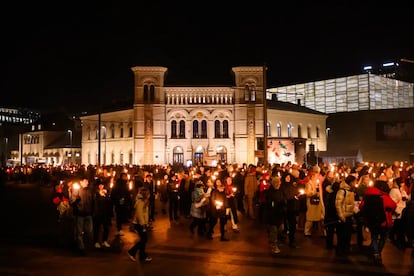

It is one of the most symbolic rituals in the Nobel Peace Prize celebrations. Following the award ceremony at Oslo City Hall, hundreds of people have taken to the streets of the Norwegian capital since 1954 to participate in the traditional torchlight procession, honoring each year’s winners and demonstrating that light always prevails in the darkness. This year’s event, however, was nearly canceled after the Norwegian Peace Council, a coalition of 17 civil society organizations, announced on October 24 that it would not be organizing the event, as it had in recent years, in protest against the decision to award the prize to María Corina Machado. The Council argued that the Venezuelan opposition leader’s profile was not “in line” with the values they represent. Amid the controversy, The Norwegian Venezuelan Justice Alliance, a small and little-known organization of Venezuelans residing in the Nordic country, stepped forward so that Machado could receive the same honor as her predecessors.
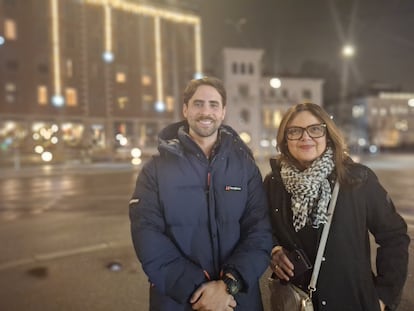
“We decided as soon as we found out,” explains Sonia Zapata, the founder and president of the association, which has a core leadership of no more than six members and about 15 volunteers who support them. “They kept telling us there was nothing else to be done, that we had to accept it, until finally they asked us if we wanted to do it, and we said yes,” says the 60-year-old Venezuelan lawyer, in an interview given this Monday in a café in downtown Oslo, just a few meters from the Norwegian Nobel Institute, the main organizer of the celebrations.
“It was the day that changed all of our lives,” she says, laughing, about October 24, exactly two weeks after Machado was announced as the Nobel Peace Prize winner. That’s how the name of the alliance, founded in 2018, landed on the official program of this year’s celebrations, which seek to strictly adhere to the wishes expressed in the will of Swedish chemist Alfred Nobel, the inventor of dynamite who died in 1896, and who conceived the prize to redeem himself and promote fraternity, the reduction of armies, and pacifist ideals.
“Ideology has played a significant role,” Zapata concedes regarding the controversy surrounding Machado’s award. “When she won the prize, she dedicated it to the Venezuelan people and thanked Donald Trump, and that’s all anyone has talked about in Norway since then, at least among opposition groups,” she notes. The lawyer, who has lived in the Scandinavian country for over two decades, acknowledges that raising awareness of the Venezuelan opposition’s cause has been “anything but easy,” partly because Norway maintained a degree of neutrality by participating for years as a mediator in the dialogues between Nicolás Maduro’s government and opposition groups, but also due to cultural differences, a lack of empathy, and prevailing prejudices against the Venezuelan diaspora.
“Some see us as the elites complaining because power was taken from them, but that’s a myth,” says Ramón Barreto, the organization’s political advisor. “We are nine million people who have had to leave the country, most of us on foot, with only the clothes on our backs,” says the 33-year-old political scientist, who has lived in Oslo for the past five years. “The profile of those of us here is very diverse,” adds the founder. It is, however, a small community compared to other countries. The number of Venezuelans who have applied for asylum in Norway in the last five years does not exceed 300, according to official figures.
The torchlight procession is not the only official event that has addressed the controversy surrounding Machado’s selection as this year’s peace laureate. “The global political divide of our time is not left versus right, but democracy versus dictatorship,” stated Kjersti Flogsta, director of the Nobel Peace Center, in a press release announcing a photographic exhibition of the opposition leader, opening to the public this Thursday, titled “Democracy on the Brink.” “The exhibition should be called Lives on the Brink,” counters Barreto. “It is essential to recognize the political context in which we find ourselves.”
“It’s difficult to defend certain things that are happening and certain attitudes that seem illegal to us or to be human rights violations,” Zapata says about the timing of the award, amid tensions between the Maduro regime and the White House over the U.S. military deployment in the Caribbean. “But we understand the dilemma María Corina faces,” he responds regarding the opposition leader’s relationship with the Republican. “We are in a life-or-death situation, and when we asked for help, no one helped us. The international response was minimal. So, thanking the only person who has helped you is something that comes naturally.”
“The prize allows us to call things by their name: in Venezuela there is a dictatorship that lost the elections last year and a struggle for democracy that has been internationally recognized,” Barreto states. “And it is also a recognition of an entire movement; as María Corina says, the Nobel Prize is ours because each of us can identify with this struggle.”
The award has not gone unnoticed by Chavismo either. The Venezuelan government closed its embassy in Oslo three days after Machado’s prize was announced — despite the fact that the Nobel committee is independent of the Norwegian government — citing a restructuring of its foreign service.
Members of the Norwegian Venezuelan Justice Alliance assert that they operate solely on donations and reject the myth that they have ties to economic or political powers. “We’ve been at it for 12 or 15 years, writing letters to members of parliament, organizing protests, and I’d like to think we’ve had some impact,” Zapata remarks, reflecting on the diaspora’s journey in Norway and the struggle they’ve faced against skepticism. “I know some members of the [Nobel] committee have been here and listened to the talks I’ve given, but obviously it’s not a victory I can claim as my own,” she adds regarding the prize. “Honestly, we weren’t expecting it.”
The torchlight procession is scheduled to depart this Wednesday at 5:45 p.m. (local time, 12:45 p.m. in Caracas) from the Nobel Peace Center and conclude in front of the balcony of the suite at the Grand Hotel in Oslo, where Machado is expected to stay should she attend in person to receive the prize. An estimated 800 people are expected to participate, including several groups of Venezuelans who have traveled thousands of miles in some cases to be there, according to the organizers. “Finally, the eyes of the world will be on us,” says Zapata, overwhelmed by the preparations but aware that it is a unique opportunity. “We have been waiting for this moment for years.”
Sign up for our weekly newsletter to get more English-language news coverage from EL PAÍS USA Edition









































