
Donald Trump’s big disappointment: US president loses bid for Nobel Peace Prize
The Norwegian committee’s decision to award the prize to Venezuela’s opposition leader María Corina Machado was made before the agreement between Israel and Hamas to end the war in Gaza
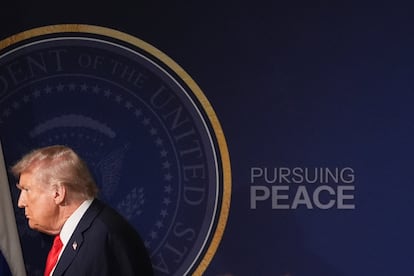
This Thursday, there was only one question in Washington: “Will Donald Trump get the Nobel Peace Prize?” The answer came at 5:00 a.m. Friday (11:00 a.m. in Oslo, Norway): And the answer was: “No.”
The U.S. president believed he deserved it, having publicly stated this for months, if not years, and lobbying for it. But the Norwegian Nobel Committee instead opted for Venezuelan opposition leader María Corina Machado. The Committee said that Machado’s work promoting democratic rights in her country is “one of the most extraordinary examples of civilian courage in Latin America in recent times.”
The White House criticized the decision through Communications Director Steven Cheung, who posted on X: “He has the heart of a humanitarian, and there will never be anyone like him who can move mountains with the sheer force of his will. The Nobel Committee proved they place politics over peace.”

Machado, 57, has been in hiding for almost a year. President Nicolás Maduro’s regime forced her to retreat to a secret location after the presidential elections of July 28, 2024, which marked a turning point in Venezuela’s recent history. Chavismo, claimed victory without providing any evidence to certify it, and “all Maduro has left today is terror,” she told EL PAÍS in a July interview from an undisclosed location.
Prize for Gaza deal
The supporters of giving the prize to Trump — a diverse list including prime ministers, foreign ministers, and Republican congressmembers seemingly as interested in world peace as in pleasing the White House resident — thought that after Trump’s announcement on Wednesday (36 hours before the Nobel Peace Prize announcement) that Israel and Hamas had agreed to the first phase of Washington’s peace plan for Gaza, the prize would be a given.
But it didn’t happen. And it was for reasons more in keeping with the prize’s guidelines than purely political ones. The Nobel Peace Prize, awarded every October since 1901 (with the logical exception of the World Wars), values candidates’ efforts of the previous year, even though the committee has sometimes broken that rule. And in 2024, Trump was not yet president of the United States, much less had he ended the “seven wars” (“eight, including Gaza,” he said this Thursday at the White House) that he repeatedly claims to have ended, despite the exaggeration that this represents.
In reality, the conflicts to which the Republican often refers, from the one between India and Pakistan to the one between Sierra Leone and the Congo, are disputes in which his Administration played a minor role, and which remain unresolved. “Unfortunately for Trump,” wrote the authors of Politico’s Playbook newsletter, perhaps the most influential one in Washington, early Thursday, “the Norwegian judges made their decision weeks ago. But next year’s award? Honestly, who knows?”
The Washington Post editorial, for its part, argued that the announcement that Israel and Hamas have agreed on Trump’s plan to end the two-year war in Gaza could be the greatest diplomatic achievement of his second presidency. In fact, the newspaper argued, if the deal holds — which we must not forget refers just to a first phase (points 3, 4, 5 and 7 of a 20-year plan) and is not yet the “lasting and permanent peace” that its promoter yearns for — the Republican leader “Trump can legitimately bolster his claim to be a peacemaker worthy of the Nobel Peace Prize.”
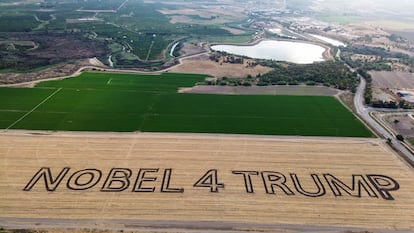
The committee chairman had already hinted this week that this year’s honoree was decided on Monday, so that Wednesday’s events could not have influenced the mood of the five voting members. The editors of Politico and The Washington Post also seem to forget that, contrary to Norwegian opinion, the “peacemaker” Trump disdains multilateral organizations and the fight against climate change, that he has ordered the deployment of troops against his own citizens and has asked the military to use cities like Portland and Chicago as “training camps.” Or that he has been launching extrajudicial military operations in Caribbean waters for weeks, as part of a “war” against drug trafficking and Venezuelan criminal gangs that he himself declared, without consulting Congress.
Sign up for our weekly newsletter to get more English-language news coverage from EL PAÍS USA Edition









































