
Trump anticipates a new phase of the US anti-drug operation in the Caribbean
The president considers the attacks on alleged trafficking boats a success and adds, ‘we’ll look at what phase two is’
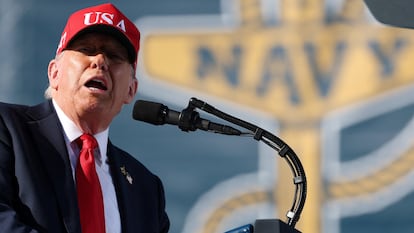

The U.S. government is entrenched in its defense of attacks against alleged drug boats in international waters in the Caribbean, and has threatened to move to a new phase of the operation. This Sunday, Trump boasted about these operations, spoke without giving details about a new attack that apparently took place on Saturday, and stated that “they’re not coming in by sea anymore, so now we’ll have to start looking about the land because they’ll be forced to go by land.”
In a speech aboard the aircraft carrier Harry Truman at the Norfolk Naval Base in Virginia to commemorate the 250th anniversary of the U.S. Navy, Trump boasted that since U.S. forces began their campaign of attacks against alleged drug smuggling boats in international waters in the Caribbean, “we can’t find any boats” in that area. “We’re so good at it that there are no boats. In fact, even fishing boats: nobody wants to go into the water anymore,” he said.
He also stated that “we did another one last night,” although he did not provide any details about this new attack, or whether there were any casualties. The lack of information may suggest that he was alluding to the incident revealed by his Secretary of Defense Pete Hegseth last Friday, in which U.S. forces killed four people when they fired on a boat. On previous occasions, when reporting on such strikes, neither Trump nor his team have provided many details — they have never identified the victims or the type of drugs they were allegedly transporting, for example — but they have disclosed how many people were on board. They have also often released a video with images of the attack.
A few hours earlier, Trump had declared the success of a campaign in which at least 21 people have died in four attacks, and said, “There’s no drugs coming into the water. And we’ll look at what phase two is.” On board the aircraft carrier, he gave some more clues about what he has in mind, indicating that he is considering bringing the operation against the cartels ashore, a possibility he had already raised in various statements. “They (the drug traffickers) won’t do so well there either,” he said in his speech on Sunday, without referring to the serious international repercussions that such action would likely have. Experts and human rights organizations have expressed serious reservations about the attacks on the boats, or directly consider them illegal.
For his part, Pentagon chief Hegseth assured Fox News, where he was an anchor until taking up his post last January, that his department has all the necessary authorizations to attack the vessels. “We have every authorization needed. These are designated as foreign terrorist organizations,” Hegseth said. “If you’re in our hemisphere, if you’re in the Caribbean, if you’re north of Venezuela and you want to traffic drugs to the United States, you are a legitimate target of the United States military.”
Since February, the United States has included several drug cartels, including the Venezuelan Cartel of the Suns and Tren de Aragua, on its list of foreign terrorist organizations, and justifies its attacks on the boats with this argument. When announcing the new attack on social media, the Secretary of Defense did not specify exactly which organization he linked the sunken boat to. In none of the attacks have he or any other member of the Republican administration, including Trump himself, provided evidence of this link or that the boats were transporting drugs.
This week, the U.S. government sent a memorandum to Congress in which Trump determined that the United States is in an “armed conflict” with drug cartels.
Trump made the remarks to reporters at the White House before attending the event to mark the 250th anniversary of the U.S. Navy at the Norfolk base, the largest in the world and home to the world’s most modern aircraft carrier, the Gerald Ford. His office described the event as a “display of naval might.”
Experts and human rights organizations consider these attacks illegal and point out that the correct course of action, if there is suspicion about the boats and their contents, is simply to intercept them and question their occupants, a task that until now has been handled by the Coast Guard.
Sign up for our weekly newsletter to get more English-language news coverage from EL PAÍS USA Edition









































