
US announces new attack on ‘narco-trafficking vessel’ off the coast of Venezuela
Defense Secretary Pete Hegseth claimed that the four crew members killed in the military operation were ‘narco-terrorists’
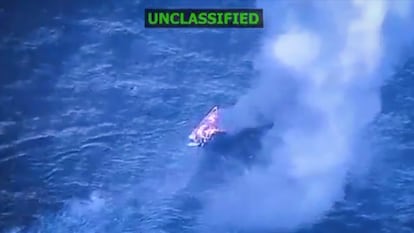

U.S. Defense Secretary Pete Hegseth announced on his X account this Friday a new attack against a boat in Caribbean waters, “off the coast of Venezuela.” This is the fourth such attack since the United States began these extrajudicial military operations in early September, which were carried out without requesting authorization from Congress.
This time, the announcement was not made by Donald Trump, as on previous occasions, although Hegseth said in the post that the orders came from the president. He added that the strike was against a “narco-trafficking vessel affiliated with Designated Terrorist Organizations in the USSOUTHCOM area of responsibility” — a reference to the U.S. Southern Command. He provided no evidence for any of these claims, and none has been offered for previous operations either.
According to the Pentagon chief, “four male narco-terrorists aboard the vessel were killed in the strike.” “The vessel was transporting substantial amounts of narcotics - headed to America to poison our people,” continued Hegseth’s message, which linked the military operation to the worst drug-related public health crisis in U.S. history. “These strikes will continue until the attacks on the American people are over!” the Defense Secretary also warned.

A few minutes later, Trump shared on his social network, Truth Social, the same video released by Hegseth, showing the moment the speedboat blew up. He also said it “was carrying enough drugs to kill between 25,000 and 50,000 people.” Again, he provided no evidence for this.
The attack comes after U.S. media reported on Thursday that Trump had sent a letter to Congress indicating his decision to consider the country as being in a “non-international” war with the drug cartels, and describing their members as “unlawful combatants.”
The notice followed the extrajudicial attacks that, over the past month, have sunk at least three boats (Trump has mentioned four, but all indications are that he referred to the same boat on two occasions) that allegedly carried drugs in international Caribbean waters. At least 17 people have died in these operations. A group of Democratic senators had demanded explanations from the White House in a letter regarding the legality of the attacks, reminding it that Congress must give the president permission to authorize a military strike, in accordance with the U.S. War Powers Resolution of 1973.
Rising tension
The news of the existence of that document coincided on Thursday, as tensions rose in Washington and Caracas over the imminence of a possible attack, with Venezuelan Defense Minister Vladimir Padrino López reporting the presence of five U.S. combat aircraft flying near Venezuela, over the country’s central northern coast.
The news of the document’s existence coincided Thursday with Venezuelan Defense Minister Vladimir Padrino López’s denunciation of the presence of five U.S. fighter jets flying near Venezuela, north of the Caribbean country’s central coast. “It is a provocation, a major threat against the nation’s security,” the general declared.
The White House accuses Nicolás Maduro’s government of leading a criminal organization dedicated to drug trafficking, and in recent weeks, the idea has spread among analysts in Washington that Trump could take advantage of the situation to force, with the determined push of Secretary of State Marco Rubio, a regime change in Venezuela.
In an armed conflict, one nation can attack another’s combatants even when engaged in combat. It can also detain them and subject them to military trials. By characterizing the campaign against the cartels as an armed conflict, the Trump administration appeared to claim extraordinary war powers to justify the attacks on the boats in the Caribbean. Many experts and human rights organizations consider these attacks illegal.
White House spokesperson Karoline Leavitt justified in her press briefing on Friday the fact that Trump is not involving Congress in this offensive. She also warned that he “has been very clear, dating back to the campaign trail,” when he “promised the American people he was going to end the drug epidemic.”
Sign up for our weekly newsletter to get more English-language news coverage from EL PAÍS USA Edition









































