
Israeli government approves Gaza ceasefire
The Netanyahu administration has approved by a broad majority the first phase of Trump’s plan, which according to the agreement, implies the war will ‘immediately end’

Two years, 67,000 deaths, and immense suffering later, the ceasefire in Gaza came into effect in the early hours of Friday morning after being approved by the Israeli government by a wide majority. All ministers voted in favor, except for nearly all members of the far-right parties Otzma Yehudit (Jewish Power) and Religious Zionist Party.
The text of the agreement signed that same morning in Egypt — and revealed by Israel’s public broadcaster — says that if it is agreed by both sides, the war would “immediately end.” However, Prime Minister Netanyahu’s office merely reported the approval of the “framework for the release of all of the hostages — the living and the deceased.” The Israeli army now has 24 hours to withdraw to the middle of Gaza and facilitate the exchange of prisoners and hostages, which will take place in the coming days.
The vote ends a dizzying 24 hours in which Donald Trump announced an agreement on the first phase of his peace plan for the battered Gaza Strip. The two sides and the Qatari, Egyptian, and now also Turkish mediators signed the deal in great secrecy and without media coverage in the Egyptian resort town of Sharm el-Sheikh, even as celebrations were already breaking out in Gaza and Tel Aviv.
A sign of the importance Trump attaches to the agreement is that his special envoy for the Middle East, Steve Witkoff, and his son-in-law and adviser, Jared Kushner, joined the Cabinet meeting, which concluded in the early hours of the morning.
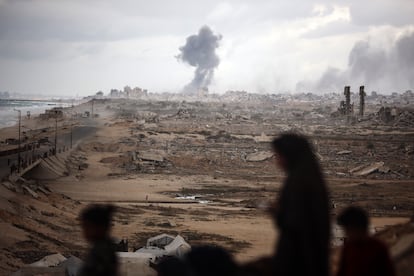
The first phase involves the release of hostages — officially set to take place within 72 hours of the army’s partial withdrawal, though Trump says it will likely happen on Monday or Tuesday — the freeing of nearly 2,000 Palestinian prisoners, the pullback of Israeli troops from half of the Gaza Strip, and a massive entry of humanitarian aid previously blocked by Israel. “I think it’s going to be a lasting peace, hopefully an everlasting peace,” the U.S. president declared in Washington.
Hamas will hand over the 20 living hostages and the remains of another 28 it has located. In addition, it commits to providing information on the whereabouts of other bodies. In exchange, Israel will release 1,700 Palestinians detained during the mass arrests carried out in Gaza during the invasion, plus another 250 prisoners — each including at least one serving a life sentence for participating in or organizing attacks related to the Middle East conflict. Israel will also return the bodies of 360 Palestinians killed in combat in the Gaza Strip.
The agreement is, above all, the first step toward a definitive end to the invasion that Israel launched two years ago — on the anniversary marked this past Tuesday — following the attack by the Islamist militia. The head of Hamas’s negotiating team in Egypt, Khalil al-Hayya, said Thursday afternoon that he had received “guarantees from the mediators [Qatar and Egypt]and the Americans that the war has ended indefinitely.”
The leaked text of the agreement is explicit on this point. “The war will immediately end upon the approval of the Israeli government,” states the agreement. “All military operations, including aerial and artillery bombardment and targeting operations will be suspended.” It also states that the Israeli army will not return to the areas from which it has withdrawn, though it leaves a vague caveat, conditioning this on Hamas’s “full implementation of the agreement.” Bombardments continued on Thursday, killing at least 20 people, according to Palestinian health sources.

Celebrations
Scenes of jubilation have unfolded in both Gaza and Israel since the U.S. president announced the deal Wednesday night. Negotiating delegations worked until Thursday morning fine-tuning the final details, according to Egyptian state media.
There is still no precise date for the release of the at least 20 living Israeli hostages, whose preparation — given that they are scattered across secret locations, some held by militias other than Hamas — will take at least two days. Israeli media reported Thursday morning that the handover of captives could begin as early as Saturday, an expectation that Trump himself dampened hours later, estimating that they would return to Israel “on Monday or Tuesday,” according to correspondent Iker Seisdedos.
That same Monday, Trump will address the Israeli Parliament at Netanyahu’s invitation.
In an interview with the U.S. conservative network Fox, Israel’s Foreign Minister Gideon Saar emphasized that Israel is committed to the ceasefire plan and has no intention of resuming the war once the agreement is implemented.
Earlier, a Hamas spokesperson, Hazem Qassem, accused Netanyahu of manipulating the agreed-upon timelines, lists, and procedures. “There was talk of the ceasefire taking effect at 12:00 noon today, but the [Israeli] occupation is delaying the announcement for internal reasons,” said Qassem, who added that Hamas remains in contact with mediators to ensure Israel complies with the terms agreed upon.
A senior official of the Palestinian militia, who responded to questions from EL PAÍS on condition of anonymity, also criticized Netanyahu, asserting that “he is trying to avoid implementing the decisions [outlined in the agreement] to stop the genocide.” According to this Hamas representative, the Israeli prime minister “has not yet given his army the order to halt the bombings.”
In Israel, the most critical voice, Finance Minister Bezalel Smotrich, has limited himself to saying he has “mixed feelings” and will therefore not vote in favor. On one hand, he said he felt “great joy” at the return of the hostages, but on the other, “immense fear of the consequences of emptying the prisons and releasing the next generation of terrorist leaders who will do everything to continue to pour rivers of Jewish blood.” He added: “Immediately after the abductees return home, the state of Israel must continue to strive with all its strength to fully eradicate Hamas.”
Challenges in second phase
Since Trump and Netanyahu presented the agreement at the White House on September 19, the way it has been interpreted has been a textbook example of realpolitik. The deadlines and the official start date of the agreement have not followed what was initially announced. It was also not originally designed as a two-phase plan, but it has been treated as such, which has allowed Netanyahu to push it through. Most of the challenges are concentrated in the second phase, such as disarming Hamas or establishing a technocratic Palestinian government.
Egypt, meanwhile, continued pressing on Thursday for the authorization of excavators to enter Gaza to facilitate the delivery of humanitarian aid. In a social media message, Egyptian President Abdel Fattah el-Sisi celebrated the Sharm El Sheikh agreement, noting that it comes “after two years of suffering.” He also expressed his hope that the deal not only closes the chapter of war, but “opens the door of hope for the peoples of the region for a future defined by justice and stability.”
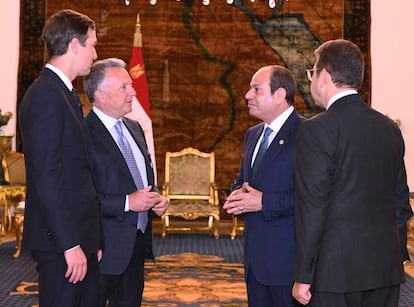
The agreement came after an intense day of indirect negotiations that began Wednesday morning in Sharm El Sheikh between mediators from Egypt and Qatar and the Hamas delegation, led by Khalil al-Hayya. In the afternoon, the Egyptian and Qatari mediators met with the U.S. and Israeli delegations, which included the head of its negotiating team and Minister of Strategic Affairs Ron Dermer, a close ally of Netanyahu. In the evening, a further expanded session was held, continuing into the early hours of Thursday, when Trump finally announced the agreement and both parties, along with the rest of the mediators, joined in the celebrations.
Sign up for our weekly newsletter to get more English-language news coverage from EL PAÍS USA Edition









































