
A life without school in Gaza: ‘At night, I use my phone’s flashlight to study. Hunger makes it hard for me to concentrate’
The Palestinian Authority, the UN, and NGOs offer classes in shelters and displacement camps, as well as online courses, but 60% of students have not been able to continue any type of learning since October 2023, in a territory where illiteracy was almost nonexistent
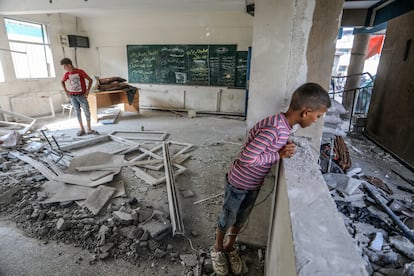

Forty children between the ages of six and 10 sit on the ground in four tents, worn by months of wind, rain, and sun, near the Nuseirat refugee camp in the central Gaza Strip. Young volunteer teachers from a local association teach them the basic subjects: grammar, math, science, and a little English. They also try to instill in them a love of reading. Almost everything is taught orally, without blackboards or books, and with barely any notebooks or pencils, which have become a real luxury in Gaza, devastated by two years of war. Seven-year old Dania lives in the camp, and every morning she attends these classes, smiling and with her braids freshly combed.
“We would very much like to see her sitting at a desk, in a real school... but it’s this or nothing,” sighs Talal Abu Majd, her grandfather, a veteran teacher from Gaza, who was the headmaster of a school until the Israeli offensive began in October 2023.
Abu Majd explained to this newspaper by phone that the family is afraid to leave the girl in this makeshift school “in case something happens” during the hours she is there, but they are aware that it is the happiest time of the day for her. “She is very happy when she gets ready. This routine is very good for her psychologically. It is very important for us that she does not forget the habit of going to class, listening quietly, and applying herself, even if it is just in this way,” explains her grandfather.
Some 660,000 Gazan children should be in school right now, but for the third consecutive October, they are not. In reality, some may be physically in a school, but with their families and surrounded by hundreds of displaced people like them, since the schools in the Gaza Strip, if they are even remotely standing, are being used as shelters.
According to the UN, more than 91% of Gaza’s schools (518 out of a total of 564) will need to be rebuilt to be usable again. UNRWA, the UN agency for Palestinian refugees, states that 432 schools have been directly targeted since October 7, 2023.
According to the UN, more than 91% of Gaza’s schools will need to be rebuilt to be usable again
“As long as children continue to go to school, even if it’s in a tent, there’s less risk of them becoming a lost generation. We see this in every conflict, and Gaza is no different,” Juliette Touma, UNRWA’s Director of Communications, told this newspaper.
A weapon for life
Dina, 40, is a mother of four children. The two youngest, aged nine and 12, have been trying to attend classes since October 2023, but difficulties have meant they have only been able to study for about two or three months a year. The family has moved several times and now lives in a tent in the Al Mawasi area, in the southern Strip, where they attend a community center staffed by several volunteer teachers. “I don’t really know what they’re learning, because there’s no method, nor any kind of assessment or follow-up. This is not what a mother wants for her children. I wanted education to be their greatest weapon in life,” she says.
“They could take classes remotely, but sometimes I can’t charge my phone and the internet is terrible. I’m afraid my children have lost their future,” Dina says anxiously, hoping for an agreement soon that will end the bombing and allow a semblance of normality to return.
This is not what a mother wants for her children. I wanted education to be their greatest weapon in lifeDina, Gazan mother
According to the UN, only 38% of school-aged Gazans have been able to access any form of learning in the last two years. When a ceasefire was declared last January, which lasted almost two months, Palestinians in the Strip wanted to quickly rebuild their homes and their lives. In the north and south of the territory, one of the first gestures of this determination to recover was to get children back to school. Wherever it was: in tents, among the ruins of schools, outdoors...
“Education in Gaza has been a priority for generations, regardless of a person’s social status. It’s a right they value highly, which is why classes resumed quickly,” Touma explains.
According to UNESCO figures published by official Palestinian agencies, only 2% of the Strip’s population aged over 15 was illiterate in October 2023, one of the lowest percentages in the Arab world. Gazan youth was educated and cultured, even though they viewed the world through a cell phone screen due to the Israeli blockade, in place since 2007.
Before the Israeli offensive began, a total of 300,000 children in Gaza attended UNRWA schools. For the past two years, the UN has offered “temporary learning spaces,” often located within schools converted into shelters, where UN teachers teach students basic concepts so they maintain the habit of studying and learning. According to UNICEF, some 50,000 children attended these informal learning spaces during the previous school year.
“During the ceasefire, the number of students in these locations increased every day. But when the truce ended, many of these locations disappeared,” Touma laments.
Today, over 80% of the Strip’s 140 square miles are military zones or areas that have received an evacuation order. As a result, dozens of these informal schools have closed or been destroyed.
Hala is a mother of eight children, and only one of them, eight-year-old Ahmed, goes to a tent to study three days a week. “They’ve given him a notebook and a pen. When he returns to the tent, his older sister helps him with his homework,” she explains. “I hope there will soon be more learning centers for my other children to attend,” this mother prays.
Studying with a flashlight
Touma recalls that more than 360 of the organization’s workers have died violently since October 7, 2023. “A significant number were teachers. But we won’t stop working, even if we’re under attack, and there will always be a school open somewhere.”
Currently, thousands of Gazan students of all ages are studying online, either by visiting locations where organizations try to provide them with an internet connection, or simply by using their cell phone signal.
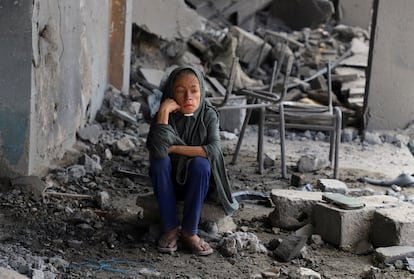
“I have to walk quite a bit to find an internet connection that allows me to download the videos I need. At night, I use my phone’s flashlight to study because there’s no electricity in Gaza. The bombs and fear distract me a lot. Hunger also prevents me from concentrating,” says Sham Ammar, a high school student in Nuseirat, in statements reported by the Palestinian NGO Al Mezan, which tries to facilitate internet connections for students.
Nothing replaces school. It goes beyond learning itself. I’m talking about friends and developing social skills. All of that is being lostJuliette Touma, UNRWA
Despite the difficulties, which are difficult to imagine from a distance, Touma is pleased that there are increasingly more online learning options and the possibility of sitting for remote exams in Gaza. “But nothing replaces school. It goes beyond learning itself. I’m talking about friends and developing social skills. All of that is being lost,” laments the official, referring to the trauma that has struck virtually all of Gaza’s children.
In September, the Palestinian Authority’s Education Minister Amjad Barham welcomed the fact that 26,000 students in Gaza were able to take university entrance exams, known as tawjihi, remotely. “Despite the destruction, displacement, and hunger, the students of Gaza reaffirm that education is an essential right,” he said at a press conference.
But since October 2023, a total of 71,000 Gazan students have been unable to take these exams, according to ministry figures. The UN also estimates that at least 18,000 students have died violently in Gaza over the past two years.
Online education is also the only option available to Gazans who were able to leave for Egypt in the early months of the war. The neighboring country prohibits their entry into public schools, and they must continue their studies remotely, following the curriculum offered by Palestinian schools.
In addition to Gaza, UNRWA was also unable to open 10 schools in the northern West Bank at the start of this school year due to Israeli raids in recent months, leaving 4,000 children without classes. The same occurred in six schools in East Jerusalem after they were forced to close by Israel, affecting nearly 800 children. Only some of these students have been able to enroll in other schools. “Others haven’t found alternatives,” Touma laments.
Sign up for our weekly newsletter to get more English-language news coverage from EL PAÍS USA Edition









































