
Tensions rise after India strikes ‘terrorist infrastructure’ in Pakistan
At least 26 people have been killed in the air raid, according to Pakistani authorities, who have promised to retaliate
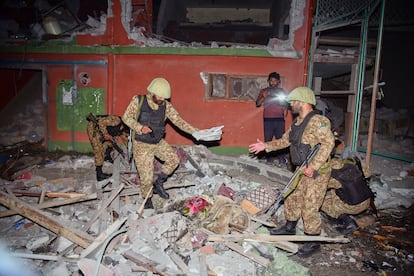

The already strained relationship between India and Pakistan — marked by decades of hostility and deep mistrust — has reached one of its most critical points in over 20 years. Early Wednesday, the Indian Army launched an air offensive against several targets in Pakistani territory and the Pakistan-controlled portion of Kashmir. According to India, these sites were linked to the planning of last month’s terrorist attack on Indian soil.
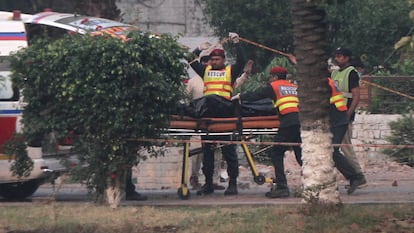
The bombing has left at least 26 people dead and 46 wounded, according to Pakistani authorities, and has triggered a wave of mutual accusations between two nuclear-armed neighbors locked in a territorial conflict that has lasted nearly eight decades. Pakistani Prime Minister Shehbaz Sharif said that his country is preparing a response but did not provide further details.
India has framed the strike as part of “Operation Sindoor,” a retaliatory measure following the April attack in the tourist resort of Pahalgam, located in the Indian-controlled part of Kashmir. In that incident, 26 Hindu tourists were killed in a shooting claimed by the Resistance Front, an insurgent group linked to the Islamist militant organization Lashkar-e-Taiba — an outfit India accuses of receiving support from Islamabad. Pakistan, however, has denied any involvement.
“India has demonstrated considerable restraint in selection of targets and method of execution,” the Indian Ministry of Defense stated in a press release. It also specified that nine facilities were attacked, described as “terrorist infrastructure” in Pakistan and in “Pakistan-occupied” Jammu and Kashmir, where, it insists, “terrorist attacks against India have been planned and directed.” The statement described the operation as “measured” and “non-escalatory,” arguing that it deliberately avoided striking Pakistani military installations.
Pakistan’s Ministry of Foreign Affairs has called the assault “a blatant act of war” and denounced India for violating its sovereignty by “using precision weapons from its own airspace” and “targeting civilians with missiles.”
An Indian military spokesperson cited by Reuters said Indian forces had struck barracks of the armed groups Jaish-e-Mohammed and Lashkar-e-Taiba, both linked to previous attacks on Indian territory. The Indian news channel CNN News-18 reported that “12 terrorists” were killed and at least 55 people were injured. Following the bombardment, the Indian Army posted on X: “Justice is served.”
However, Islamabad maintains that six sites were bombed, all of them civilian, including two mosques. Pakistan claims that Indian missiles struck three locations within its territory and that its military shot down five Indian fighter jets, a claim New Delhi has not addressed. A Pakistani military spokesman told Geo News that in addition to the eight dead, there were 35 wounded and two people missing.
The escalation has shaken the fragile truce first signed in 2003 and reaffirmed in 2021. This attack goes beyond India’s 2019 airstrike in retaliation for a suicide bombing in Pulwama, Indian Kashmir, that killed 40 paramilitary personnel — an event that led to India’s first air incursion into Pakistani territory since the 1971 war. It also surpasses the 2016 operation, when Indian commandos crossed the Line of Control to strike alleged insurgent bases after 18 soldiers were killed in Uri.
Unlike those actions, the current operation has involved a broader and more coordinated offensive, using long-range missiles launched from Indian airspace to hit targets outside the Kashmir region. In effect, it represents a redefinition of the tacit boundaries both countries had observed since the 2003 ceasefire, and it rekindles fears of a potential spiral of retaliation with unpredictable consequences.
Images aired on Indian television showed explosions, plumes of smoke, and scenes of panic. Witnesses quoted by Reuters confirmed blackouts and the presence of military aircraft over Muzaffarabad, the capital of Pakistan-administered Kashmir. Pakistan has declared a state of emergency in Punjab province and placed hospitals on high alert. On the Indian side of Kashmir, residents and police reported artillery shelling and aerial activity along the Line of Control, the de facto border between the two countries.
India has begun rallying support and justifying its actions to key allies. National Security Advisor Ajit Doval has contacted U.S. Secretary of State Marco Rubio, while other senior officials have briefed counterparts in the United Kingdom, Russia, Saudi Arabia, and the United Arab Emirates, according to diplomatic sources cited by several agencies.
U.S. President Donald Trump described the situation as “a shame” and said he hoped it would end “very quickly.” The United Nations has urged both sides to exercise “maximum military restraint.” Pakistan’s main ally, China — whose President Xi Jinping is visiting Russia this Wednesday, a key Indian partner — has expressed regret over India’s military offensive and concern about how the situation may unfold. “India and Pakistan are and will always be each other’s neighbors, and they are both China’s neighbors,” said a spokesperson for China’s Foreign Ministry.
Sign up for our weekly newsletter to get more English-language news coverage from EL PAÍS USA Edition









































