
A Nobel Peace Prize for Trump, a genuine possibility that raises many questions
The US president is one of 338 names registered as candidates, but bookmakers give him a 3% probability of victory
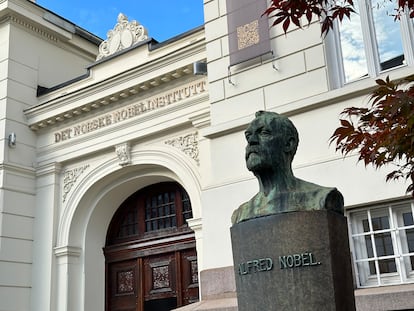
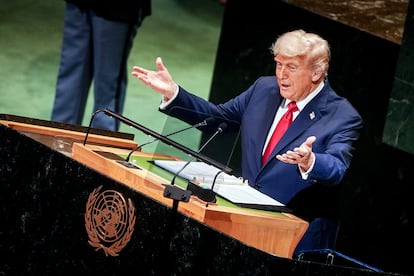
Speculation is growing ahead of the Norwegian Nobel Committee’s announcement in Oslo this Friday that it will reveal the winner of the Peace Prize. U.S. President Donald Trump has been insisting for months that he deserves it for his supposedly peaceful initiatives as a mediator between warring countries. This year, the committee received a total of 338 nominations for the prize (244 individuals and 94 organizations). Although the list is not made public, it is known that Trump is among the nominees, as confirmed by Nina Graeger, director of the Peace Research Institute Oslo (PRIO), which advises the committee.
In his will, Alfred Nobel, the father of the five prizes named after him, left a clear description of the ideal candidate for the Peace Prize: “[...] the person who shall have done the most or the best work for fraternity between nations, for the abolition or reduction of standing armies and for the holding and promotion of peace congresses.” And this, according to Graeger, clashes with some of the initiatives promoted by Trump.
“The United States’ withdrawal from global agreements and the trade war it has unleashed violate the principle of ‘promoting international cooperation.’ And its intention to seize Greenland would, if realized, be a violation of international law.” The biggest obstacle, the expert says, is the president’s overly “businesslike” attitude toward entering into peace negotiations: “It’s not just about the handshake.”
Graeger doesn’t rule out the possibility of Trump winning the Nobel Prize, although she considers it unlikely. This opinion is shared by bookmakers. On the Polymarket platform, one of the world’s largest prediction markets, bettors assign the Republican only a 3% chance of victory. Meanwhile, the Sudan Emergency Response Rooms (ERR), an initiative led by the Sudanese community in response to the humanitarian crisis unleashed by the civil war that erupted in April 2023, leads that market with 28%. ERR is followed by Yulia Navalnaya, widow of Russian opposition leader Alexei Navalny (10%), and UNRWA, the UN agency for Palestinian refugees (8%).
If the Republican magnate’s dream is realized, Graeger believes it would become a highly controversial case: “It would draw a lot of attention to the award. It could damage the reputation of the Nobel Peace Committee, unless he actually manages to negotiate a lasting peace in Gaza.” Trump’s peace plan for Gaza is still partial and, furthermore, according to the expert, “probably came too late to be considered this year.”
Graeger also highlights other Trump efforts, such as the attempt at mediation between Russia and Ukraine, and the “seven wars” the U.S. president claims to have ended, an assertion that in some cases clashes with reality.
In general, awarding the prize to sitting leaders — as was the case with Barack Obama, less than a year after taking office — is a risky move, according to the PRIO director, mainly because there are external factors that can alter the president’s behavior.
Kristian Berg Harpviken, director of the Norwegian Nobel Institute and secretary of the committee, declined to comment on Trump due to a confidentiality clause. He and the five members — politicians appointed by the Norwegian Parliament, as Alfred Nobel desired — who make up the panel are prohibited from revealing any information about the candidates. The secretary of the organization explains why: “At first [the confidentiality clause] was so that the committee could work without undue influence. Now it’s because we value the safety and security of each candidate.”
In this regard, only the committee can receive and evaluate nominations. Once the deadline for submissions has closed (January 31), the panel convenes several sessions, consults with experts, and thoroughly studies each profile, always following the three criteria outlined in Nobel’s will, until a shortlist is selected with a pre-selection of candidates.
The PRIO director breaks down the criteria stipulated by Nobel: “The committee evaluates three principles that the candidate must meet: promoting international cooperation, contributing to disarmament, and fostering peace.” However, she asserts that these are not indispensable elements, but merely guidelines, as other factors are also taken into account, such as the relevance and duration of the peace agreements reached.
“You don’t have to be a saint to win the Nobel Peace Prize,” jokes Harpviken. “The committee evaluates the merit of each candidate.” Still, he emphasizes how demanding the process is. “It’s easy to be nominated; the hard part is winning the prize,” he adds. The Nobel Peace Prize is, in his words, a “very attractive” award, due to “the certificate of [the winner’s] contribution to the world.”
Despite the committee’s demands and rigor in evaluating profiles, the final decision sometimes generates a lot of controversy. In fact, the panel frequently receives criticism. But it doesn’t seem that outside opinions influence its members’ decision. “The committee is bold; it’s not afraid to award the prize to a candidate, even if it’s controversial,” Graeger notes.
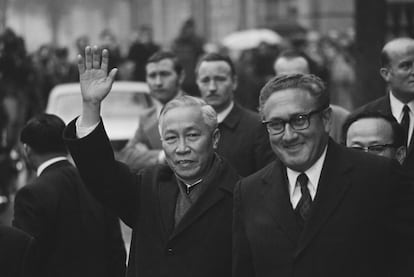
One of the most notable cases occurred in 1973. The awarding of the prize to Henry Kissinger, the strategist who set the course of U.S. diplomacy in the second half of the 20th century, and the Vietnamese revolutionary Le Duc Tho “for jointly having negotiated a cease fire in Vietnam,” according to the award’s website, sparked protests in Norway because the conflict had not ended as a result of their efforts. Le Duc Tho declined the prize, while Kissinger did not attend the ceremony.
Whether controversial or not, the Nobel Peace Prize is irrevocable once awarded. Therefore, the committee cannot reverse its decision, under any circumstances, once the winner has been revealed.
The other prize categories include Medicine or Physiology, Physics, Chemistry, Literature, and Economics, although the latter was not part of the original prizes, having been established in 1968. All awards are presented between October 6 and 13. The 10th of the month commemorates Alfred Nobel’s death.
Sign up for our weekly newsletter to get more English-language news coverage from EL PAÍS USA Edition









































