
Trump, Nobel Peace Prize winner? The president and his allies are maneuvering to achieve it
From Netanyahu to the leader of Pakistan, proposals are growing to reward the US president and thus gain his sympathy. Experts consider it unlikely, although they do not rule it out altogether
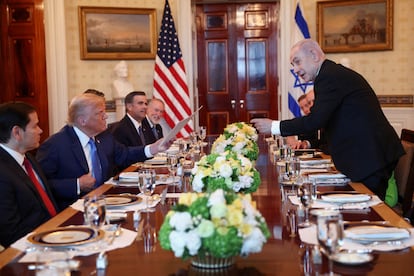

A new trick has been added in recent weeks to the repertoire available to international leaders visiting the White House to win over Donald Trump: asking for him to be awarded the Nobel Peace Prize. Benjamin Netanyahu did it during his recent trip to discuss the Washington-proposed ceasefire in Gaza. And so did the leaders of five African countries in a meeting with the U.S. president that will be remembered for the fact that Trump marveled at the excellent English spoken by Joseph Boakai of Liberia, a country founded in the 19th century by freed American slaves and whose official language is... English.
After that, an African journalist who has gained some notoriety in Washington for her eagerness to curry favor with the U.S. president, asked the African leaders if they would support awarding the Nobel Peace prize to Trump. The president, who had begun the meeting by asking everyone present to keep their speeches short, came out of his apparent daze and let them speak at length, while he listened with a smile on his face.
The leaders of Pakistan and Belarus also support this motion, as do a handful of House Republicans and two of Trump’s cabinet secretaries. Most importantly, Trump himself has been convinced he deserves the award since around 2019, when he traveled to North Korea.
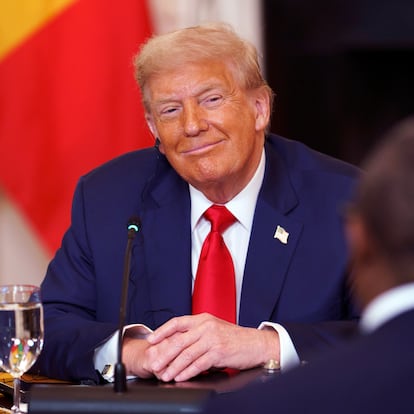
Since his return to power last January, and according to his own telling of it, the president has personally ended the following conflicts: the escalation of tensions in May between India and Pakistan, the recent “12-Day War” between Israel and Iran, and the “more than 30-year-old” dispute between Rwanda and the Democratic Republic of the Congo, whose foreign ministers he received at the White House. He has also asserted that he stopped a war between Serbia and Kosovo before it began. And he insists, whenever possible, that he would like to change the title of Defense Secretary Pete Hegseth to Secretary of War, a name that was used until 1947.
The conservative columnist Jay Nordlinger, author of the most comprehensive book on the history of the Nobel Peace Prize, published in 2012, cannot “imagine that these achievements claimed by the U.S. president are true” and doubts that he will be awarded it, “although it cannot be ruled out entirely.” The greatest merit on his resume, according to Nordlinger, is the signing of the Abraham Accords, which in 2020 led to the reestablishment of relations between Israel and several Arab countries. One of the conditions of Alfred Nobel’s will states that the prize should be awarded in recognition of achievements from the previous year, but the committee does not always comply with that premise.
Four precedents
“Trump is an old-school guy,” Nordlinger adds in a video interview from his home in New York. “He grew up in the second half of the 20th century, so he thinks it’s a great achievement to be on the cover of Time magazine, when it’s already lost all relevance. The same goes for the Nobel Prize. It’s always been a great achievement to win it. He would love to belong to that club, to rub shoulders, for example, with Mother Teresa of Calcutta. He’s a man fascinated by grandeur, and the Nobel Peace Prize is a great award, perhaps the most prestigious in the world.”
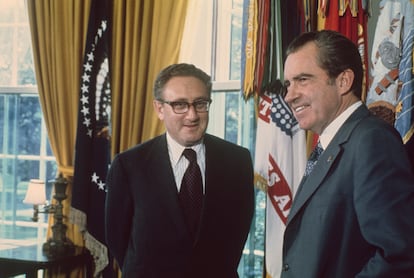
If he wins, Trump would become the fifth White House resident to do so since the award was founded in 1901. The others are Theodore Roosevelt (1906), Woodrow Wilson (1920), Jimmy Carter (in 2002, when he was no longer in power), and Barack Obama (2009). Henry Kissinger also has the honor; he was awarded the prize in 1973, along with North Vietnamese diplomat Le Duc Tho. That was, Nordlinger acknowledges, the most controversial decision in the award’s history.
Dan Smith, director of the Stockholm International Peace Research Institute, from where he spoke to EL PAÍS via videoconference, says that concluding that just because the prize was once awarded to Kissinger—who ordered bombings in Cambodia and Vietnam that caused hundreds of thousands of deaths—it’s possible they’ll give it to Trump ignores the fact that the current Nobel committee isn’t the same as it was then, “not even the one that honored Obama.” “Knowing its members, I don’t think they’ll be impressed by Trump’s boasting. If there were a real achievement, they’d take it seriously, and even though they know it would be controversial, they might award it. But so far, there isn’t.” This committee has also tended in recent years, Smith warns, “to honor individual activists and grassroots movements, rather than presidents.”
Peace in Ukraine continues to be elusive, the expert continues. “He has only achieved an extremely brief ceasefire in Gaza, and since then, he has been supporting Israel in actions that, even for much of the public in that country, fall into the category of war crimes. As for Iran, he supported Netanyahu in an illegal act of aggression against Tehran,” he adds.
Smith—who last year unsuccessfully proposed that the Nobel Peace Prize be declared void for the first time since 1972, given the current state of the world, “full of conflict, hostility, and confrontation”—believes that Trumps mediation between Rwanda and the Democratic Republic of the Congo has been “more about defending American interests. And you don’t get an award in Oslo for defending your own interests,” he adds. Although with Trump, you never know. And it wouldn’t be the first time that one of the president’s favorite tricks worked: often repeating something that might initially sound absurd to make it seem less so.
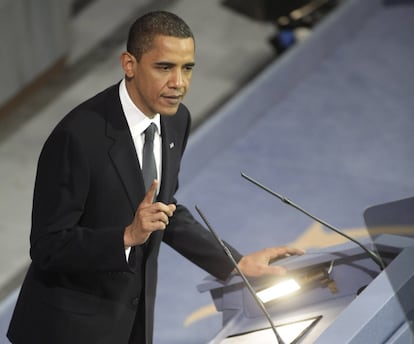
Obama’s precedent particularly irritates Trump. “He doesn’t like being downplayed compared to his predecessors,” explains Jeff Le, who served as a liaison between the California administration and Trump’s in his first term. “Why did Obama, who hadn’t yet done much to deserve it, get it, and not him?” Obama received it after only a few months in office. Nordlinger writes in his book on the history of the Nobel Prize that the committee awarded him the prize because he emerged as “the dream president [for its members], just as George W. Bush represented their worst nightmare. That award was like a sign of relief, because Bush was no longer in charge. A way to bless a new beginning.”
Jeff Le, for his part, ventures that Trump won’t let up on his push for the award. “Next year, for example, is the 250th anniversary of American independence, as well as the World Cup and the Olympic Games [in 2028].” “We’re still halfway through the season,” Le adds, “and, like in football, a lot can still happen, but it seems to me that [Trump] is pretty high up the list.”
As high as second place, with a 25% chance, according to the prediction website Oddspedia. Leading the way is Yulia Navalnaya, widow of Russian dissident Alexei Navalny (40%). And in third place? Ukrainian President Volodymyr Zelenskiy, who has been waiting for more than six months for Trump to fulfill his biggest unfulfilled peace promise: that he would end Russian aggression “in a single day.”
Sign up for our weekly newsletter to get more English-language news coverage from EL PAÍS USA Edition









































