
Who will win the Nobel Prize for Literature?
Amitav Ghosh, László Krasznahorkai, Cristina Rivera Garza, and Enrique Vila-Matas are the bookmakers’ favorites
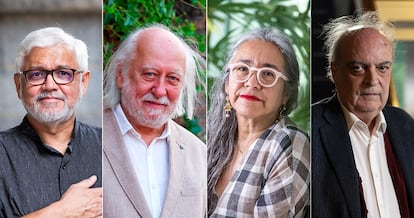

This Thursday, the Nobel Prize in Literature will be announced in Stockholm, so it’s that time of year when readers, booksellers, translators, editors — and of course, writers — try to predict who will win.
Beyond the personal biases that can cloud judgment in these discussions, what do the betting houses say? According to Ladbrokes, the Chinese writer Can Xue and the Hungarian László Krasznahorkai are in the lead this year, followed by two Spanish-language authors, Mexican writer Cristina Rivera Garza and the Spaniard Enrique Vila-Matas, who are tied with the Australian Gerald Murnane, the Romanian Mircea Cărtărescu, and the U.S. writer Thomas Pynchon.
Cross-referencing odds from various bookmakers, as compiled by Nicerodds, places the Indian Amitav Ghosh at the top. In addition to the previously mentioned contenders, it highlights several other perennial favorites: the Japanese writer Haruki Murakami, British-American Salman Rushdie, Canadian poet Ann Carson, and the Antigua-born Jamaica Kincaid. Also ranked highly on the lists are Margaret Atwood, Lyudmila Ulitskaya, and Ersi Sotiropoulos.
Language, geography...
Geographic and political factors also emerge each year in discussions about who will receive the Nobel, and they could give an edge in 2025 to the Syrian poet Adonis, a long-standing candidate. These global considerations may also benefit Spanish-language writers, since it has been 15 years since a writer in Spanish, Mario Vargas Llosa in 2010, received the award (the previous one being Camilo José Cela in 1989). If Indian author Amitav Ghosh wins, he would be only the second author from that country to be honored, after Rabindranath Tagore in 1913.
Gender parity
The Swedish Academy emphasizes that the Nobel Prize is fundamentally a literary award, and that is what it rewards. Six members of the Academy make up the jury, which rotates every three years and is currently chaired by Anders Olsson, 76. The 2025 jury members who voted are Ellen Mattsson, Anne Swärd, Steve Sem-Sandberg, Anna-Karin Palm, and Mats Malm, who serves as secretary. The controversies that surrounded the jury in 2018 are now behind them.
There is gender parity on the jury, and parity has also been observed among the list of laureates over the past 10 years. As for the age of recipients, last year Han Kang, the first Asian woman and first South Korean to win the Nobel, demonstrated — like Olga Tokarczuk before her — that a writer does not need to be 70 or older to be recognized by the Swedish Academy.
From June through the end of August, the jury and its advisers read works from the pool of nominees, and deliberations began in September. Notes from these discussions will be made public 50 years from now, as required by the rules. But this Thursday, the verdict will be announced, and a writer will receive the call that could change their life.
Instinct or luck beyond the odds
Other oracles? The British publishing house Fritzcarraldo, founded in 2014 by Jacques Testard, has correctly predicted the Nobel four times in its little more than 10 years of existence: Svetlana Alexievich in 2015, Olga Tokarczuk in 2018, Annie Ernaux in 2022, and Jon Fosse in 2023. The elegant, youthful imprint seems attuned to the same wavelength as the Nobel Committee, although the Franco-British author Testard told EL PAÍS last year that it is more a matter of luck.
He attributed his success to closely following translations and the reception certain authors receive in different countries. His first coup came with the Belarusian Svetlana Alexievich, whose rights he purchased months before she won the Nobel, after reading her work in French and noting its critical acclaim during the literary season in France. And indeed, France is the country with the most Nobel Prizes in Literature (16). Could its current literary scene serve as a crystal ball? Time will tell.
Sign up for our weekly newsletter to get more English-language news coverage from EL PAÍS USA Edition









































