
Petro emerges reinforced from his meeting with Trump at the White House
The highly anticipated get-together exceeded the expectations of the Colombian leader, four months before the presidential election that will define the continuity of his political project
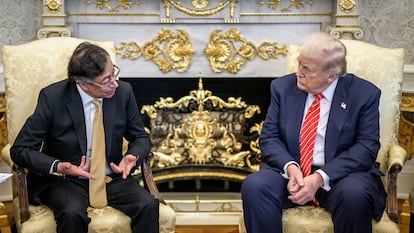

For weeks, in Colombia, there was more talk about what could go wrong than what could go right. The meeting between Donald Trump and Gustavo Petro this Tuesday was a trial by fire. Two unpredictable leaders with a history of excesses could easily turn it into a train wreck, one in which Colombia stood to lose. The fear wasn’t just of a direct confrontation. There were also other concerns: that Petro would go off on tangents, that he would monopolize the conversation, or that, as some of those who saw him the day before the meeting warned, he would end up “focusing on the cosmic.” In some sectors, there even seemed to be an expectation — almost a desire — that everything would derail in the middle of the Colombian election campaign. It didn’t happen. Against many predictions, the meeting went well. “I thought he was terrific,” said the Republican. “I like frank Americans,” praised the Colombian leader.
Colombia had a lot riding on that meeting. What will happen next remains to be seen, and the specific agreements haven’t been made public, but everything suggests that the country is regaining an alliance on sensitive issues such as drug trafficking, energy, and regional mediation. An unexpected ally, but an ally nonetheless.
For decades, Colombia has benefited from U.S. military cooperation, which was a key factor in bringing the FARC guerrillas to the negotiating table. While this relationship has persisted, its intensity has diminished. However, the country is suffering from escalating violence, for which U.S. intelligence and technology remain strategic.
In addition, the economic link is vital: Colombia’s trade deficit is partly balanced by remittances from more than three million Colombians living in the U.S. — more than $13 billion a year. And about 30% of its exports go to the United States.
The United States also needs Colombia to remain firm against drug trafficking, to shares intelligence information, and to serve as an accomplice in a turbulent region, especially now that neighboring Venezuela faces uncertain political change and seems to be opening up its economy — or at least its enormous oil deposits — to Washington.

In this context, six months before the end of his term, the president of Colombia leaves Washington feeling reinforced. More so than his critics expected and, probably, more than he himself had anticipated. It was an unequal meeting with a much more powerful president who is his ideological opposite. But what could have been a trap — an awkward scene or even a public humiliation, as happened to Ukrainian President Volodymyr Zelenskiy — has ended up being a political asset just four months before the presidential elections that will define the continuity of Petro’s political project. Petro is leaving, but the benefits will ultimately be reaped by whoever takes his place among Colombia’s progressive candidates.
By adopting a more pragmatic and less ideological approach, Petro has defused one of the country’s most widespread fears: that of a crisis which he himself has suggested could have been triggered by a U.S. attack against him. Petro even held his tongue to avoid elaborating on his thoughts regarding Nicolás Maduro’s arrest just days after publicly demanding his return to Venezuela.
Polls had long evidenced an uncomfortable trend for Petro, who for a year has been confronting the most powerful man in the world. In general, Colombians have a favorable opinion of the United States. According to an Invamer poll, 81% believe it is important for the next president to maintain good relations with Washington. And even among sectors with an anti-imperialist rhetoric, like Petro’s, the fear of a trade, diplomatic, or other kind of war with Washington has grown in recent months. The president even considered the possibility of an attack on Colombian soil after seeing how far Trump was willing to go in Venezuela. That fear was there, and Petro had contributed to fueling it with his rhetoric.
Nothing was left to chance in the Oval Office. The Colombian delegation meticulously planned everything, down to the gold color of the ambassador’s tie and the book he would carry. The meeting was the culmination of weeks — in fact, months — of discreet work. Business leaders, diplomats, political intermediaries, and even pastors had been trying for some time to extinguish a fire that seemed uncontrollable. After the January 7 call, which laid the groundwork for reconciliation, contacts intensified to prepare the ground for the meeting and avoid any surprises. Concessions were made on security matters, such as resuming the bombing campaign, and Petro’s advisors convinced him of at least three things: to get straight to the point with concrete proposals, not to out-talk Trump — as had happened during the call — and not to fall for predictable provocations.
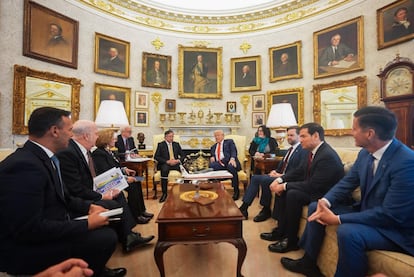
The result was that the Petro who appeared before Trump was neither the bombastic one nor the one prone to lengthy ideological dissertations. Instead, his more pragmatic version emerged. He asked for support in managing regional relations, such as the conflict with Ecuador, which he is incapable of resolving; he offered to mediate with Venezuela; and he outlined energy possibilities in the region. He also left having resolved a more personal matter: his inclusion, and that of his associates, on the Clinton List. The issue wasn’t explicitly addressed, but he expressed confidence that it would be resolved. Trump doesn’t believe in sanctions, and neither does he, he said. At the end, one of the members of the delegation summed it up like this: “I’m happy.” When everything could have gone wrong and it didn’t, relief spread.
The internal impact is immediate. Colombia is already in election season. The right wing has lost one of its key campaign weapons in the midst of the legislative elections, though it is already scrambling to find new ammunition. Petro had accused the opposition of fueling the fire, and at least this time, he has managed to extinguish it. The key now is where the next flames will ignite.
Sign up for our weekly newsletter to get more English-language news coverage from EL PAÍS USA Edition









































