
A year of terror at the hands of ICE, Trump’s anti-immigrant enforcement arm
US immigration police operate with ‘absolute immunity’ while they pursue, abuse, detain, deport, and even kill


Car windows smashed and people dragged from their vehicles. Individuals knocked to the ground and pinned down. Guns pointed at unarmed civilians. Citizens and migrants alike, shot and killed in their cars. Protesters sprayed directly in the face with pepper spray or choked with tear gas. Anyone who dares to speak English with an accent or who has brown skin is forced to prove their citizenship at random. These are scenes that have become commonplace in the United States of Donald Trump, a country whose cities, especially those governed by Democrats, have been besieged by immigration agents who patrol predominantly Latino neighborhoods and lurk in courthouses looking for migrants to arrest and deport.
In the first year of the Republican’s second presidency, Immigration and Customs Enforcement (ICE, its now globally recognized and feared acronym) has become the primary enforcer of his anti-immigrant offensive, resulting in more than half a million deportations in 12 months. The agency has been described as a paramilitary force and, according to the government itself, operates with “absolute immunity.”
In Minneapolis, the latest target of the Trump administration, the agency’s most violent side has been revealed. Some 3,000 federal agents arrived in Minnesota’s most populous city in just over a week, starting in the first week of January, for what ICE’s acting director, Todd Lyons, has called “the largest immigration operation ever conducted.” The result? A city in terror, with businesses closed, in-person classes canceled, and families sheltering in their homes.

Among these people is Saul, who prefers not to give his last name because his mother recently received a deportation order and is hiding in her home in the neighboring city of St. Paul. “The agents are harassing us every day. We’re all terrified; my parents don’t want to go out. We’re living in fear that they’ll come to the house and break down the door to take my mom,” he says while protesting outside the federal building where ICE maintains the central base of its immigration operation in Minneapolis.
He’s wrapped in a Mexican flag and has his U.S. passport in his pocket in case he has to show it. Saul, 26, was born in Minnesota to parents who emigrated from Mexico more than two decades ago. “I never thought this would happen to me, that someone would judge me by the color of my skin. I thought it was something that was in the past, but now I’ve experienced it firsthand,” he says, referring to the racial profiling that officers use to detain people without warrants.
The agents, masked and armed, travel in unmarked cars and get out anywhere without warning. Even so, the locals have learned to recognize their vehicles and try to warn of their presence whenever possible: they know that the SUVs with tinted windows that disregard traffic laws are usually theirs, and they start blowing their whistles or honking their own horns. But little deters them from their mission: they grab the migrant they were looking for and take anyone who gets in their way, regardless of whether the person begs and shouts that they have legal permission to be in the country or that they are a U.S. citizen.
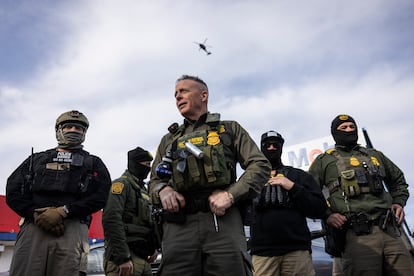
Protests against the presence of federal agents in Minneapolis have been taking place daily, and unrest in the streets has only grown with each passing day that the Trump administration refuses to end what local and state officials denounce as a “federal invasion.” Now, tensions have reached a boiling point from which it will be difficult to recover: after two shootings by agents, one of which resulted in the death of a 37-year-old woman, the president has threatened to invoke the Insurrection Act, which would allow him to send the U.S. military into the city to quell the demonstrations.
“I will quickly put an end to the travesty that is taking place in that once-great state,” the Republican declared last Thursday. In his view, the ICE agents deployed in the city, including the one who fatally shot Renee Good on January 7, are all “patriots” who are “only trying to do their job.”
Immunity or impunity
It’s something Republican administration officials have repeated incessantly over the past 12 months. With each new incident in which agents are accused of excessive use of force or violence, Kristi Noem, the secretary of the Department of Homeland Security, which oversees ICE, defends their actions. “Every single action taken by our ICE agents is in accordance with the law and follows the protocols we have used for years,” the high-ranking official said Thursday. Noem insisted that the real victims are the officers.
“The hateful rhetoric and resistance against men and women who are simply trying to do their jobs must end. Federal law enforcement officers are facing a more than 1,300% increase in assaults against them as they put their lives on the line to arrest criminals and lawbreakers,” the department said in a statement this week after a migrant was wounded in a second shooting in Minneapolis.

The Trump administration not only defends the violent tactics employed by immigration officials, but also justifies them. Sources within the agency itself know that agents have been ordered to take “decisive action” if threatened. This is what the White House maintains Agent Jonathan Ross did when he shot Good: according to the official account, the woman, a U.S. citizen and mother of three, tried to run Ross over, although video footage of the incident shows the opposite — that she attempted to turn her vehicle away from him.
While the FBI is investigating the shooting on its own — after the Justice Department refused to allow Minneapolis authorities to participate in the investigation — sources in Washington indicate that Ross “is protected by absolute immunity.” This was stated by Vice President J.D. Vance the day after Good’s death.
This week, the Department of Homeland Security reiterated that claim by republishing a video of an interview Stephen Miller, White House Deputy Chief of Staff and mastermind behind the Trump administration’s anti-immigrant offensive, gave to Fox News in October. In the recording, Miller refers to the agents and asserts: “You have immunity to perform your duties, and no one — no city official, no state official, no illegal alien, no leftist agitator or domestic insurrectionist — can prevent you from fulfilling your legal obligations and duties.”
The reality is that ICE agents are not fully protected from prosecution. However, experts point out that the government’s assertion that they do have immunity will only embolden them and reinforce the perception that they act with impunity.

“Kristi Noem has plainly tried to signal to ICE that they are free to act with impunity, to personally manufacture and escalate confrontations and even execute whomever they please,” said Mississippi Representative Bennie Thompson, the ranking Democrat on the House Homeland Security Committee, on Wednesday. “She has unleashed ICE and other federal law enforcement officers upon American communities, not to protect them, but to attack them and to sow fear, violence, and chaos,” he added, calling for the secretary’s removal, a move that has gained traction among Democrats on Capitol Hill.
Abolition of ICE
Since last summer, the government has deployed thousands of immigration agents to several Democratic-leaning cities: Los Angeles, Washington, D.C., Charlotte (North Carolina), Portland (Oregon), Chicago, New Orleans… and even the Twin Cities, as the Minneapolis-St. Paul area is known. These massive operations have been possible because ICE now has the largest budget for any agency in U.S. history, exceeding the funding allocated to the FBI, the DEA, and other federal entities. Approved last July as part of Trump’s tax reform, the funding exceeds $100 billion through 2029.
Of that budget, $30 billion is earmarked for hiring and training thousands of agents to locate, detain, and deport migrants. To this end, the Department of Homeland Security launched a historic recruitment campaign that has allowed it to rapidly expand its ranks: by early January, some 12,000 new agents had been hired, a 120% increase in its staff in about four months. In total, ICE now has 22,000 officers, according to its own figures.
Another large portion of the budget — $45 billion over four years, two-thirds of the total — will be used to detain migrants in the network of detention centers operated by ICE, places where complaints of human rights abuses and appalling conditions abound. The year 2025 ended with the highest number of deaths in two decades in these centers: 32, according to figures from the Department of Homeland Security. So far in 2026, at least four migrants have died in ICE custody.

The unprecedented expansion of ICE has also increased calls to abolish it or, at the very least, reform it. In fact, for the first time, more American adults now support dismantling ICE than oppose the idea, according to a recent poll by The Economist and UK-based data analytics firm YouGov.
Support for this idea comes after months of polls showing that backing for the Trump administration’s immigration policies has been declining. A CNN poll released last Wednesday revealed that 51% of Americans believe the immigration agency is making cities less safe.
Some politicians from the more progressive wing of the Democratic Party have joined the calls to abolish ICE: Shri Thanedar, a representative from Michigan, plans to introduce a bill that would dismantle the federal agency. However, while both parties negotiate funding for the Department of Homeland Security for fiscal year 2026 in the face of a potential government shutdown on January 30, the Democratic establishment has opted to demand that ICE be held accountable and subject to oversight.
Meanwhile, over 900 miles from the Capitol, on the streets of Minneapolis, the demand is clear: “ICE out.” As night falls, and amid the Arctic cold, Genesis Kark and her husband join the protest that has been ongoing all day in front of the Bishop Henry Whipple Federal Building in Minneapolis. They carry boxes of pizza and cookies to share with the demonstrators. “Atrocities have been committed in the last week,” says Kark, a 26-year-old Minnesota native. And she warns: “We don’t want ICE in our city, and we will continue to let them know.”
Sign up for our weekly newsletter to get more English-language news coverage from EL PAÍS USA Edition









































