
Stephen Miller, the most radical voice in Trump’s inner circle
The deputy chief of staff for domestic policy, one of the most influential advisors in the White House, advocates for the annexation of Greenland and will be one of the president’s point people on Venezuela
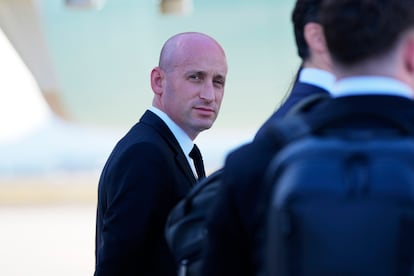

When Stephen Miller declares that the United States has the right to annex Greenland — or when he talks about anything at all — you have to listen.
The 40-year-old, a lover of tailored suits and the White House deputy chief of staff for domestic policy, is, despite his seemingly insignificant official position, one of the most influential figures in the administration. Perhaps he’s even the most influential, aside from President Donald Trump (who trusts him completely).
A champion of ultraconservative ideas, Miller is Trump’s chief ideologue. He’s the president’s advisor on domestic policy and homeland security, as well as the architect of some of his harshest initiatives, including the mass deportation strategy. And his influence is increasingly extending into foreign policy as well.
Miller’s ultranationalist ideas fit like a glove with Trump’s worldview, in which the United States dictates the terms through negotiation or coercion (the former for friendly countries, the latter for more rebellious governments), while respecting the lebensraum of other great powers. The rest of the countries, meanwhile, become mere vassals: they must simply comply with the directives, without the right to an opinion.
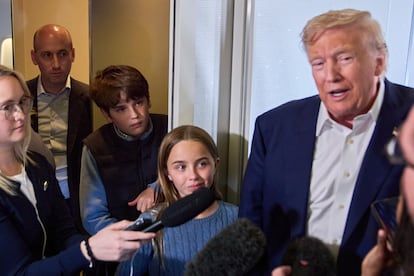
“We live in a world in which you can talk all you want about international niceties and everything else, but we live in a world, in the real world… that is governed by strength, that is governed by force, that is governed by power,” he argued in an interview with CNN on January 5, in which he defended the United States’ claim to Greenland because “we’re a superpower.”
This move has sparked concern among European foreign ministries. “These are the iron laws of the world,” Miller shrugged.
This view permeates Trump’s new foreign policy, starkly laid out in the National Security Strategy published last month, in which the White House declares the Americas its top priority. The document identifies immigration and drug trafficking — Miller’s greatest phobias — as being the main international risks that the U.S. faces.
The White House domestic policy advisor will be part of the quartet — along with Secretary of State Marco Rubio, Pentagon chief Pete Hegseth, and Vice President J.D. Vance — that will coordinate U.S. oversight of a post-Maduro Venezuela. Miller will be responsible for deciding the political strategy parallel to the economic one, which is based on the oil sector. This strategy is expected to focus on reversing mass Venezuelan migration to the United States and eradicating drug trafficking.
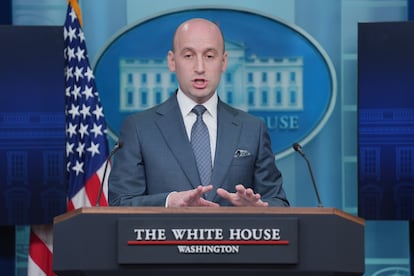
“The United States is in charge. But obviously that doesn’t mean President Trump is setting the bus fare schedule inside the country. We are in charge because we have the United States military stationed outside the country. We set the terms and conditions,” he declared, in the same CNN interview.
Trump has little interest in limiting his ally’s opinions. Although, on occasion, even the president himself — never one to filter his comments — has indicated that his advisor’s views sometimes seem too extreme. “I would love to have him come up and explain his true feelings. Maybe not his truest feelings. That might be going a little bit too far,” Trump joked, while speaking at an event with business leaders in October of 2025.
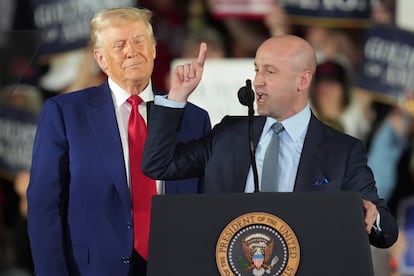
The president and his advisor share numerous affinities, beyond ideology. They often express themselves with phrases and ideas borrowed from each other. For instance, Trump had also spoken of the “ironclad rules of the world” less than 24 hours before Miller made his remarks. And none of this is by chance: at the start of the Republican’s first term, Miller was the speechwriter for the inaugural address. But both men also come from families that have made their fortunes in real estate. They share an attraction to casinos, they like to embellish their narratives with vivid details… and they have a penchant for provocation.
Miller’s family originated in what is now Belarus and arrived in New York in 1903, fleeing persecution against Jews. The high-ranking official was born in the affluent and progressive city of Santa Monica, California, where his father, Michael, made his fortune with a real estate company.
The future presidential advisor’s childhood unfolded in a liberal environment, an oasis amid a California still reeling from the unrest following the 1991 police beating of Rodney King. However, as he entered his teens, a financial setback for the family business forced the Millers to move to a less affluent area with a larger Hispanic population. This period — coupled with his voracious appetite for conservative talk radio — shaped his xenophobic views against any form of multiculturalism and bilingualism, leading to clashes with students and teachers at his high school.
During this time, Miller discovered his love for arguing, contradicting others… and being the center of attention. His classmates recall frequent debates in which, among other things, he complained about the ushers not properly collecting the trash, or invoked patriotism to defend his nationalist positions.
After the family’s financial situation stabilized, the young Miller attended Duke University in North Carolina. There, he became famous for defending the white players on a lacrosse team — accused of raping a Black woman — in the media. The accusations against the athletes turned out to be false.
After graduating, he began working on the staff of Congresswoman Michele Bachmann, then a leading figure in the Republican Party’s most conservative wing. From there, he moved to the office of Senator Jeff Sessions, another prominent conservative with strong nationalist views. During this time, he began to develop connections with figures of the alt-right, such as Steve Bannon.
Even before Trump considered entering politics, the young Miller had expressed his admiration for him and his false claims that President Barack Obama was not born in the United States and, therefore, could not hold office. When the real estate mogul finally announced his candidacy, Miller was among the first to join his campaign. His messages against the Salvadoran criminal gang Mara Salvatrucha (originally from California) and other xenophobic narratives — such as alleged massacres taking place against Americans, or the myth that immigrants seek to replace the white majority — began to appear regularly at Trump’s campaign rallies, capturing the attention of part of the electorate.
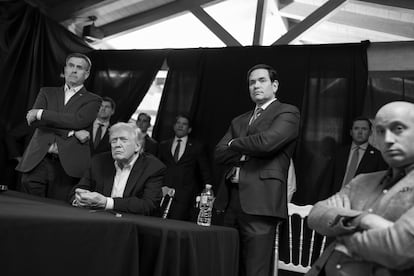
Their shared worldview and political acumen (along with Miller’s deft touch for dealing with the unpredictable billionaire) helped the speechwriter survive Trump’s chaotic first term (2017-2021), while other more powerful or famous figures fell one after another, including Bannon himself.
From speechwriter, Miller became an immigration policy advisor. Inspired by readings such as Jean Raspail’s xenophobic French novel, The Camp of the Saints (1973), he opposes even legal immigration in most cases. His position allows Trump to give free rein to his instincts. And the president respects every opinion that comes from his subordinate who, during the first term, devised the ban on citizens from a dozen Muslim-majority countries from entering the United States, as well as the strategy of separating undocumented families who had been detained.
For now, Miller will be able to take his radical positions to the international arena. And his own wife — Katie Miller, a former White House advisor herself — has made a statement of intent. Just hours after Maduro’s capture in Venezuela on Saturday, she posted a map of Greenland on social media, with the colors of the American flag and one word: “Soon.”
Sign up for our weekly newsletter to get more English-language news coverage from EL PAÍS USA Edition









































