
The year the world peered into the authoritarian abyss of Donald Trump
The first anniversary of the Republican’s second term is marked a broken country and an international panorama at the mercy of the unpredictable White House show
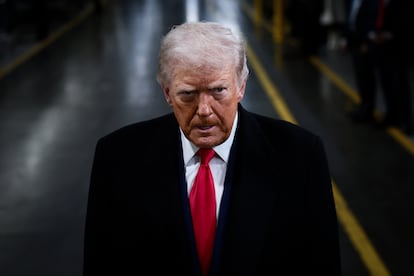

January 20 will mark one year since the United States embarked on a flight toward the abyss: Donald Trump’s second coming. Twelve months of dizzying authoritarianism followed that inauguration. The crossing of one unthinkable Rubicon after another without time to look back. A year in which the entire world has witnessed the deterioration — perhaps irreparable — of one of its oldest democracies, always at the mercy of the unpredictable mind of the most powerful man on the planet, who also happens to be one of the most capricious.
The runaway carousel of Trump’s second presidency has hurtled along in what often seemed like an eternity, lurching from one mood swing to another, threats, a climate of vengeance, exaggerations and lies, insults and tasteless jokes, almost always posted on Truth, his social media platform. And it has done so with only one certainty: as he himself admitted last week in an interview, the only limit to his power at the helm of an empire threatened by China is not institutional decorum or the manners that used to govern traditional politics, but his own “morality.”
No one can say, however, that what happened at the start of this Trump 2.0 term has come as a surprise. He promised much of it during the election campaign, although perhaps his voters fell into the common trap of those who advise taking the Republican seriously, but not literally.
Not only that: after reluctantly relinquishing power in 2021, with an electoral defeat he still refuses to acknowledge, and after instigating the storming of the Capitol, he spent four years in the political wilderness, during which he had time to publicly plot his revenge. He also surrounded himself with a team of loyalists who — from his Cabinet and with the complicity (or apathy) of the Supreme Court and the Republican Party in Congress — are allowing him to implement his authoritarian agenda — given the impotence (or ineptitude) of the Democrats — without offering any resistance to his obsession with expanding executive power.
Despite the precedents, it is also — in another of those paradoxes that only Trump’s ability to control the narrative can create — almost impossible to escape the daily astonishment or even keep track of the White House’s output. It is a dizzying avalanche of gestures, a deluge of narcotic effects on the capacity for outrage of those who are not part of Trump’s loyal base: a MAGA movement which, according to polls, represents 35% of the electorate.
The hyperactivity of a president whose days are numbered (not because of his age — 79 — but because the Constitution, unless he changes it, prevents him from running again in 2028) has resulted in an impossible-to-summarize list of decrees and executive decisions that affect all aspects of American life and have altered the balance of power in the world.
Internal affairs
The tsunami began on January 20, 2025, in the Oval Office, where he fulfilled the first of a long list of promises that few believed he would honor: the pardon of some 1,500 people prosecuted for the 2021 attack on the Capitol.
Nearly 365 days later, the tide shows no signs of receding. There have been decisions that are (only) laughable in appearance — such as forcing an increase in shower pressure or banning cardboard straws — initiatives to lower the price of medicines or improve the diet of Americans, and, above all, measures with serious consequences for minorities, transgender people, scientific consensus, dissenting lawyers, culture that is critical of power, the way the United States portrays its history, and academic, press, and freedom of expression.
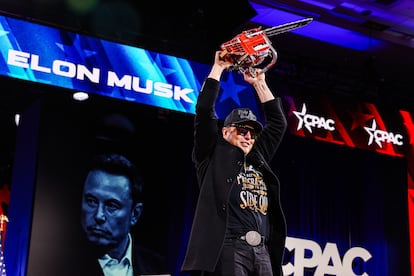
Internally, everything seemed to revolve at the end of last winter around a government of billionaires and Elon Musk, who, before his high-profile divorce from Trump, took the reins of that chainsaw of public spending known as the Department of Government Efficiency (DOGE); from there he caused the dismissal of tens of thousands of civil servants, cuts in one federal agency after another, and the annihilation of funding for the United States Agency for International Development (USAID).
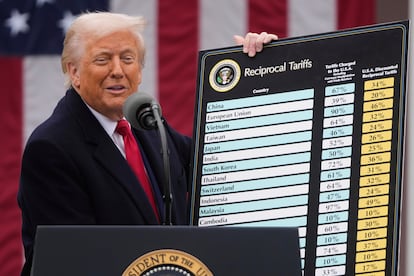
In the spring and summer, the pressure on the Federal Reserve’s independence intensified, along with the tariff offensive, which, while shaking global trade and keeping the world on edge, hasn’t had as much of an impact on a resilient economy as analysts feared. And in the fall came the longest government shutdown in history, leading to the suspension of certain public services and salaries due to a lack of funding, and the demolition of the East Wing of the White House to build a gigantic ballroom paid for by the president and his friends.
That White House project is the best metaphor for the dismantling of American democracy and Trump’s haste — with his real estate developer’s soul — to shore up his legacy. He has sought to do so by putting his name on everything, from the Kennedy Center in Washington to a new generation of warships, or by renaming geographic areas like the Gulf of Mexico (to America) or institutions like the Department of Defense (to War).
And so we arrived at this second winter — a winter of discontent, according to the polls, which show over 300 days of low presidential approval ratings. Last week in Minneapolis, a police officer killed U.S. citizen Renee Good in an incident that graphic evidence confirms was murder, but which Trump supporters consider an “act of self-defense.” The events in that city have brought into sharp focus the political manipulation of law enforcement and the Department of Justice to persecute the president’s enemies. They have also highlighted the terror inherent in the U.S. administration’s immigration agenda.
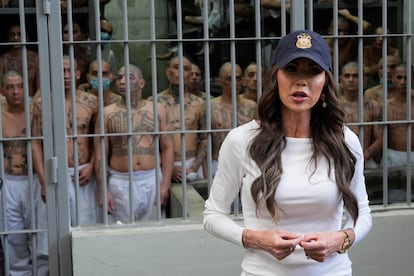
This policy had already displayed its full brutality last February with the deportation of more than 250 Venezuelans to the hell of a maximum-security prison in El Salvador, without trial. And it hasn’t let up in the following 11 months, in a desperate race to fulfill another of the White House occupant’s ambitions, who can boast of having “closed” the southern border but is still far from carrying out the “largest deportation in history.”
Many of his compatriots may agree with the goal (regulating irregular immigration), but polls indicate they disagree with the means. These are the same citizens who have started going out for walks with their passports in their pockets, lest they be mistaken for an “illegal” and end up being detained. This year, more than 600,000 people have been deported and another two million have chosen to leave the country due to harassment, according to official figures.
When Trump first won in 2016, Sinclair Lewis’s classic It Can’t Happen Here (1935), a dystopian novel about a populist leading the United States down the path to dictatorship, became an unexpected bestseller and a frequently referenced topic, now echoed in the headline of the latest issue of The New Republic. “It Is Happening Here,” it proclaims, introducing a special issue on “how Trump is turning America into a police state.”
Minneapolis is just the latest Democratic city, after Los Angeles, Washington, and Chicago, to which the government has sent masked troops under the pretext of public safety, while the left debates whether or not the time has come to start talking about “fascism.”
Geopolitical earthquake
This is also happening in foreign policy, where Trump has imposed his law of the jungle. During the campaign that took him back to the White House, he promised to end the wars in Ukraine and Gaza as soon as soon as he took office; but, so far, in addition to a series of deceptions by Russian President Vladimir Putin — who has repeatedly led him to believe in a false commitment to seeking peace — he has only achieved a fragile ceasefire and a peace plan between Israel and Hamas that is struggling to move into its second phase.
His voters supported him, confident that the days of the United States acting as the world’s policeman were over. But in his first year, he has strengthened the U.S. Armed Forces, bombed Iran, and on January 3 captured — in a military operation in Caracas that killed more than 80 people — Venezuelan autocrat Nicolás Maduro and his wife, Cilia Flores, who now await trial in New York.
The shadow of a new military adventure looms over the anniversary of his inauguration, with an emboldened Trump considering an attack on the ayatollahs’ regime in response to the thousands killed during the crackdown on citizen protests in Iran.
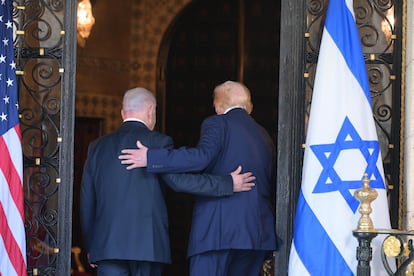
The intervention in Venezuela was the culmination of a campaign of extrajudicial executions that in just four months ended the lives of more than 100 crew members of alleged drug-running boats; and the interception of oil tankers originating from or destined for Venezuela, a country whose uncertain fate is now in the hands of the United States, as is that of its phenomenal crude oil reserves.
It was also confirmation of Trump’s resurrection of the Monroe Doctrine: the days of Washington’s intervention in Latin America in favor of its interests are back. This intervention will be carried out both by force — perhaps nothing seems impossible anymore, with targeted bombings of drug cartels in Mexican territory — and by influencing elections, from Argentina to Honduras. In these two countries, for example, Trump openly threatened to cut off economic aid if his allied candidates did not win.
That point was made clear in the National Security Strategy document, which in December also underpinned the new rules governing the relationship between the United States and Europe, a continent which, the text argued, faces “civilizational erasure.” Against this “threat,” the White House has a recipe: fight from within, supporting far-right parties whose ideologies it has adopted.
It was another shock to the transatlantic relationship, which began the year with pressure on NATO partners to increase military spending to 5% and ends with Trump’s offensive to seize Greenland, putting Denmark (of which the Arctic island is a part) and the rest of the EU on alert. Trump insists that ownership of the world’s largest island is crucial for the security of the world’s leading power and for asserting its dominance in the Arctic against Russia and China.
In Washington, few see this obsession as anything other than a classic Trump negotiating strategy: a maximalist gamble to see where he can get his footing while he tries to gain ground. Or as a distraction tactic to keep people away from more uncomfortable issues: the cost of living and his broken promise to control prices, or the Epstein papers, a scandal that has dogged the president in recent months, given his years-long friendship with the disgraced financier. The Justice Department is legally obligated to release the case files, but a month later it continues to offer all sorts of excuses to avoid doing so.
In a United States increasingly resembling the paranoid plot of a Thomas Pynchon novel, the feeling is often one of living behind a smokescreen. One need only tune in daily to the nonstop White House show, where each new spectacle, each message on the Truth social network, tends to surpass (and make us forget) the previous one.
In these past 12 months, the world has seen the presidential residence transformed into a Tesla dealership (owned by Musk); the scene of a setup to humiliate a supposed ally, Ukrainian President Volodymyr Zelenskiy; and the leader of the free world struggling to stay awake on camera. And all of this in an Oval Office that grew increasingly gilded and ornate, becoming at times as crowded as a television studio where interviewees bring gifts.
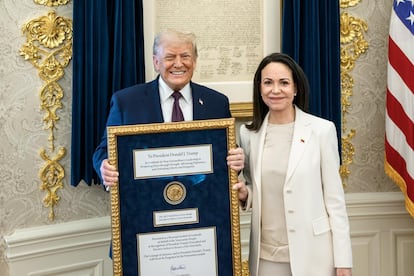
In the case of this television set, the gifts are brought by visitors confident that stroking Trump’s ego is the best way to win him over or, at least, to appease him. Comfortable with the diplomacy of subservience, he has happily received everything from a letter from King Charles III to a substitute for the Nobel Peace Prize invented by FIFA President Gianni Infantino, or, just this week, the authentic medal of the most recent recipient of that distinction, Venezuelan opposition leader María Corina Machado.
Obtaining that recognition — the Nobel Peace Prize — is another of Trump’s extravagant obsessions that have kept the whole world on edge. The Norwegian Academy elected not to give it to him in 2025, perhaps because the president of the United States is exaggerating when he claims that he has ended “eight or nine wars.”
The new year
The next act of Trump’s second era may not be the year he wins the Nobel Prize. It will certainly be the year of the crucial midterm elections, in which the entire House of Representatives and a third of the Senate are up for grabs. Or perhaps not so certain: the president said twice last week that — given these elections are traditionally damaging for the incumbent party — “they shouldn’t be held.” His spokeswoman, Karoline Leavitt, later excused him, saying he was just “joking.”
The truth is that polls predict the Republicans will lose at least the House of Representatives, which could open the door to an impeachment like the two that Trump has already survived in the past.
The country will also celebrate the 250th anniversary of its independence in 2026, as well as 50 years since the bicentennial. Those 1976 celebrations are remembered as a moment of unity around a shared past for a society emerging from the Vietnam War and the Watergate scandal. With Trump — who in his first year has squandered opportunities such as the murders of a Minnesota congresswoman and MAGA youth leader Charlie Kirk to call for unity — it seems unwise to expect that magic glue will once again bind together a polarized society with an increasingly degraded public discourse thanks to social media.
To find out for sure, we’ll have to wait until July 4, the day of the big celebration. Just over five dizzying months remain. An eternity in this time, the era of Donald Trump’s second plunge into the abyss.
Sign up for our weekly newsletter to get more English-language news coverage from EL PAÍS USA Edition









































