
When Zelenskiy played the president in a TV show: 10 years on from ‘Servant of the People’
A decade has passed since the premiere of the television series that catapulted the Ukrainian leader to office. The show discussed corruption, but made no mention of the threat of Russia
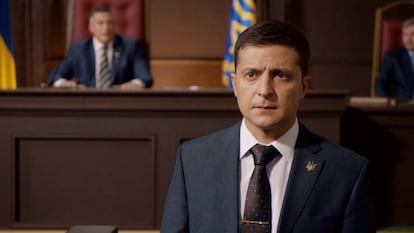

Watching Servant of the People today is striking. The television series that catapulted Volodymyr Zelenskiy to the presidency of Ukraine premiered 10 years, but it seems like there’s a century between the country depicted in the show and today’s Ukraine. What stands out about the comedy is the use of the Russian language, the utopian fight against corruption, and most strikingly, the absence of any threat from the Kremlin. What Zelenskiy projected as the on-screen president of Ukraine was exactly what 73% of the population wanted — the same population that voted for him in the runoff of the 2019 presidential election. It has little to do with present-day Ukraine.
Servant of the People, which is available on Netflix, was a parody of the everyday political and social miseries of Ukraine. But it was also Zelenskiy’s election program and campaign. The series follows the tribulations of Vasyl Holoborodko, a history teacher at a Kyiv high school who, through a twist of fate, ends up being elected head of state. The show aired on channel 1+1, one of the largest in Ukraine, from November 2015 to March 2019. Three days after its finale, Zelenskiy announced he was running in real life for the presidency.
The first striking thing about Servant of the People is that it is entirely filmed in Russian. Television content in Russian in Ukraine is now practically nonexistent due to law. Even if a news broadcast reproduces the words of a Russian-speaking citizen or a Moscow official, they are dubbed into Ukrainian.
Getting along with Russia
The series tackles the major issues of modern Ukraine: endemic corruption, popular protests that topple governments, negotiations with the International Monetary Fund, and the perpetually frustrated hopes of one day joining the European Union… All the problems appear, except one, the most important: the threat of Russia.
The series doesn’t depict the war in the Donbas region. That conflict began in 2014 with the uprising of pro-Russian separatists and Russia’s illegal annexation of Crimea. By 2015, the conflict was at a boiling point, but none of this is addressed explicitly in Servant of the People. In the third season, aired between 2018 and 2019, the country descends into chaos, Ukraine fragments into multiple states — but not because of Russia; the blame falls entirely on the incompetence of the Ukrainians themselves.
The villains of the series are three oligarchs who have the political class in their pockets. And when the situation spirals completely out of control, the assault on Kyiv to stage a coup in the Rada, the Ukrainian Parliament, is not carried out by the Russians or their allies in eastern Ukraine, but by a group of Ukrainian ultranationalists.
Vladimir Putin’s name appears sporadically, like a sort of older brother best left alone. There are also occasional, lighthearted jokes about Putin, but neither the Russian leader nor his aggressive nationalism, which had already sunk its claws into parts of Ukraine, feature in Servant of the People.
The only moment in the series created by Zelenskiy in which there is a clear indication that Ukraine and Russia are following different paths comes in the final episode of the first season. Holoborodko imagines a dialogue with Ivan the Terrible. In it, the tsar tries to convince him that they are the same people, sharing the same concept of authoritarian power, but Zelenskiy–Holoborodko replies that Ukraine has chosen the democratic values of Western Europe.
One of Zelenskiy’s promises upon assuming the presidency in 2019 — one that also aligned with the wishes of most of his fellow citizens — was to end the conflict with Russia through diplomatic means. He maintained this stance until just hours before Putin ordered the full-scale invasion in February 2022.
In an episode aired 10 years ago in December, Zelenskiy even pokes fun at the heated debates among parliamentarians over street name changes under Ukraine’s decommunization laws (aimed at erasing the Soviet past). A joke like that would hardly be acceptable today. President Holoborodko bursts into the Rada, while its members are embroiled in a violent argument over which name should replace an avenue dedicated to the Soviet military officer Semion Timoshenko. Holoborodko ends the street-name dispute, calling it frivolous, and forces the Rada to urgently vote on a law that imposes a tax cut.
The deputies do not have time to read or debate it; they must approve it by a show of hands. If there is anything in Servant of the People that predicted the future, says Oleksii Garan, professor of political science at Kyiv-Mohyla University, it is examples like this. “If there is one thing that has been confirmed, 10 years later, it is a model of personalist management in which only he is right,” says Garan. “Servant of the People was an amendment to the entire political system; it was pure populism, and in part, that has endured.”
Past and present mistakes
In July, Zelenskiy made a serious mistake in a similar manner: suddenly, without even giving the Rada time to debate, his parliamentary majority presented a law for an urgent vote that effectively nullified the independence of the National Anti-Corruption Bureau (NABU) and the Specialized Anti-Corruption Attorney General’s Office (SAPO). This move sparked a wave of criticism from Europe and led to the first protests against him on the streets of Ukraine.
Prior to that vote, Ukraine’s Security Service (SSU, under the Ministry of the Interior) arrested around 20 inspectors from the anti-corruption agencies who were suspected of cooperating with Russia. The accused were later released, with most of the charges dismissed. At the time, NABU and SAPO leaked to the media that Zelenskiy’s reason for undermining their independence was related to recordings they were conducting of Timur Mindich, a friend and partner of the president at Kvartal 95, the audiovisual production company that brought the now-president to fame.
The consequences of the recordings materialized this past November, when NABU and SAPO carried out searches and arrests within the president’s inner circle and also published parts of the recordings. These revealed that Mindich was the mastermind behind a network that collected kickbacks on public contracts and laundered money.
Mindich fled the country on November 10, just a few hours before a raid on his home, using his Israeli passport. The irony is that in Servant of the People, one of the oligarchs trying to overthrow Holoborodko considers himself untouchable precisely because he is an Israeli citizen.
Fiction became reality when Zelenskiy assumed the presidency. His small inner circle was mostly made up of friends and associates from his professional world, with no experience in public administration. Holoborodko would choose his friends and family for key positions, but whereas in the series they remained incorruptible, in real life the script has changed. Six years and seven months after Zelenskiy took office, NABU and SAPO have not only exposed Mindich, but their investigation also led to the dismissal in November of Zelenskiy’s number two, Andriy Yermak, an old acquaintance from his days as a lawyer and audiovisual producer.
Another, at least surprising, coincidence is that in the first season of the series from a decade ago, President Holoborodko advocates for dismantling the anti-corruption offices and transferring their powers to the SSU, which is headed by a friend of his. Yermak is currently under investigation for allegedly using the SSU against NABU and SAPO.
Many people who voted for Zelenskiy would now think twice about doing so, according to polls. Presidential and legislative elections cannot take place while martial law is in effect. Bogdan Kucher, a political scientist and officer in the Ukrainian Army, voted for Zelenskiy back in 2019. What remains, in his view, of the Ukraine depicted in Servant of the People? “Practically nothing,” Kucher says. “It’s now a country mired in a grueling war for survival against the continent’s largest military power.”
Kucher recalls that a decade ago, Zelenskiy’s series promoted a double message: that a rapprochement with Russia was possible, while Europe was Ukraine’s future. Ambiguity was his main political weapon, the officer believes: “The main success of Servant of the People lies in Zelenskiy’s personal image. He managed to unite key electoral groups by promising each of them what they wanted to hear. In fact, the entire campaign was based on uncertainty.”
Professor Garan agrees with Kucher that the populism and charisma of Holoborodko were decisive. “Zelenskiy managed to mobilize people who normally did not participate in elections,” Kucher recalls. “The image of a simple, popular man who ridiculed representatives of the old political class was associated by many citizens with someone capable of bringing a new generation of politicians to power who would transform Ukraine.”
Olena Lifenko, 46, works for a state energy company. She had never voted before, and completely distrusted Ukraine’s leaders. But she voted for Zelenskiy, and admits it was because of the series. “I regret it,” Lifenko says, “it has been more of the same, and on top of that, we have a war.” Lifenko laments the economic hardships she and her family endure but insists she would not swap positions with Zelenskiy’s for anything in the world. She also does not feel sorry for the president: “He sought it out; he wanted to be president. Others didn’t have the option of choosing their destiny.”
Sign up for our weekly newsletter to get more English-language news coverage from EL PAÍS USA Edition









































