
Luuk van Middelaar: ‘The best Europe can do is make the bad Ukraine deal less bad’
The director of the Brussels Institute for Geopolitics criticizes the EU’s appeasement policy towards Trump
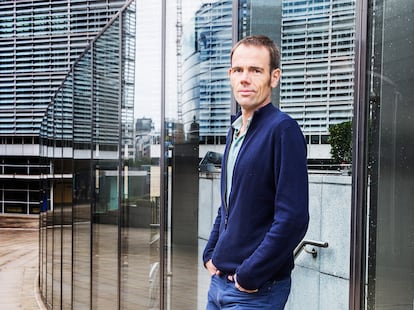

Brussels aroused in Baudelaire “the most irresistible disgust.” During the years when the poet, already very ill, wandered through the European capital in his bitterness, the Hôtel van Eetvelde, a jewel of Art Nouveau, was about to be built — an incredible structure of wood, steel, and glass embedded in the European Quarter (and financed with the atrocities committed by Belgium in the Congo, incidentally). Luuk van Middelaar (Eindhoven, 52 years old), director of the Brussels Institute for Geopolitics, meets with EL PAÍS in that handsome building, the institution’s headquarters. A historian, philosopher, and expert on EU institutions, Van Middelaar is one of the most interesting thinkers in Europe, “a place of adventure,” according to the apt definition of sociologist Zygmunt Bauman. Brussels and European geopolitics lie somewhere between Baudelaire’s and Bauman’s phrases: it depends on the day. Van Middelaar leans towards Bauman, but does not entirely escape the inevitable pessimism.
Question. After a disastrous summer, Donald Trump reached an agreement on Gaza in which Europe did not participate, but for which it will foot the bill. Something similar is happening with Ukraine. Can we be optimistic about this EU?
Answer. In the summer, the leaders of the European Union were supposed to be negotiating a trade agreement with the U.S., but in reality, those negotiations revolved around security, Washington’s commitment to NATO, and its support for Ukraine. It was a humiliating episode because of the outcome: asymmetric tariffs and the obligation to buy U.S. energy and weapons.
Q. And now?
A. Since Trump came to power, there’s a pattern that never fails: the more advantages he gains, the more determinedly he advances toward the next objective. The first was the obligation to accept a bad trade deal for security reasons. The next is to loosen regulations for tech companies and weaken the Green Deal. Europe should consider where to draw its red lines. We’re not ready to defend ourselves alone: that affects everything else. Russia complicates our relationship with the U.S. and, indirectly, with China. Spain has been able to show a more open attitude toward Beijing because it’s far from the front lines: the others have to grit their teeth in this geopolitical era of strongmen who threaten with blackmail.
Q. Should international relations be de-Americanized while Trump is in power?
A. Trump is determined to dismantle the order the U.S. established after 1945. With his characteristic arrogance, he claims to be building a new era that will last 100 years. The hawks of Trumpism intend to impose a neo-imperial order — Canada, Greenland, Panama — that leaves Europe exposed. The transatlantic relationship is meaningless to Trump: it’s “America First,” nothing else matters.
Q. And he has several populist branches in Europe.
A. During the Cold War, the USSR supported the far left to undermine European democracies. Now we have the U.S. supporting the far right with the same objective. A battle for the soul of Europe is being waged with these ugly cards.
Q. Is Brussels’ policy of appeasement with Trump working?
A. The Peace Plan is not about the relationship between the U.S. and the EU but about that between the U.S. and Russia, and between Trump and Putin. For the third time this year — after the White House debacle in March and the Alaska summit with Putin this summer — Trump is forcing an ugly Great Power Politics approach on Ukraine and the Europeans. Sidelining international law, and letting speak the balance of power. Previously, Ukraine and Europeans fought back diplomatically with some success, and no deal materialized, for which Putin was conveniently blamed. But Trump says: “No deal will end in U.S. retreat,” which is worse. So the Europeans and Ukrainians have the choice between no deal (very risky in view of battlefield situation) and a bad deal (accepting some of Russia’s claims but not all). The “good deal” does not exist. The best we can do is make the bad deal less bad. All of this shows the U.S. has moved on.
Q. It’s not a great goal.
A. We Europeans need to wake up. History is changing, and we are underestimating this metamorphosis. We are unable to keep up. We are falling behind; we are appallingly slow. The main risk for Europe is geopolitical: neither the economic risk, nor climate change, nor aging, nor Europe’s demographic winter are as serious right now as the geopolitical risk.
Q. To take that risk seriously, we need to invest in strategic autonomy. Instead, Brussels is unraveling part of the path like Penelope: the mantra is to simplify and deregulate across the board. Weren’t we a regulatory power?
A. I partly disagree: for example, regarding the dismantling of the green agenda. The EU defended that agenda alongside China in Belém. There has been a correction in the Green Deal, due to the political shift in Europe, but the trend remains. The U.S.-China struggle for hegemony is also being played out on the energy chessboard. Russia and the Gulf are on the U.S. side. Europe is closer to China. Quite a change.
Q. What to do when a quarter of the electorate supports parties that block everything?
A. The political center needs to be effective, to show results. In reindustrialization. In energy prices. In housing. In offering a future for young people. And we must counterattack in the culture war, in the ideological war, offering a counter-narrative. It is false that the triumph of the far-right, supported by tech companies, is inevitable because they perfectly capture the zeitgeist, the spirit of our time. True Trumpism controls barely 10% of the electorate. But the populists, allied with the tech magnates, are riding a wave, they have momentum, they carry the banner of a revolution, and they are well-funded: they can pretend to be much stronger than they are. They own the networks, they control the algorithm, they indelibly shape the debates. And so we arrive at Stephen Miller’s speech after the death of activist Charlie Kirk: “You are nothing, we are everything.” It is a terrible speech. It is frightening. We must counterattack.
Q. Do you think that’s what the president of the European Commission, Ursula von der Leyen, is doing?
A. There are a constellation of reasons why Von der Leyen has raised her profile and encroached on other areas of responsibility: the Commissioner for Defense should be the Commissioner for Defense Industry, according to the treaties. But this is the era of geopolitics and geoeconomics: many key issues fall under the competence of the Member States and the Council, but they have consequences for industry, energy, and tariffs, which are the responsibility of the Commission. In terms of economic security, Europe is negotiating trade policy with Trump, but also NATO and Ukraine. The Commission decides to take the reins, without any experience in doing so. With Von der Leyen, we are witnessing a live institutional metamorphosis.
Q. What comes next?
A. In 2022, with the invasion of Ukraine, something new began: a neo-Westphalian international order. With great powers and minor powers in a multipolar world where each looks after its own interests. For Europe, it is a difficult moment, because we were born for the liberal international order, for soft power. Will the EU be able to adapt so as not to be left behind?
Q. The catastrophists say no.
A. We Europeans still have good ideas, excellent universities, we innovate, we are wealthy. Just look at migration flows: we are still attractive. A century ago, Europeans were fleeing here: we had wars, poverty, famines, antisemitism. We still have some cards to play. We must be firm yet pragmatic in defending our interests. Sometimes we forget that the European values we miss so much were based on pure and simple power: on Western power. That has changed; we must change too. Twenty-five years ago, we could fight climate change alone; now we must seek alliances. That is why Spain’s role in China is so interesting.
Q. It has received harsh criticism for it.
A. But there is a way forward. With China, with India, and with the Global South, Europe has to play its cards right. Mid-century will mark the centenary of the Chinese revolution. That date is circled in red in Beijing. What the U.S. and China will do until then remains to be seen: we Europeans have a responsibility to try to balance the scales, to calm tempers, to prevent the two superpowers of this century from becoming embroiled in a global conflict with an uncertain outcome.
Sign up for our weekly newsletter to get more English-language news coverage from EL PAÍS USA Edition









































