
One of these waves of protests in Iran will bring down the state
It is more likely that a fall of the regime would lead to chaos and civil war than to an orderly transition
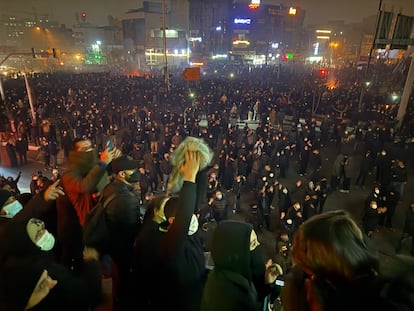
The events in Iran are both bitter and familiar. It is by now almost a ritual, every other year the high level discontent goes beyond the low level protests and develops into something more national and dramatic. The grievances are real, the repression equally so. Iran’s economy is in some respects in an extended free fall, the result of decades of mismanagement corruption — but also American sanctions. The end result is a situation that barely anyone one in the country can any longer endure and thus, all other issues aside, the economy will elicit near universal fury.
But the protests and the misery of Iranians it springs from also become a canvas for all and sundry to proclaim and project all kinds of ideological positions and claims about what is happening in the country. For each iteration of these protests social media, as a channel to spread awareness of them as well as disinformation about the situation in the country, grows. And the state uses its control over internet access and mobile phone systems to stymie people’s ability to participate and hide its own use of violence against them.
It is said that Mark Twain once said that history does not repeat itself, but it does rhyme. The ongoing protests follow a pattern, and yet there are new circumstances as well. The spread is wide and deep as in the previous protest (2017, 2018-2019, 2022-2023), but the escalation of violence (including to a small degree from some protestors) faster. One contributing reason for the latter is that this takes place in the shadow of the military attack Israel initiated in June 2025 which showed the weakness of Iran’s defenses (in several senses) and the willingness of Israel and the U.S. under Trump to militarily confront Iran.
One of Israel’s allies in the confrontation is the son of the last Shah, Reza Pahlavi. He has received much more exposure in the last year, clearly betting that he has a chance of taking over the country with the help of Netanyahu and Trump. In this he follows a family tradition, his grandfather came to power with the help of the British in 1921 and his father regained the throne through a coup orchestrated by the CIA in 1953. Reza Pahlavi’s name has been herald among the protestors, it evokes a nostalgia — bereft of historical accuracy — of how better things were “before.” After decades of exile in the U.S., he has so far not managed to create and sustain an organizational foundation for his political ambitions there — let alone inside Iran.
More than anything else, the calls for the return of a monarch is a sign of desperation on the part of some protesters, who under the repression of the Islamic Republic have not been able to coalesce around any single political figure inside the country. In many ways the most vociferous political opposition groups outside of Iran have constituted the perfect enemy for the security apparatus in Tehran. On the one hand, there is the Mojahedin-e Khalq (People’s Mojahedin Organization of Iran), a cultish organization that sided with Saddam Hussein in the war 1980-88 against Iran, and on the other, the hapless pretender to the throne. The real opposition that could pose a danger to the Islamic Republic are those inside, who are organically enmeshed in the society, human rights activists, alienated politicians from within the system who have turned against it. But these figures, and the labour unions that could form the backbone of their political struggle, are always imprisoned, harassed and persecuted.
The previous state “solution” to these protests — repression and a few tactical concessions — do not work anymore. The population has no faith or respect for the political elite. The best-case scenario for the political system would be to find the political will power to reconsider their form of (mis)governance and in a sense re-invent themselves, though it is unlikely the population at large will find this metamorphosis credible. With business as usual these protests will escalate and at some point one of these iterative protest waves will break the state. What then will follow is unfortunately more likely to be chaos and civil war than an orderly transition to something new.
Sign up for our weekly newsletter to get more English-language news coverage from EL PAÍS USA Edition









































