
Repression in Iran stifles protests while the government claims to have the situation ‘under control’
Tehran has indicated its willingness to negotiate with the US and restore internet service. Hundreds of protesters have died
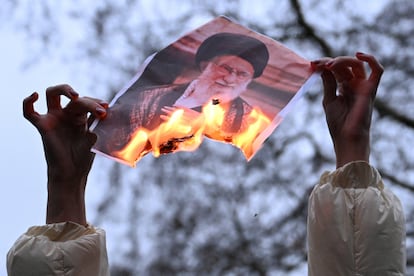

The severity of the crackdown in Iran has reduced the intensity of the protests of recent days, and on Monday the government sought to turn the page. After four days of communication blackouts, accompanied by reports of hundreds of deaths, the leaders of the Islamic Republic claim to have regained “control” of the situation.
During a meeting with foreign diplomats on Monday, Foreign Minister Abbas Araghchi said that the authorities are willing to restore internet connectivity in the country and negotiate with the U.S., according to reports by Qatari broadcaster Al Jazeera, the only major international outlet able to broadcast from Tehran during the communications blackout.
U.S. President Donald Trump on Sunday reiterated the possibility of striking Tehran as punishment for the bloodshed that occurred during the rallies, but several analysts are considering the possibility that the destabilization of Iran could lead to negotiations for a new nuclear agreement that imposes conditions — such as abandoning uranium enrichment — that the Iranian government had previously deemed unacceptable.
Araghchi’s words — the minister stated the riots sought to provide “an excuse” for U.S. intervention and that the situation is now “under total control” — seem part of an attempt to put one of the worst episodes in the country’s recent history behind it. At the same time, on Sunday night, the government declared three days of national mourning for those who died in the protests, which the regime blames on “rioters” or “terrorists” backed by the U.S. and Israel. Several cities across the country, including Tehran, held mass rallies on Monday by supporters of the regime, who defend the legitimacy of the authorities — which many Iranians see as being in decline — and protested against alleged foreign interference in the unrest.
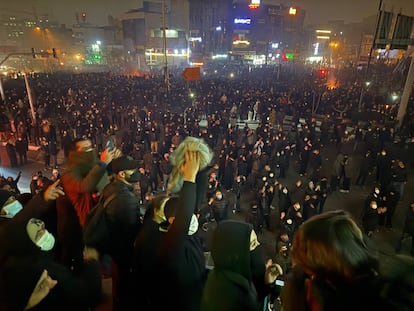
The change in attitude by the Islamic Republic coincides with the cooling off of protests. Journalist Tohid Asadi, reporting for Al Jazeera from the Iranian capital, said on Monday morning that there is a large police presence on the streets and that tensions on the ground have eased compared to Thursday. On that day, several sources reported an uncontrolled situation that included apparent indiscriminate shooting by the authorities.
The BBC, which has contacts inside the country, points in the same direction and cited several sources indicating that protests continued throughout Sunday night, “albeit at a reduced level” compared to previous days. Citizens, whom the broadcaster does not identify for security reasons, attributed the lower turnout to the fear of protesters in the face of authorities’ crackdown.
Various human rights groups claim that hundreds of people have died as a result of police violence. The U.S.-based Human Rights Activists News Agency (HRANA) has verified the deaths of 572 people — 69 security officers and the rest protesters — during two weeks of protests, and says it is verifying others. The group also counts 10,694 arrests, according to its updated records as of Monday. These figures are consistent with the information gathered by several witnesses.
The family of one of the victims said they found “hundreds of bodies” in a morgue in the capital, according to a statement made to Iran Human Rights (IHR) by the mother of a student who was shot. Sources contacted by the BBC on Sunday counted 180 bags in a single morgue near Tehran, where broken families gathered in search of their loved ones. “The streets are full of blood,” the sources said, adding that municipal workers rush to clean the streets before sunrise.
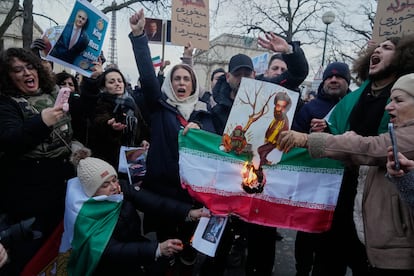
Cushioning the blow
Since the protests began in late December, sparked by anger over the country’s economic collapse, Iranian authorities have increased their violence against demonstrators. Iran’s supreme leader, Ayatollah Ali Khamenei, denounced the existence of “saboteurs” and demanded that they be “put in their place.” Similar statements by security and justice officials raised fears of a wave of repression similar to those in 2019 and 2022, which quelled demonstrations calling for an end to the Islamic Republic, leaving hundreds dead.
The omens materialized last Thursday night. After 12 days of demonstrations in dozens of municipalities, the authorities plunged Iran into informational darkness and abandoned restraint. Until that moment, Iranian human rights groups had recorded 45 deaths during almost two weeks of demonstrations. Less than 100 hours later, the number of confirmed victims is 12 times higher.
On Monday, after having dampened the protests, Iranian leaders are trying to gain full control of the situation domestically and internationally. The foreign minister has indicated that Iran is prepared “for war” but even more so for dialogue, and the ministry’s spokesman, Esmaeil Baghaei, has assured that there are open lines of communication with Washington.
This comes after Trump indicated on Sunday, aboard Air Force One, that the White House is considering various “very strong” military options in response to the killing of civilians. The president, who had previously warned that the U.S. was “ready to help” Iranians in their quest for “freedom,” said during the same flight that Iranian authorities had contacted him because “they want to negotiate.”
At the local level, the government called for rallies on Monday, which were attended by tens of thousands of regime supporters in an attempt to flex their muscles, judging by aerial images broadcast by Islamic Republic of Iran Broadcasting. According to state news agencies, the demonstrations seek to “condemn” the burning of shops, mosques, and vehicles, as well as to reject the actions of alleged agents of Washington and Israeli intelligence, who are blamed for the “dozens” of deaths — according to those agencies — that occurred during the riots. “Until now, this type of violence had only been seen on the part of Islamic State terrorists raised by the U.S.,” said the official statement calling for the mobilization. Press TV, a state outlet broadcasting overseas, said on Monday that the rally in the capital had “millions” of attendees.
Although the mobilization of Iranians from all walks of life had seemed to push the Islamic Republic to the brink in recent days, the regime still stands on significant roots. In a country with 90 million residents, some analysts point to the 13 million votes cast in 2024 for hardline presidential candidate Saeed Jalili as indicative of the pool of supporters of the status quo.
Another factor is the cohesion that the security forces have shown so far. Karim Sadjadpour, a researcher at the Carnegie Endowment, warns that Iran meets all the other necessary conditions for a revolution that would bring down the authorities, such as economic crisis, division among the elites, and a favorable international context. When the repressive forces decide they no longer benefit from the regime and are unwilling to kill for it, Sadjadpour writes on social media, the lethal force that “keeps the Islamic Republic alive” will cease to do so.
Sign up for our weekly newsletter to get more English-language news coverage from EL PAÍS USA Edition









































