
Trump signs bill ending the longest government shutdown in US history
Federal funds will start flowing again after nearly 43 days, following a favorable House vote on Wednesday. But the spending package only funds the government through January
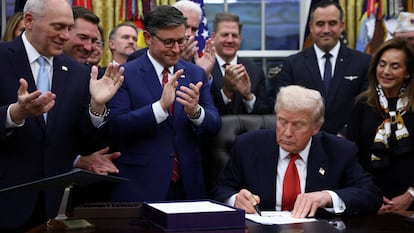

The clock on the longest government shutdown in U.S. history had been ticking for 42 days, 23 hours, and 24 minutes when President Donald Trump signed the bill ending it. It was the final step in a slow-motion death that had been dragging on for days since Sunday, when Republicans in the Senate secured enough votes to reopen the public money tap, which had been partially closed since October 1.
The bill had been approved a couple of hours earlier by the House of Representatives, whose members met in session for the first time since September 19 to vote on the government’s funding proposal, approved on Monday in the Senate after seven Democrats and one independent defected to the Republican ranks.
The House voted 222 (216 Republicans and six Democrats) to 209 (202 Democrats and seven Republicans) on Wednesday. With that formality out of the way, all that remained was Trump’s signature to end the shutdown — a recurring threat that materializes when the two parties cannot agree on budgetary matters.
Trump signed the funding proposal, which is valid only until January 30, in the Oval Office. He was flanked by House Speaker Mike Johnson and other members of Congress. The president did not miss the opportunity to repeat some of the lies he has been reiterating during the prolonged government shutdown. He also took the opportunity to lash out at his rivals and urge his allies in the Senate to end the filibuster rule, which requires a majority of 60 votes out of 100 to pass most legislative initiatives.
Afterwards he did not take questions from reporters, who shouted them out anyway. These had to do with the topic of the day: the presence of Trump’s name in a new batch of documents involving the millionaire pedophile Jeffrey Epstein.
With the president’s signature, things will gradually return to normal at dozens of federal agencies, museums, monuments and national parks that were closed or neglected, as well as to major U.S. airports, which have suffered thousands of flight cancellations and tens of thousands of delays due to the effects of the shutdown on air traffic controllers and security employees, officials considered “essential” and therefore forced to work without pay. Other federal workers, some 750,000, have been suspended from work without pay for more than six weeks.
It is unclear when all these problems will be resolved, especially the one affecting airports. The Federal Aviation Administration (FAA), which last week launched a plan to prevent air traffic congestion, put it on hold on Wednesday night.
It is also unclear to what extent the 42 million beneficiaries of the food stamp program (SNAP) will ultimately be affected. The Trump administration has tried by all means to avoid paying the amounts due for November, and last Friday the Supreme Court sided with the White House.
The agreement includes provisions for federal government funding until the end of January, when a new crisis may arise; funding for food stamps throughout fiscal year 2026; and a commitment from the Trump administration to reinstate the employees laid off during these 43 days. It also includes retroactively paying back wages to those who retained their jobs and not laying off any more federal employees for the next two and a half months.
Almost more important is what that pact doesn’t include. This is especially true for the Democrats, who are once again facing an internal crisis just a week after their resounding electoral victories in New York, Virginia, and New Jersey. The Republicans are not committing to extending a portion of the health coverage included in the Affordable Care Act (Obamacare), named after the president who enacted it. These are subsidies approved during the Covid pandemic, and their likely end will cause health insurance costs to skyrocket for 24 million Americans. Republicans have agreed to hold a vote on these subsidies soon, although it doesn’t seem likely that the initiative will pass Congress.
House Speaker Mike Johnson kept the chamber in recess for 54 days in an unprecedented attempt to blame Democrats for the effects of the government shutdown. The last thing the representatives did before going on indefinite recess was to pass the budget plan, which then failed to secure the necessary support in the Senate — a supermajority of 60 votes that wasn’t reached until Sunday, after 14 failed attempts. Democrats then refused to support the plan that would have allowed the government, which has been shut down since October 1, to remain open.
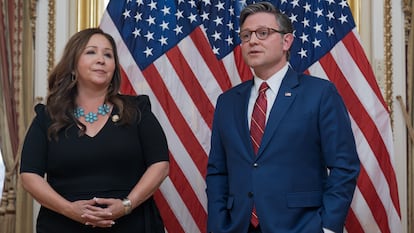
During that time, Johnson also refused — and everything indicates that it was due to a political calculation based on his unwavering loyalty to Trump — to allow Congresswoman-elect Adelita Grijalva (Arizona) to be sworn into office after winning a special election on September 22 to succeed her father, Raúl Grijalva, who died in January.
Grijalva’s vote
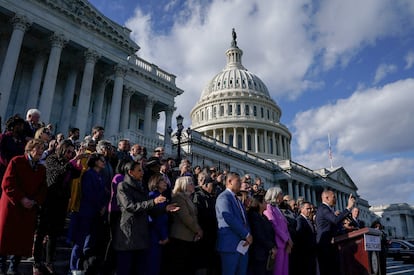
Grijalva finally succeeded on Wednesday afternoon. The first thing she did was sign a petition with her supporters to force a vote in Congress. If it passes, which is unlikely, it would compel the White House to release all the files held by the Justice Department related to the case of Jeffrey Epstein. Johnson has scheduled that vote for next week.
Democrats and a handful of Republicans who give them the 218 required votes (Thomas Massie, Marjorie Taylor Greene, Lauren Boebert, and Nancy Mace) want to know the contents of those documents that the Justice Department had promised to release for months, until last July, when Attorney General Pam Bondi issued a statement, signed by FBI Director Kash Patel, changing their minds.
New emails from Epstein, released Wednesday by Democrats on the House Oversight Committee, reveal that he repeatedly mentions Trump. The two were friends for 15 years, until their falling out in 2004. This was before Epstein’s first trial and before the real estate mogul and reality TV star first became president.
The White House’s sudden refusal to release these files has fueled suspicions that they contain something Trump doesn’t want revealed. It triggered Trump’s most serious crisis with his MAGA supporters at the beginning of the summer. Conspiracy theorists have long suspected that these files contain a list of wealthy and famous individuals implicated in Epstein’s crimes, a list that is being withheld to protect them. They also suspect that the financier did not take his own life in jail while awaiting trial as the coroner’s report concluded.
Until the Trump administration releases all the material, if it ever does, Congress has been obtaining batches of documents from Epstein’s estate since August. The emails released most recently are from the latest batch. Bondi has the complete dossier on her desk, according to her own statements.
Trump maintains he knew nothing about his old friend’s crimes. On Wednesday, he dismissed the new revelations as yet another example of a Democratic tactic to distract from the end of the government shutdown. “The Democrats are trying to bring up the Jeffrey Epstein Hoax again because they’ll do anything at all to deflect on how badly they’ve done on the Shutdown, and so many other subjects,” he wrote on his platform, Truth Social.
Sign up for our weekly newsletter to get more English-language news coverage from EL PAÍS USA Edition









































