
US airports will take months to recover from the government shutdown
Although Congress is close to approving a deal to reopen the federal government, officials warn that flights could be limited to ‘a trickle’ ahead of Thanksgiving if the gridlock persists
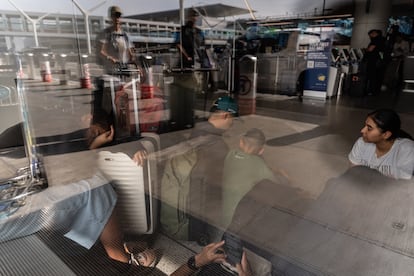

The crisis at major U.S. airports, triggered by restrictions on air traffic resulting from the government shutdown, will worsen before it begins to improve. Although Congress is nearing approval of an agreement to reopen the federal government, officials warn that flights could be limited to a trickle before the Thanksgiving holiday at the end of the month, one of the busiest times for travel.
The Federal Aviation Administration (FAA) issued an emergency order last Friday to gradually reduce the number of flights at 40 of the nation’s major airports. The cuts began at 4%, increased to 6% this Tuesday, and will rise to 10% by next Friday, as a proactive measure to ensure traveler safety due to “the strain on the system” caused by staff reductions at air traffic control facilities, which have reached “critical levels” during the government shutdown.
Transportation Secretary Sean Duffy has warned that flight cuts could reach 15% or even more. The order states that airlines must cancel flights seven days before the travel date. The order does not require a reduction in international flights.
Since the restrictions were announced last Friday, many of the country’s major airports have witnessed scenes of chaos. Immense lines for check-in and security, flights delayed for several hours, hundreds of cancellations... On Monday alone, 2,422 flight cancellations and 9,640 delays were recorded nationwide, according to the specialized website FlightAware. By Tuesday afternoon, cancellations had already surpassed 1,200 and delays had reached 3,000. The airport with the most cancellations on Monday was Chicago O’Hare (where a winter storm hit), with more than 300. On Tuesday, LaGuardia in New York took first place. For reference, last year the daily average was 340 canceled flights nationwide.
Air traffic controllers in the U.S. are employees of the federal agency FAA, and they have been working without pay since October 1, when the government shutdown — now the longest in the country’s history — began. There are an estimated 14,000 controllers nationwide. According to the FAA, between 20% and 40% of them at the 30 largest airports have missed work at some point during the shutdown. Some have begun taking leave citing stress, or the need to find other jobs.
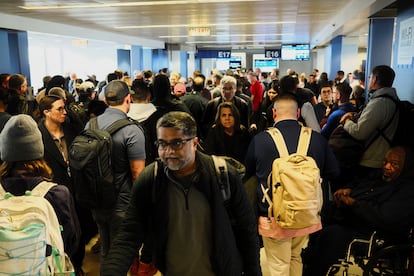
Despite signs of legislative progress, the outlook remains uncertain. The Senate passed a funding measure to reopen the government on Monday night, which now needs to be ratified by the House of Representatives and subsequently signed by President Donald Trump. The agreement is expected to be voted on in the House as early as Wednesday, which would allow for the restoration of critical services such as food assistance for millions of people and the payment of salaries to federal employees.
Speaking to reporters on Sunday, Duffy indicated that the situation is “only going to get worse” if the government shutdown continues. “I look to the two weeks before Thanksgiving, you’re going to see air travel be reduced to a trickle,” the secretary said in statements to CNN.
However, even when the Administration reopens, flight cuts will remain in place until staffing levels in control towers stabilize, according to the official.
This personnel shortage is not new, but it is now exacerbated by the political gridlock. Becoming an air traffic controller in the U.S. requires graduating from the FAA Academy and accumulating one to three years of work experience before becoming a certified professional. According to the agency, the average salary exceeds $160,000 annually by the third year of experience. Controllers work full-time, and frequently overtime, in facilities that operate around the clock and require weekend and holiday shifts. Currently, there is an estimated shortage of more than 3,000 controllers. At the beginning of the year, the government attempted to retain personnel by offering bonuses to those nearing retirement.
Federal employees affected by the government shutdown receive back pay once the budget is approved, but even so, the National Air Traffic Controllers Association (NATCA) noted that after the 2019 shutdown, the second longest after the current one, back pay took up to two months to arrive. This time, the number of daily air traffic controller retirements has also increased from an average of four to more than 20 since the shutdown began, Secretary Duffy told CNN.
Meanwhile, President Trump lashed out at air traffic controllers on Monday in a post on his social media platform Truth, demanding they return to work immediately, threatening to cut their pay, and saying he would recommend a $10,000 bonus per person for those who did not take time off during the shutdown.
Sign up for our weekly newsletter to get more English-language news coverage from EL PAÍS USA Edition









































