
Agreement to end the government shutdown puts healthcare of 24 million people at risk
In exchange for the support of Democratic dissident senators, the Republicans are only vaguely committing to holding a vote on the subsidies in December
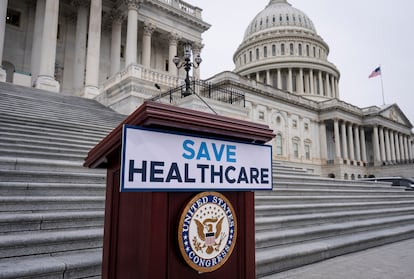

For nearly 40 days, Democrats were locked in a standoff with the Trump administration, refusing to yield to the president’s pressure to reopen the federal government. The consequences of the longest shutdown in U.S. history were significant: mass layoffs of federal workers, chaos at the nation’s major airports, and the disruption of the food stamp program, on which one in eight Americans depend. Democrats stood firm because access to healthcare for millions of people was at stake. These millions can afford insurance thanks to federal subsidies that expire at the end of the year, and whose renewal has kept the two parties at odds for over a month. Now, with an agreement to end the government shutdown in sight, access to affordable healthcare is once again in jeopardy.
Last Sunday, seven Democratic senators switched sides and, along with an independent senator, facilitated the deal that will be voted on this week in Congress and will then go to Trump’s desk to end the partial government shutdown. In addition to independent Senator Angus King (Maine), Senators Tim Kaine (Virginia), Dick Durbin (Illinois), John Fetterman (Pennsylvania), Jeanne Shaheen (New Hampshire), Catherine Cortez Masto (Nevada), and Jacky Rosen (Nevada) conceded on a condition that their party considered non-negotiable. In exchange for their support, the Republicans are only committing to holding a vote on the subsidies in December; a vague promise that is not convincing.
“The shutdown may be ending, but the fight to contain healthcare costs must continue,” said Anthony Wright, executive director of Families USA, a health rights advocacy organization, in a statement Monday. “More than 22 million Americans who purchase their own health coverage are now at risk of facing skyrocketing premiums or losing their coverage altogether. We are profoundly disappointed that this agreement includes only a promise of a future vote on extending the enhanced premium tax credits that millions of Americans depend on to afford their coverage.”
The federal subsidies that expire at the end of the year are part of the Affordable Care Act (ACA), known as Obamacare, because it was passed during the Barack Obama administration, which designed the law so that millions of people who lacked healthcare coverage could access it through a marketplace that offers lower prices. The tax credits they receive to purchase insurance were approved during the Covid pandemic and are likely to disappear starting in January, since the government has not had to make any concessions on this issue to secure the necessary support to pass the budget.
In a country where medical care prices are so exorbitant that they make healthcare a luxury, some 24 million people are insured through Obamacare, a number that has doubled since subsidies were increased in 2021.
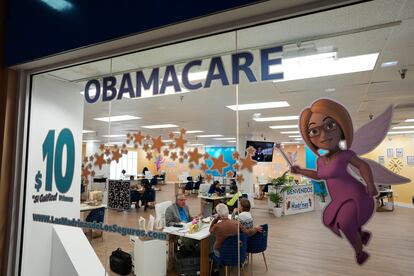
These tax credits benefit low- and middle-income individuals who do not receive health insurance through an employer or other government program. Restaurant and retail workers, small business owners and employees, barbers, hairdressers, Uber drivers, ranchers, farmers, musicians and artists, real estate agents, dentists… These are workers whose income is not low enough to qualify for Medicaid, the program reserved for the poorest, but who cannot afford insurance and therefore rely on these subsidies, which guarantee that their premiums will not exceed 8% of their earnings.
Without this assistance, that percentage could skyrocket to 25% of their salaries. For example, for someone who pays $400 a month, the premium could increase to $1,400 per month. Experts estimate that some four million people will lose their health insurance because they cannot afford it.
President Trump had already tried unsuccessfully to repeal the law during his first term in office. Last weekend, he reiterated his intention to eliminate the subsidies, posting on his social media account, Truth, that they were a “windfall for Health Insurance Companies, and a DISASTER for the American people.”
Political fallout
It remains to be seen how the loss of subsidies will affect the 2026 midterm elections. This year, 18.7 million (77%) of the total 24.3 million ACA marketplace enrollees live in states that President Trump won in the 2024 election.
Public support remains high for extending the ACA tax credits, with three-quarters (74%) of the population in favor of continuing them, according to a recent survey by KFF, an independent health research organization.
According to the same poll, more than half (55%) of those who purchase their own health insurance, mostly through ACA marketplaces, say Democrats should reject a budget that does not include an extension of subsidies. With next year’s midterms approaching, the survey suggests voters favor the Democratic Party on issues related to healthcare costs. When asked which party they trust most to manage the future of the ACA, a larger percentage of voters favor the Democratic Party (43%) than the Republican Party (32%).
Sign up for our weekly newsletter to get more English-language news coverage from EL PAÍS USA Edition









































