
Promises made, promises kept? Between illusion and reality, Trump forges ahead with his authoritarian project
From foreign policy to the economy, immigration and civil rights, this is a look at how the US president’s conservative revolution has advanced in the year since his election victory
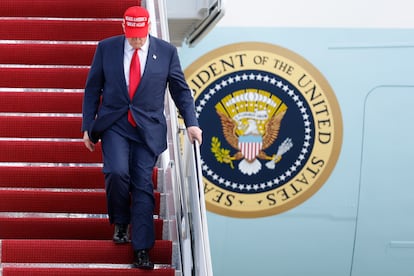
“Promises made, promises kept.” Donald Trump is not the first politician to use this simple slogan — Ronald Reagan and Bill Clinton did it before him — but perhaps he is the one who has repeated it most insistently since his election victory last November, a triumph that on Wednesday marked its first anniversary amid the longest government shutdown in U.S. history, brought on by the standoff between Democrats and Republicans over funding the administration. It is one of his ways of selling the idea — often stretching the truth — that he is fulfilling the agenda that brought him back to power in January.
With Trump, it is never easy to separate theater from reality. Yet even in the realm of performance, he has shown remarkable speed and ruthlessness in carrying out his program and effecting a profound transformation of both American society and the country’s place in the world — catching nearly everyone in Washington off guard.
His haste stems from the fact that this time he arrived at the White House far more experienced than during his first term (2017–2021), surrounded by an extraordinarily loyal team that raises no objections to his assault on the institutions.
His authoritarian path — his “my way or the highway” style — is best symbolized by his decision to demolish, without asking anyone’s permission, the East Wing of the White House to build a ballroom. Nor does he face obstacles elsewhere in government: the Republican Party controls Congress and has shown both firm loyalty to its leader and almost no inclination to rebel against his policies, even when those policies hurt their own voters. As for the judiciary, the Supreme Court holds a 6–3 conservative supermajority; last year it issued a ruling expanding presidential immunity for official acts and has consistently sided with Trump when deciding on challenges to his extremist policies.
Trump also has time working against him. At 78, he was the oldest president ever to take office. And though he has toyed with the idea of running again in 2028 — despite it being banned by the U.S. Constitution — he remains, until proven otherwise, what in U.S. politics is known as a lame duck. He has just over three years to deliver on the ultra-conservative agenda laid out by Project 2025.
Here is a look at what he has managed to do in this first year — and what he hasn’t.
Tariffs for all
The word Trump has called the most beautiful in the English language has been on everyone’s lips since his victory — and with more ups and downs than a roller coaster. Barely sworn in, he imposed 25% tariffs on Mexico and Canada for what he described as their inaction in fighting fentanyl, only to postpone them almost immediately for a month. Around the same time, he ordered sectoral tariffs on steel and aluminum, which he later doubled to 50%, and extended to automobiles and copper.
The great fiasco came on April 2 — the day the president had dubbed “Liberation Day” — when he grandly announced “reciprocal” tariffs of at least 10% on all countries and territories, including one inhabited only by penguins. And from there, up they went: as high as 50% for countries running trade surpluses with Washington. The chaos unleashed in the markets was such that tariffs above 10% were put on hold for 90 days while dozens of bilateral agreements were negotiated with major partners, including the European Union.
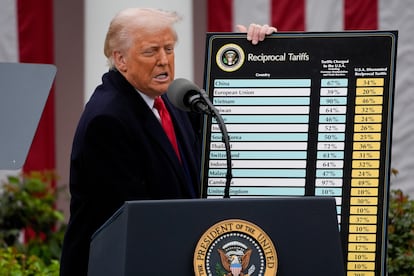
The final tariffs went into effect in August — and an appeals court struck them down that same month. The final decision now lies with the Supreme Court, which began to hear arguments on Wednesday. Trump has warned that if the tariffs are overturned, the economy will “go to hell.” By the end of fiscal year 2025, which closed on September 30, the U.S. Treasury had collected $195 billion in tariff revenue. The president has said he plans to use the funds to reduce the deficit and offset the tax cuts already approved.
Revenge against enemies
Revenge — against his enemies, both real and imagined — was one of the cornerstones of Trump’s campaign. He promised revenge against those he blames for his legal troubles over the past four years. And against opponents he openly admits to “hating.” Since returning to the White House, he has done everything possible to impose reprisals while pardoning his supporters — from the January 6 Capitol rioters to figures convicted of major financial crimes, such as Changpeng Zhao, who was found guilty of massive money laundering through his cryptocurrency business.
In some cases, the revenge has taken the form of dark humor — like depicting his predecessor, Joe Biden, as an autopen in the White House presidential portrait gallery. In others, it has gone much further: since September, after a social media post ordering Attorney General Pam Bondi to prosecute some of his political enemies, two of the figures he named explicitly — former FBI director James Comey and New York Attorney General Letitia James — have already been indicted, along with Trump’s former national security adviser, John Bolton.
The reprisals have also extended to cities and states that rejected him in last November’s election. Trump has ordered the deployment of National Guard troops to five Democrat-led cities (Los Angeles, Washington, Memphis, Portland, and Chicago — though courts have temporarily blocked the latter two). He has also threatened to send in additional troops from the Army or the Marines. Meanwhile, the Pentagon is fast-tracking National Guard training for civil unrest control, and Trump, in a speech before hundreds of senior military officers, suggested using those same cities as “training grounds” for the Armed Forces.
Even tougher on immigration
One of Trump’s biggest — and most popular — campaign promises was to deport millions of undocumented immigrants, starting with “the worst of the worst,” namely those with serious criminal records. In practice, the president — who during his first term did not hesitate to separate families and lock children in cages — has pursued an even harsher anti-immigration policy.
Raids and fast-track deportations have been carried out indiscriminately: many of those expelled at high speed had no criminal record, and even U.S. citizens have been affected. Trump and his Homeland Security team have reinforced the ranks of the feared Immigration and Customs Enforcement agency (ICE), deploying it in so-called sanctuary cities — often against the will of local authorities, as in Chicago.
Military aircraft have been used for deportations. The administration has also struck deals with third countries, mostly remote ones, to take in detainees whom the U.S. cannot — or will not — return to their countries of origin. The most notable case is El Salvador, which confines foreign deportees sent there in President Nayib Bukele’s infamous mega-prison.
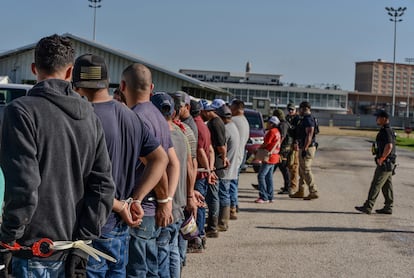
Trump boasts that thanks to this heavy-handed approach, illegal crossings have stopped cold.
Universities in the crosshairs
The anti-intellectual streak of the MAGA movement has long fueled its animosity toward universities, which it sees as “centers of Marxist indoctrination” where conservative parents send their children only to see them return as radicals. The wave of campus protests across the country against Israel’s massacre in Gaza provided the perfect pretext for the administration to launch, within its first weeks, a crackdown on higher education through coercion: comply with government demands or risk losing billions of dollars in federal funding — a threat that endangers not only the future of elite institutions, but also U.S. cultural and scientific dominance.
The first target was Columbia University in New York, which quickly capitulated. Harvard — the world’s wealthiest university — later showed itself more willing to fight in court and to defend itself against White House accusations of promoting anti-American values and antisemitism on campus. Earlier this month, the administration offered nine major universities more favorable funding in exchange for abandoning their liberal principles (which are also being debated internally amid criticism of a lack of ideological diversity among faculty). Arguing that academic freedom was at stake, seven institutions turned down the offer.
Chainsaw taken to public spending
Shrinking the federal government was one of Trump’s main campaign promises. His recruitment of the world’s richest man, Elon Musk — who made a record donation to his campaign — became one of the key draws for voters. Trump put the billionaire in charge of what they called the Department of Government Efficiency (DOGE), effectively handing him a fiscal “chainsaw” to slash public spending. At first, Musk promised he could cut $2 trillion; later, he scaled that ambition down by half.
By the time he left the job in late May — concerned about how his foray into politics might affect his businesses — the billionaire, who led a team that eliminated dozens of federal programs, shut down the U.S. Agency for International Development (USAID), and dismissed or pushed out tens of thousands of civil servants, had achieved only about $175 billion in public savings.
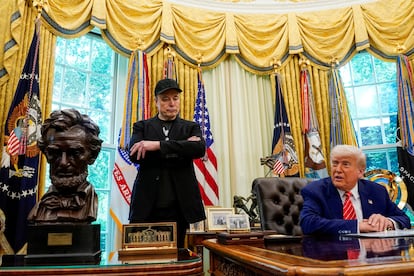
According to the Trump administration, the DOGE remains without its creator, who ended his partnership with the president after a very public and messy split. Clearly, the spending chainsaw has fallen far short of its goal — and shows little sign of getting there. But along the way, Musk’s spectacle has left thousands of people affected, cast a shadow over the economy of the Washington region (home to the highest concentration of federal workers), and reduced some agencies to the bare minimum, with potentially disastrous consequences for essential government programs, including nuclear oversight.
The war continues... in Ukraine
Trump entered the Oval Office promising to end the war in Ukraine within 24 hours; 289 days later, the conflict continues. His attempts — carried out with uneven enthusiasm over these months — have repeatedly run up against Russian President Vladimir Putin’s refusal to engage in peace talks. After initially siding with the Russian president during his first months in office, Trump now seems convinced that the Kremlin has merely been stringing him along. Nor has he shifted to giving Ukraine the kind of unconditional support Kyiv enjoyed under Joe Biden: just recently, the Republican admitted he has no serious plans to send long-range Tomahawk missiles to the embattled country, as requested by Ukrainian President Volodymyr Zelenskiy.
Military muscle in the backyard
Trump had promised that his return to the White House would not drag the U.S. into new foreign military adventures. Yet in June, he bombed three uranium enrichment or storage sites in Iran. Since early September, his administration has also launched strikes against alleged “narco-trafficking vessels” in international Caribbean waters — 18 so far — in which the military has killed at least 69 people without trial. The government has provided no proof of what cargo the vessels carried or who was aboard, but authorities claim they originated in Venezuela and were tied to criminal organizations such as the Tren de Aragua and the Cartel of the Suns. Some of the most recent attacks have taken place in the Pacific, off the coast of Colombia.
The Trump administration justifies these extrajudicial operations on the grounds that drug trafficking poses a threat to U.S. national security, amid the country’s worst-ever public health crisis caused by narcotics — particularly fentanyl, the powerful opioid responsible for roughly three-quarters of overdose deaths, which have surpassed 100,000 in recent years. That rationale doesn’t square with the fact that Venezuela does not produce fentanyl, which comes primarily from Mexico.
Meanwhile, Trump has deployed a massive military presence across the Caribbean, while openly toying with the idea of a direct intervention in Venezuela to overthrow Nicolás Maduro.
Making America respected again
This year, Trump has been far more active in foreign policy than even he might have expected. He boasts — stretching the truth — that he has brought eight international conflicts to an end.
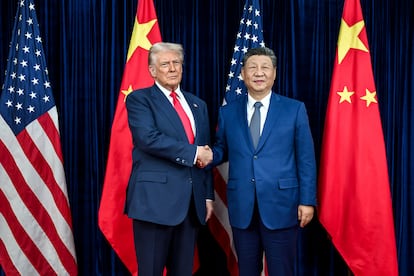
The latest, and the one he’s most proud of, is the fragile but still-standing ceasefire agreement in Gaza. And just two weeks ago, he struck a deal in South Korea with China’s leader, Xi Jinping, over rare earths. While it doesn’t end the trade war between the world’s two economic superpowers, it does freeze it for a year.
He came to his inauguration railing against NATO and even threatening to take control of Greenland. But after the allied countries pledged to raise defense spending to 5% of GDP, his criticism of the Alliance has turned into praise. As for the Arctic island — he hasn’t said a word about it since.
Beyond the Caribbean, Trump is showing an increasingly belligerent streak. He has ordered the resumption of U.S. nuclear testing — apparently referring only to delivery systems, not the bombs themselves, though he hasn’t made that entirely clear — for the first time since 1992. And he has threatened to attack Nigeria in defense of the local Christian community.
...And also healthy
During the campaign, Trump brought Robert F. Kennedy Jr. into his fold, later naming him Secretary of Health. A well-known vaccine skeptic, Kennedy — who had been running as an independent — joined with a handful of votes and a plan to improve Americans’ health that Trumpism quickly turned into a slogan: Make America Healthy Again.
The agenda has found broader consensus in its fight against ultra-processed foods and pesticides, and in its diagnosis of the country’s epidemics of obesity, diabetes, and heart disease, than in Kennedy’s views on vaccination. Kennedy managed to overcome Republican senators’ initial resistance during his Senate confirmation by promising to respect scientific consensus — a promise he has since broken repeatedly. Since then, he has dismissed experts in the field and ousted the director of the Centers for Disease Control and Prevention (CDC) — an agency he accuses of being responsible for COVID-19 deaths — for refusing to comply with his anti-scientific directives.
Kennedy has also convinced Trump that taking Tylenol (acetaminophen) during pregnancy is linked to autism — despite a lack of scientific evidence.
The scapegoating of the trans minority
In the final stretch of the campaign, one Trump ad proved more effective than any other, according to analysts. “Kamala is for they/them, President Trump is for you,” read the slogan — encapsulating the Republican fixation on trans rights as part of a broader culture war that has paid political dividends among moderate voters across the country, who are uneasy about what the right calls “gender ideology.”
In one of his first executive orders after returning to the Oval Office, Trump decreed that his administration would only recognize two sexes: male and female. He has since pushed for federal bans on gender-affirming care for minors, the participation of trans service members in the military, and trans athletes in women’s sports. He also wants to bar citizens from identifying with a gender different from their biological sex on passports. Many of these measures are now tied up in the courts. The part concerning women’s sports has become a personal obsession — and soon it will be clear whether the Supreme Court shares that concern, as it is set to hear two related cases this term.
Sign up for our weekly newsletter to get more English-language news coverage from EL PAÍS USA Edition









































